Scientists want to harness fusion, the same energy that powers the sun, on Earth. Controlling it, however, has additional perks. The process creates tiny particles called neutrons that are used in medicine, research, and national security.
Scientists at UC Davis and the Lawrence Berkeley National Laboratory discovered that the materials surrounding a fusion reaction can increase how often it happens, especially at low energies. The study was published July 18 in Nature Communications.
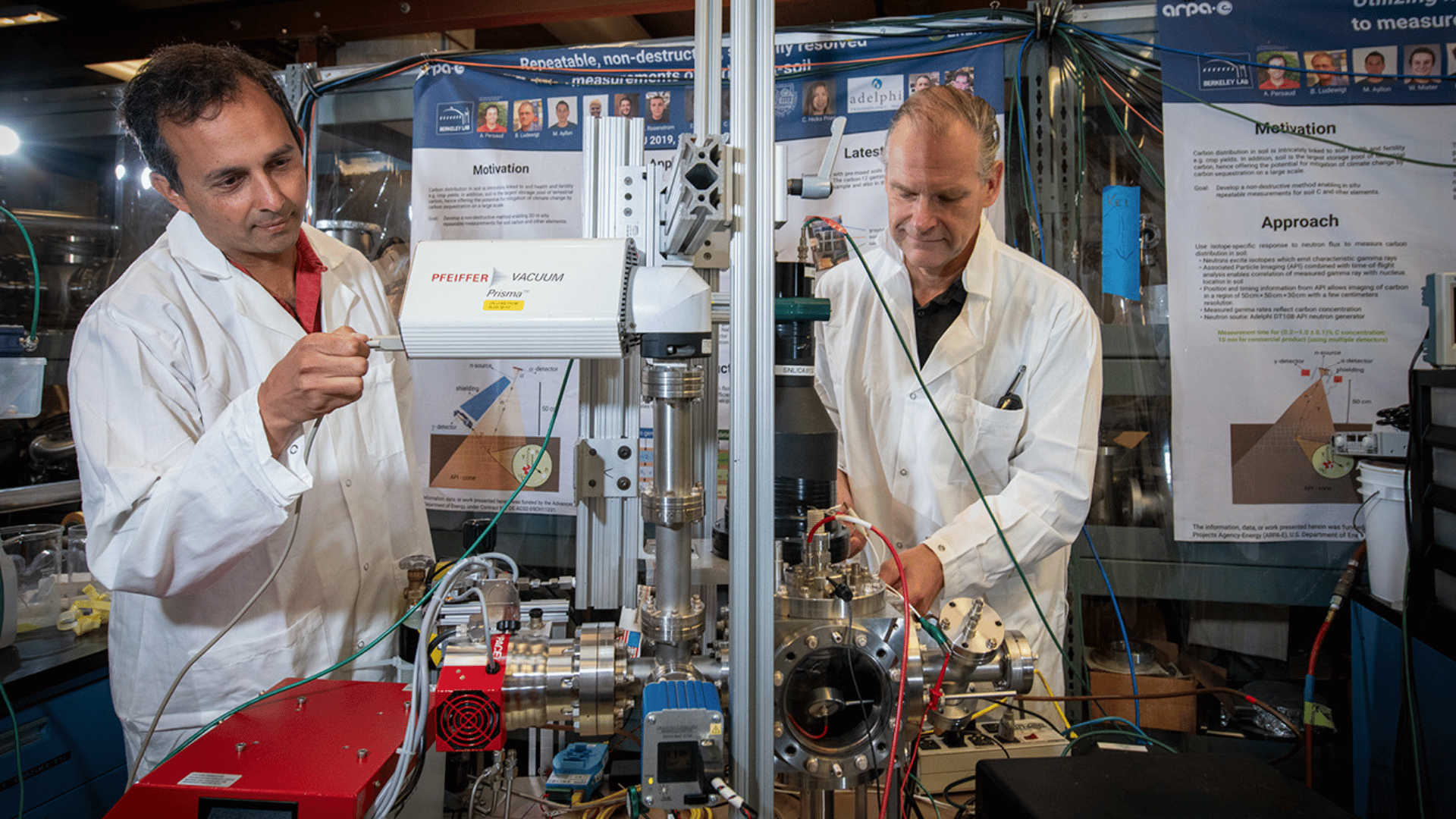
“It gives you a new knob to turn that you didn’t have before,” said Arun Persaud, head of the Fusion Science & Ion Beam Technology group in Berkeley Lab’s Accelerator Technology & Applied Physics (ATAP) Division. “If we understand this effect better, it opens the door to engineering new materials that would affect the fusion rate under certain conditions.”
Persaud continued, “Someday future progress might enable more compact and efficient neutron generators, which have all kinds of applications, like cargo screening, planetary science, and medical therapy and imaging.”
A Fusion Breakthrough
Advertisement
Researchers packed a heavy form of hydrogen, called deuterium, into thin metal foils made of palladium and titanium. They fired a beam of deuterium ions at the foils at different energies. Then they measured how often fusion happened, comparing it to a “bare” reaction with no metal present.
At very low energies, fusion rates normally drop off sharply. However, the team saw a plateau instead. Some samples had fusion rates roughly a quintillion times higher than bare reactions. (A quintillion is a 1 followed by 18 zeroes.)
Researchers suspect electrons and tiny flaws in the metal help shield the hydrogen atoms from pushing each other away, making it easier for them to fuse.
“It comes down to better understanding the mechanism so that we can try to enhance it,” said Jeremy Munday, a professor at UC Davis. “We’ve seen that we can increase fusion rates, but what is the limit? Can we bring it to lower temperatures or energies? There’s obviously a lot of interest and excitement about fusion, so if there’s something we can learn about the physics at these lower energy scales, maybe there’s something we can translate to other areas of nuclear science.”
The team plans to test more materials soon.
“The work shows conclusively that the material environment where fusion occurs at low temperatures is an active participant rather than a passive container,” said Cameron Geddes, director of ATAP. “That adds a new dimension to fusion research.”
 Read Exclusive Stories
 Bookmark & Save Articles For Later