Inspired by “birds-of-paradise,” a new paper from Cornell University’s Department of Human-Centered Design reveals how researchers created the darkest fabric ever made and used it to make a dress.
World’s Darkest Fabric Inspired by Nature
Present within the colorful plumage of species like Diphyllodes magnificus or Paradisornis rudolphi is a black so deep that it reflects less than 0.5 percent of the light that touches it. Scientists have now found a way to replicate this shade.
“Wildlife often uses a combination of colors in their skin, scales, and feathers to both attract mates and avoid predators,” begins a new paper from researchers at Cornell University’s Department of Human Centered Design, and “the various nano/microstructures that produce ultrablack have been studied and replicated synthetically.”
Because the color absorbs more than 99 percent of light that hits it, it has a wide range of potential uses. A few potential applications include solar energy conservation and fine-tuning cameras and telescopes by cutting out stray light.
Advertisement
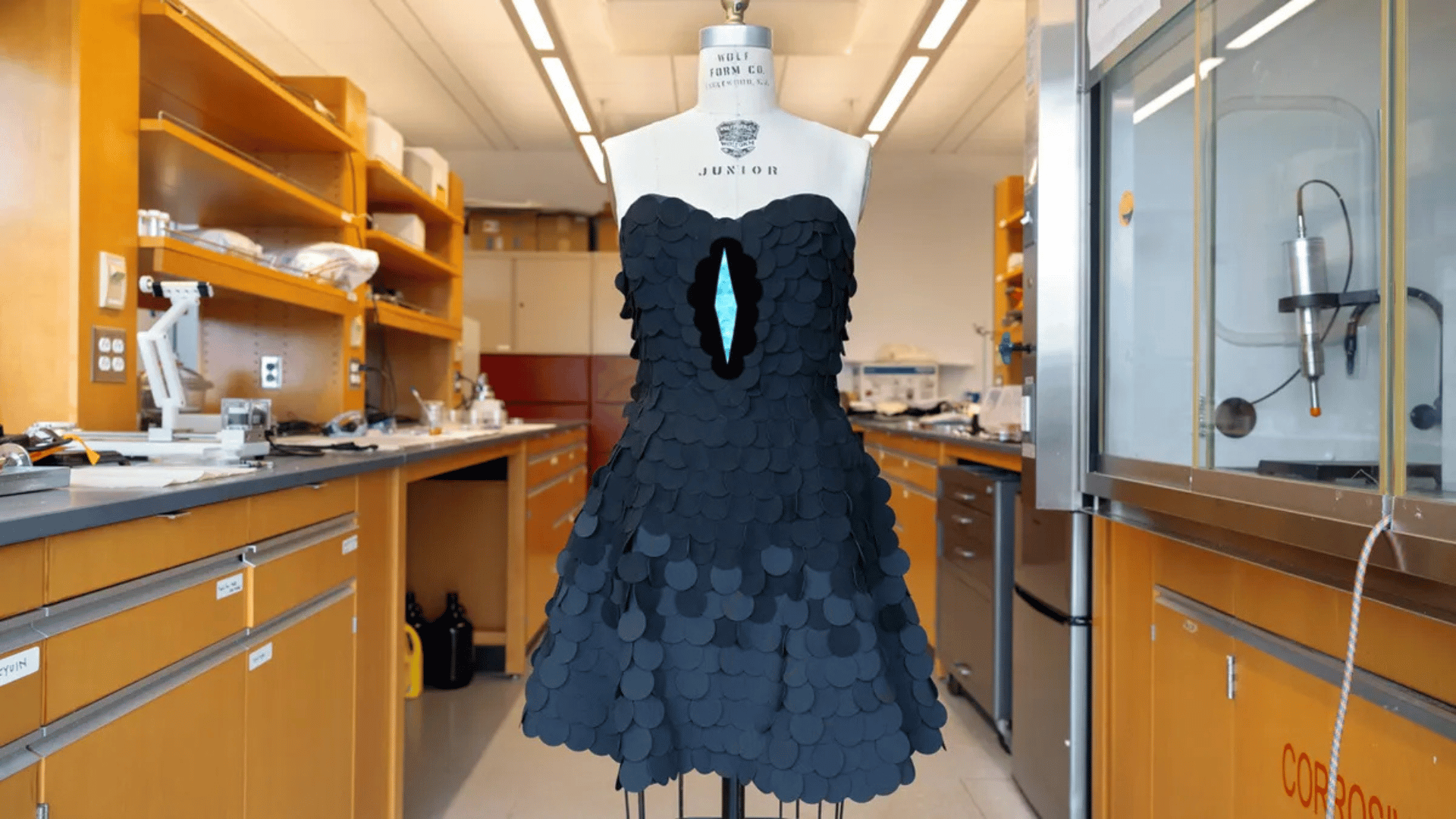
In terms of aesthetic uses, a team has constructed a dress using the material. The dark black dress also includes an iridescent blue panel at the center, paying tribute to the riflebird whose coloring inspired it.
“[M]elanin is what these creatures have,” explained Larissa Shepherd, assistant professor in the Department of Human Centered Design, in a statement this week. “And the riflebird has these really interesting hierarchical structures, the barbules, along with the melanin.”
The barbules are compacted together and covered in microscopic grooves. These, combined with the melanin, allow the bird to absorb almost all light, so Shephard claims, “we wanted to combine those aspects in a textile.”
The team used polydopamine, a synthetic form of melanin, to dye merino wool knit fabric, turning it a deep inky black. They then employed a technique known as plasma etching to create nanoscale scratches on the surface, resulting in spiky “fibrils” that mimic the tiny structures found in the birds’ barbules.
“The light basically bounces back and forth between the fibrils, instead of reflecting back out,” explained Hansadi Jayamaha, a researcher in the university’s Responsive Apparel Design (RAD) Lab. “[T]hat’s what creates the ultrablack effect.”
Analysis of the final fabric revealed an average reflectance of just 0.13 percent, “represent[ing] the darkest fabrics currently reported,” the paper boasts. The study is published in the journal Nature Communications.