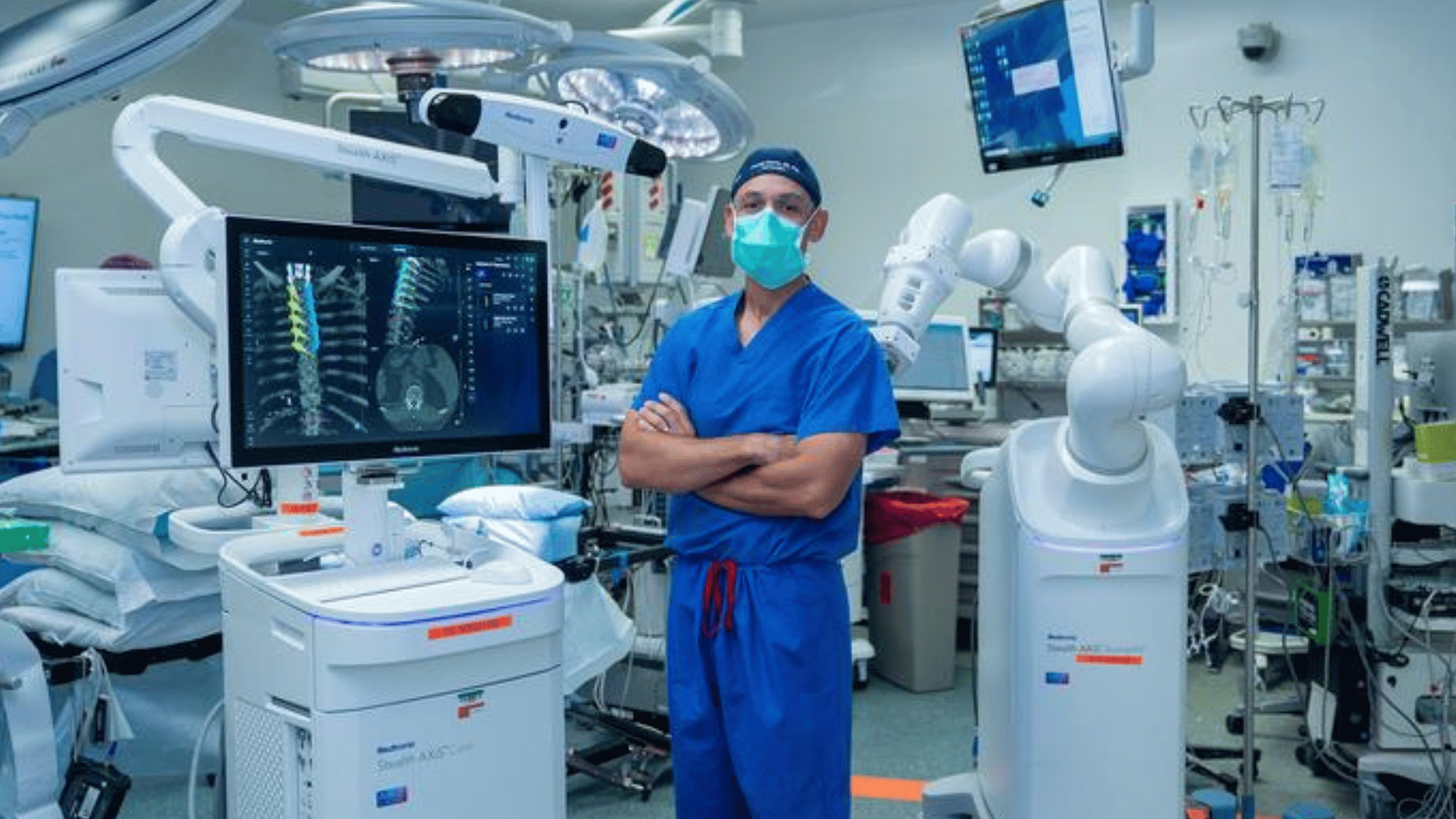
UC San Diego Health recently became the first hospital system on the West Coast to use a new robotic platform for spine surgery. While robots in the OR aren’t brand-new, this specific setup is a big deal because it handles almost everything in one go, from initial planning to the actual surgery.
Dr. Joseph Osorio, the chief of spine surgery at UC San Diego Health, led the first procedure. Ultimately, the goal is to make surgeries more predictable. By using a mix of artificial intelligence and detailed 3D imaging, the system gives surgeons a clear map of a patient’s spine before they make an incision.
“This platform fundamentally changes how we think about spine surgery,” said Osorio. “For the first time, we are bringing together artificial intelligence, data-driven alignment planning, patient-specific implants, navigation, and robotic screw delivery within a single system. That level of precision and coordination allows us to operate more efficiently while significantly enhancing safety for our patients.”
A Custom Robotic Surgery For Better Recovery
Advertisement
One of the stand-out features of this system is that it doesn’t use a “one size fits all” approach. It creates implants designed specifically for a person’s unique anatomy. This is especially helpful for spine fusions, where getting the alignment just right is the difference between a successful recovery and continued pain.
The robot acts as a high-tech guide, helping the surgeon place those implants with incredible accuracy. Because the system streamlines the workflow, it can also cut down on the time a patient spends under anesthesia.
“AI-driven planning and patient-specific implants enable personalized surgical plans to enhance patient functional outcomes,” said Alexander Khalessi, MD, the chief innovation officer at UC San Diego Health. “By combining these capabilities with intra-operative imaging, navigation and robotic workflow, surgeons can execute the procedure with precision, safety, and efficiency. Patients leave the operating room certain their surgeon’s technical goals were achieved and a smoother recovery ahead.”
At the end of the day, it’s about making sure the tools in the room are as complex as the conditions being treated. Osorio added, “Our patients will directly benefit from this advancement, and our surgeons will have tools that match the complexity of the conditions we’re treating.”
 Read Exclusive Stories
 Bookmark & Save Articles For Later