By 2026, the U.S. is expected to be short nearly 350,000 workers, according to estimates from Associated Builders and Contractors. This is a huge concern for the industry. Let’s not forget that it is also a dangerous job. Worldwide, construction accidents make up roughly 30% of all work-related deaths based on International Labour Organization data.
Civil and Environmental Engineering Professor Yizhi Liu and his Ph.D. student Yanxi Liu built a system to help. It lets a humanoid robot watch construction workers and simply copy their physical techniques. Professor Liu believes this is one of the very first setups of its kind in the construction field.
Learning by Watching
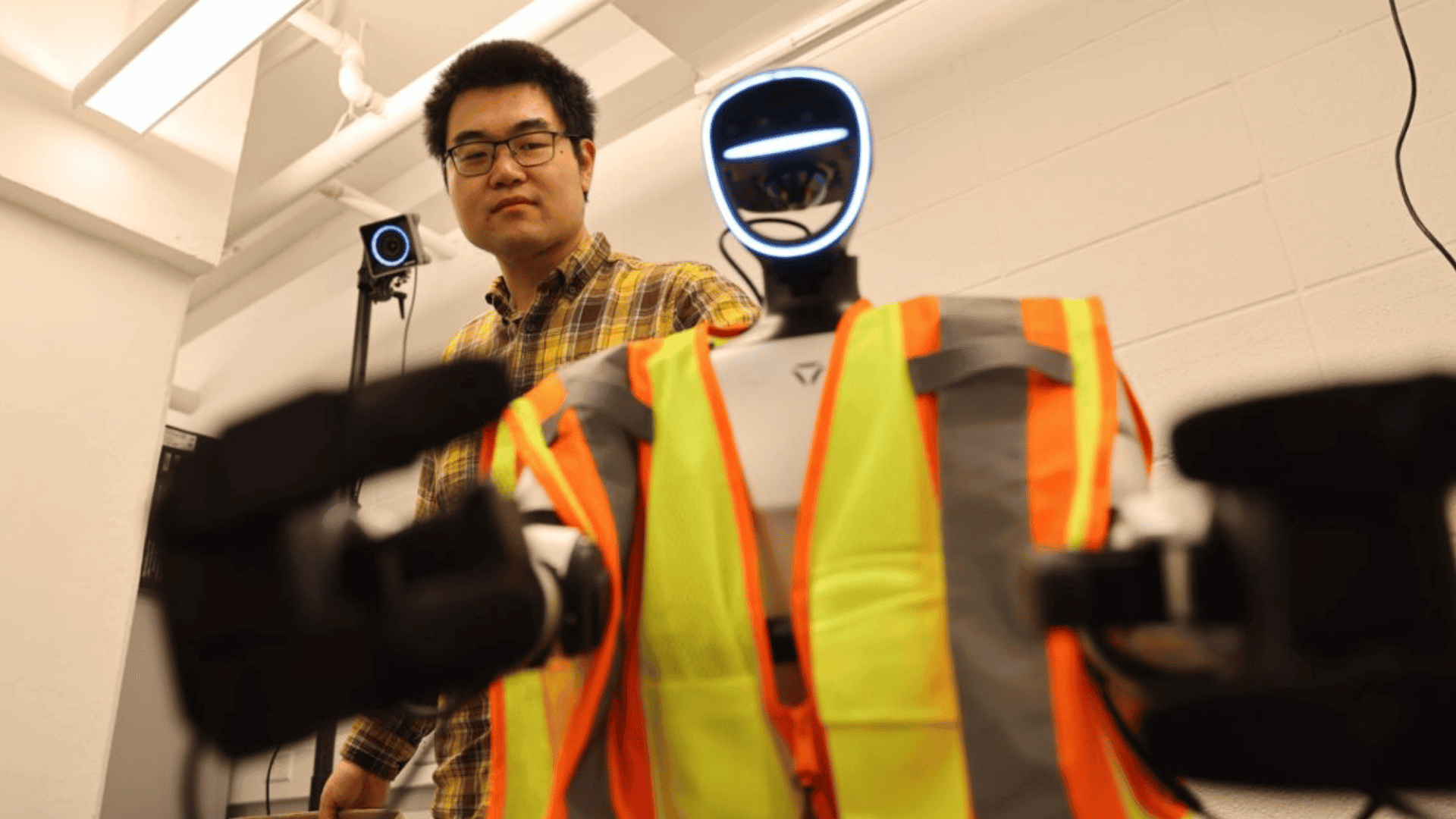
Researchers created what they call a vision-based “perception-and-action” system.
The robot is not running on remote control, and it is not using pre-programmed routines. Instead, it watches a skilled worker’s body movements in three dimensions. It figures out how to translate those motions to fit its own physical size and then carries out the task. Using this framework, the robot successfully learned and completed 30 distinct construction skills demonstrated directly by human workers on-site.
Advertisement
Humanoids are Built for Job Sites
The reason that the robots are humanoid, instead of a more simple design, is because construction sites are already built for humans. Yanxi Liu, the study’s first author, said, “Humanoid robots—machines built to approximate the human form—are particularly well-suited for construction work because job sites are designed around the human body.”
Normal industrial robots are stuck on flat, controlled factory floors because they can’t handle scaffolding, ladders, or irregular terrain. A humanoid robot can navigate those spaces.
Professor Yizhi Liu brings a deep background to this project. He joined the College of Engineering and Computer Science in 2024. He holds a doctorate in architectural engineering, plus master’s degrees in electrical engineering, robotics, and civil engineering. His A-STAR lab focuses on how humans and robots can work together safely.
This system can help fill empty jobs and keep human workers out of the most dangerous spots.
 Read Exclusive Stories
 Bookmark & Save Articles For Later