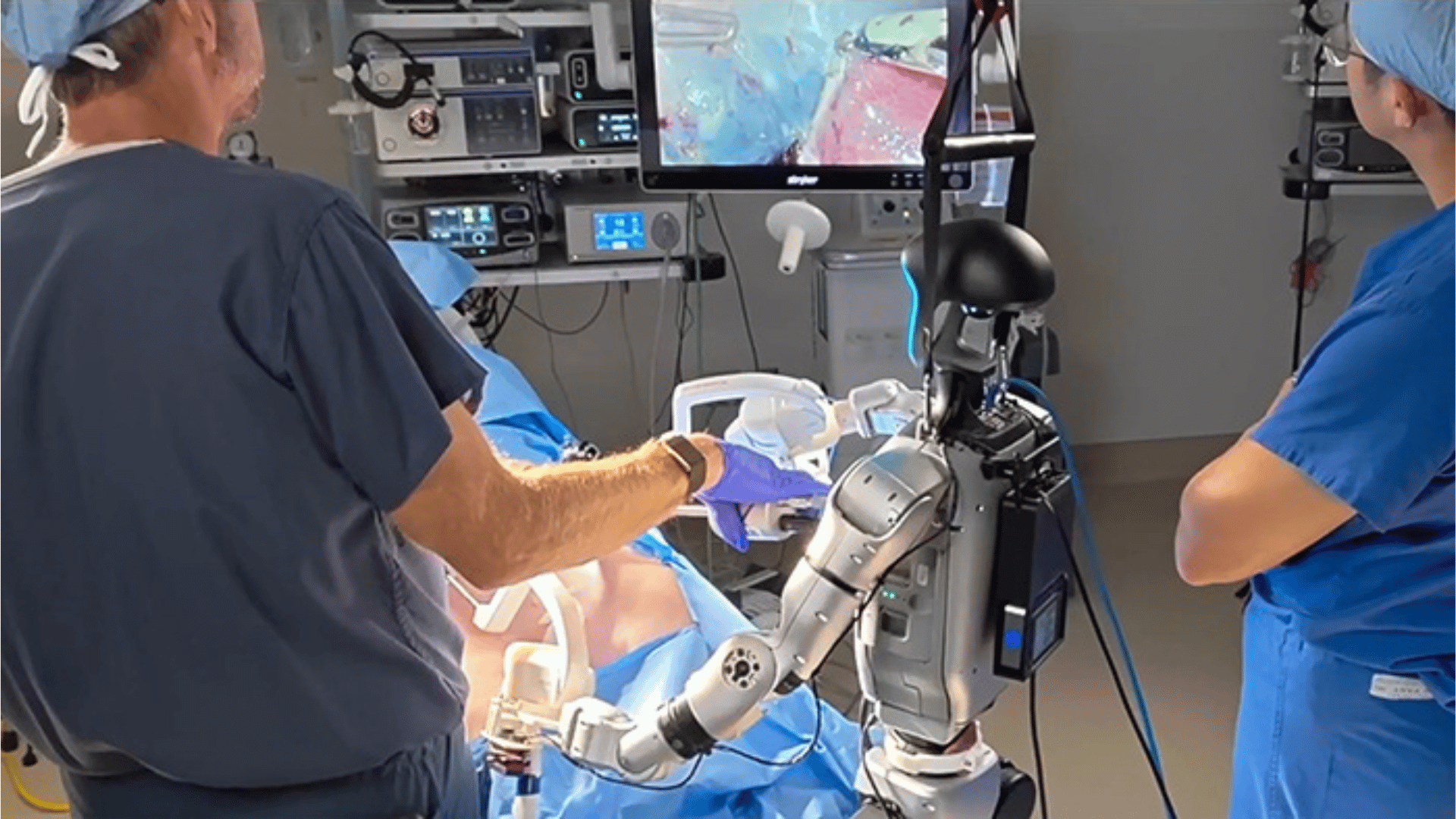
In a world’s first, surgeons and engineers at the University of California, San Diego successfully completed surgeries during a preclinical trial with the help of two remote-controlled humanoid robots. The team published their findings in the July 8 issue of the journal Nature.
In one test on a large mammal, a humanoid robot teamed up with a human assistant to remove a gallbladder. In a second surgery, two robots actually worked side by side.
A Humanoid Robot-Assisted Surgery
Right now, hospitals use specialized surgical robots, but the systems tend to be too big for comfort. They weigh about 1,800 pounds, require specially built rooms, and need big teams just to set them up.
By contrast, the robots used in this study, nicknamed Surgie, are only 5 feet tall and weigh 60 pounds. The researchers built special adapters so Surgie could hold traditional surgical tools.
Advertisement
Study co-author Dr. Nikita Thareja said, “We were surprised at how well Surgie meshed with our workspace and workflow.”
This might work well for places struggling with the current shortage of surgeons. Because they are compact and mobile, these robots can reach under-resourced areas that cannot afford expensive, massive surgical equipment.
“It’s a fraction of the cost and it takes a fraction of the space in an operating room. So it’s easy to deploy, anywhere from rural areas, to the battlefield, and even to space,” Dr. Shanglei Liu, who controlled the robot during the study, noted.
“Remotely operated and autonomous humanoid robots have real potential for amplifying access to critical surgeries to which patients would otherwise not have access,” Michael Yip, a senior author on the paper, explained. “This can help address the healthcare crisis not only in the United States, but also worldwide.”
Improving the Tech
While these initial tests show positive results, there are some bugs that need to be fixed. The robots had to be recalibrated a few times, so the surgeries took much longer than normal. The team is also trying to fix the latency, which is the slight delay between the surgeon moving the remote control and the robot actually moving.
 Read Exclusive Stories
 Bookmark & Save Articles For Later