A new, tiny species of pumpkin toadlet has been recently found in the mountain forests of southern Brazil. Barely over a centimeter long, roughly the size of a pencil tip, this tiny amphibian reminds us that there is still much left to discover in the natural world.
Tiny Pumpkin Toadlet
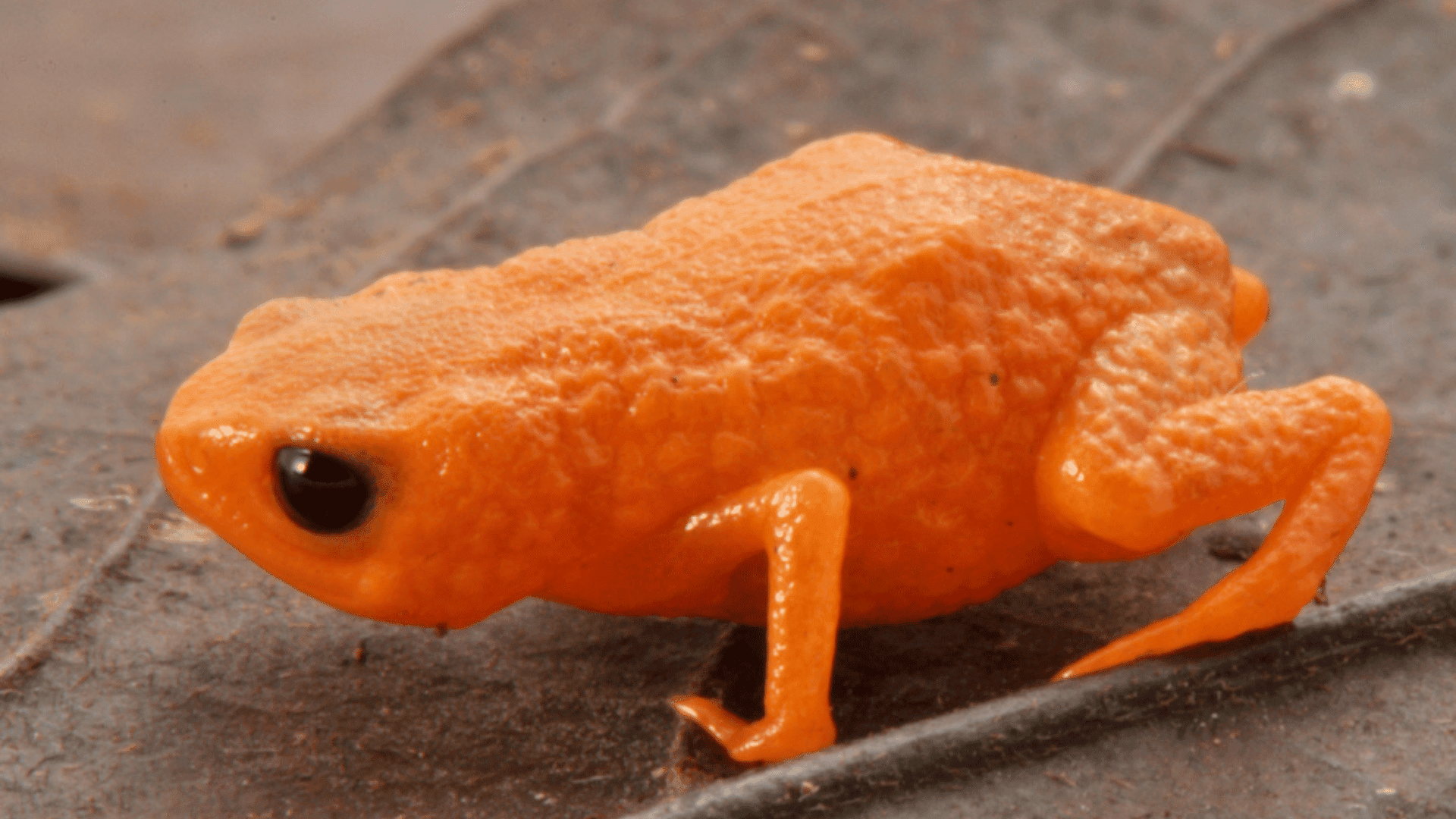
“This new species is unique due to a combination of many characteristics,” Marcos R. Bornschein, a study co-author biologist at the Universidade Estadual Paulista (UNESP) in São Paulo, Brazil, tells Popular Science. “But it stands out because of its orange coloration and particular features of its advertisement call, including the presence of four pulses per note.”
The pumpkin toadlet, or Brachycephalus lulai, was discovered by the research team due to this unique advertising call. Upon discovery, the researchers used several tools, such as CT scans and DNA analysis, to determine whether the frog was distinct from its relatives in the genus Brachycephalus.
Advertisement
The tiny frogs sport bright orange bodies with green and brown freckles. The males are 8.9 and 11.3 millimeters, and the females are between 11.7 and 13.4 millimeters. They are among the smallest four-legged animals on the planet, according to the team.
The new frog species inhabits highly preserved forests that are difficult to access, but researchers are still calling for immediate conservation efforts to protect the frog and its relatives. The study detailing the new species of frog was published in the journal PLOS One.
“Although Brachycephalus lulai sp. nov. is currently classified as Least Concern, this status is based on the absence of observed ongoing decline and the apparent lack of plausible future threats. Nevertheless, it is essential to continue systematically monitoring this scenario,” the study’s authors wrote.
“The new species is found close to other endemic and threatened anurans, justifying a proposition for the Refúgio de Vida Silvestre Serra do Quiriri, a specific type of Integral Protection Conservation Unit that would not necessitate expropriation of land by the government. This unit would help ensure both the maintenance and potential improvement of the conservation status of these species,” the study authors concluded.