First released by NASA on Valentine’s Day in 2025 and gaining popularity again this year, this photo by an astronaut highlights a pink, heart-shaped lake in Argentina.
Pink Heart Valentine’s Space Photo
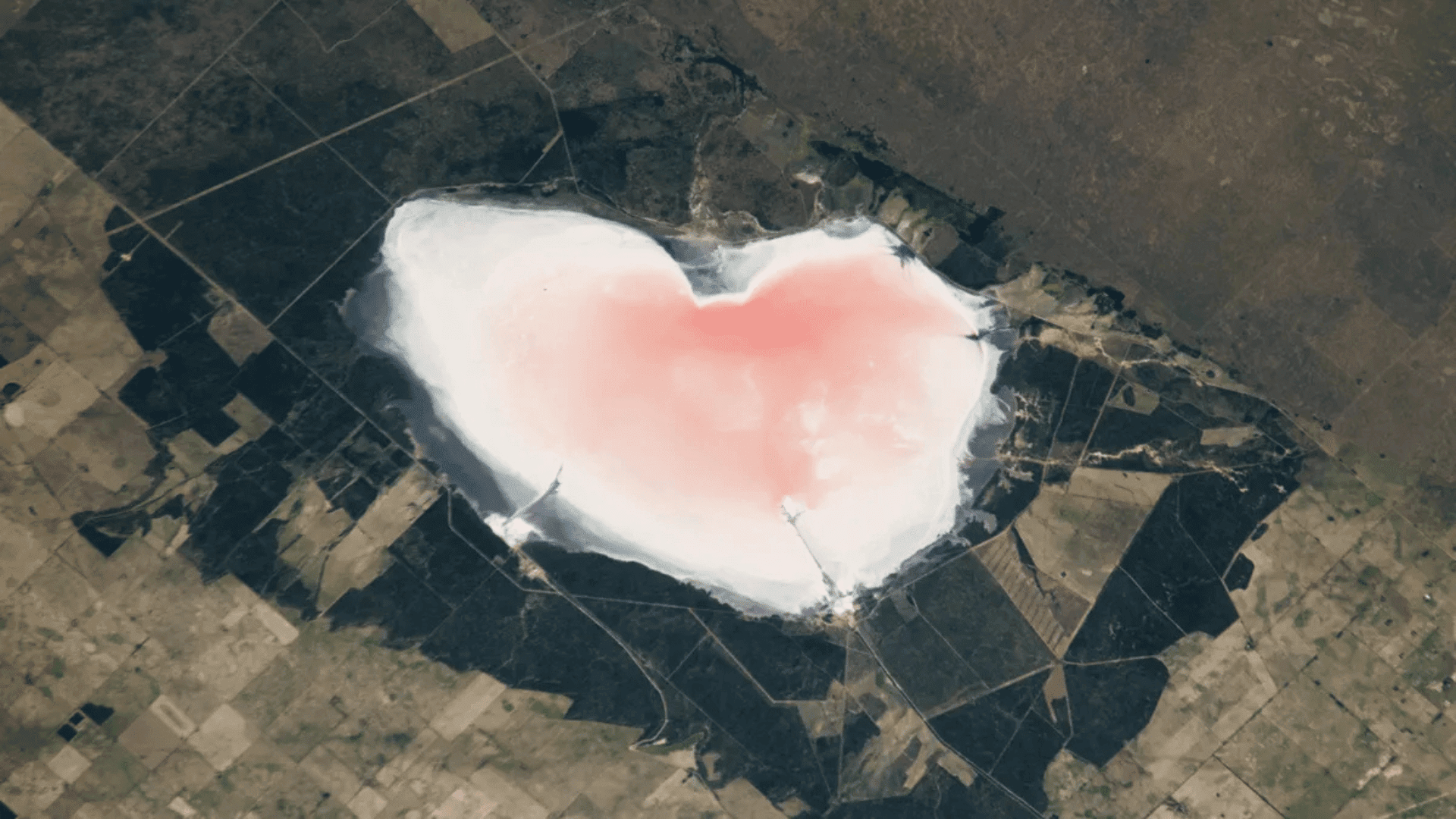
Salinas Las Barrancas, also known as Laguna de Salinas Chicas, is a shallow salt lake in Argentina’s Buenos Aires province. It’s located roughly 33 miles west of the port city of Bahía Blanca and stretches approximately 6 miles across at its widest point.
Though the area regularly fills with water after a heavy rainfall, the liquid quickly evaporates due to the intense sunlight in the region. According to NASA’s Earth Observatory, this exposes crystal-rich salt flats mined by local citizens.
Advertisement
The photo shows the lake near empty, which is why the pink hue appears so light. This is likely the result of a Dunaliella salina (a species of algae that thrives in salt lakes) and other microorganisms in the water, according to Smithsonian Magazine.
“We have rainy seasons, when the salinity levels decrease [because there’s more water in the ponds]. When there’s less salt, the Dunaliella survives and the ponds look brownish-red,” Lilliam Casillas Martinez, a microbiologist at the University of Puerto Rico at Humacao, told Smithsonian magazine while explaining the colors of similar salt ponds in Puerto Rico. “During the dry season, it gets really salty. The Dunaliella dies and the archaea and bacteria take over. Then it becomes pink, pink, pink.”
Though Salinas Las Barrancas’ high salinity means that not much can survive there, some salt-resistant vegetation does grow around the lake’s edges, according to the Earth Observatory.
It’s also the home of some vibrant bird species, including yellow cardinals and Chilean flamingos. These birds feed on tiny crustaceans rich in carotenoids, organic pigments synthesized by plants, algae, and bacteria. These carotenoids produce red and yellow pigments, and without these pigments in their diets, both bird species would be different colors, as yellow cardinals are naturally red and flamingos are naturally grey-ish white.
 Read Exclusive Stories
 Bookmark & Save Articles For Later