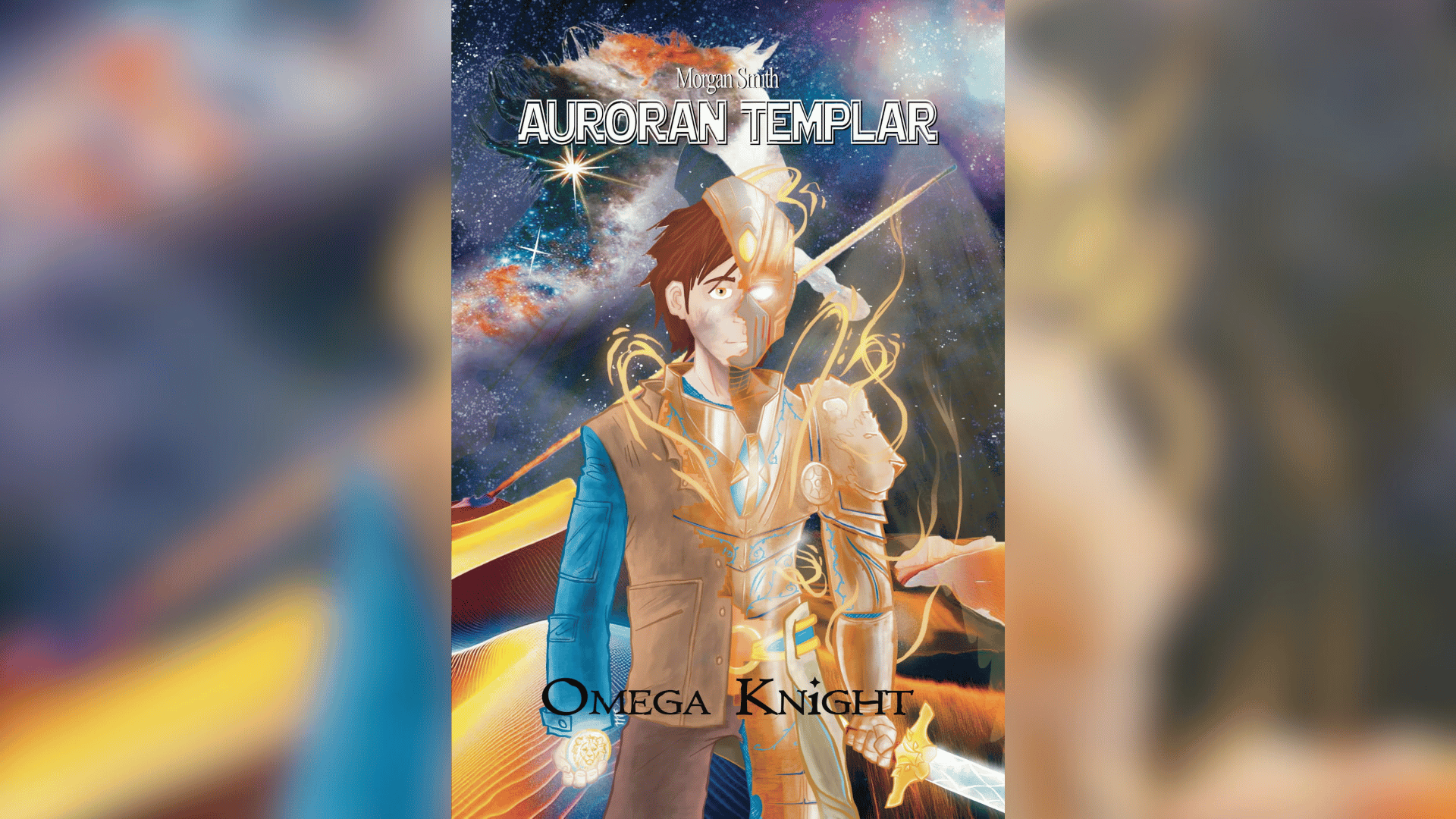
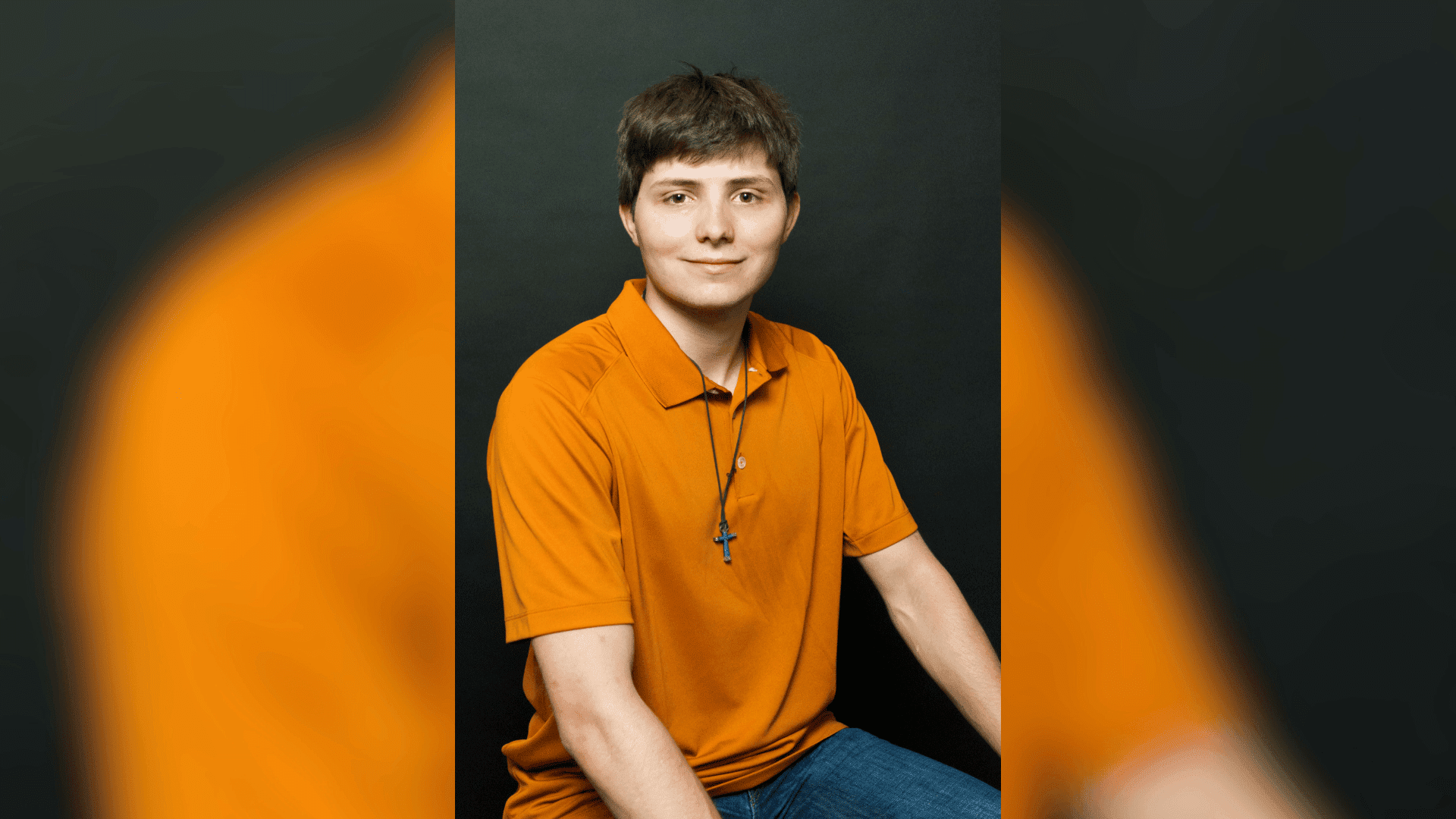
For Morgan Smith, the greatest reward in storytelling is “Just the fact that they are reading it.” In his conversation with Tomorrow’s World Today, Smith shares how his novel Auroran Templar: Omega Knight evolved from notes in a journal into a richly layered universe shaped by real-world history, scientific concepts, and spiritual themes. At its core, the story is built on the belief that writers should “Write your story, write the story that you were given,” and never wait for perfect conditions to begin.
Tomorrow’s World Today (TWT): What brings you the most joy when people read your work?
Morgan Smith (MS): Just the fact that they are reading it. I know everyone’s time is very valuable to them. And knowing that they’re taking a little of that time out because they want to read my story. That shows that it actually has their interest. It has more than their attention, it’s captured their heart. And that in itself is incredible. It makes it all the more worthwhile.
I know I’ve been there many times. I’ve read books that I had to read that dragged on, and I never thought I’d finish. And then I read other stories that I couldn’t put down. I don’t know yet where my book stands, but to know that there are people out there who are reading it because they want to, because they want to pick it up and keep on reading every sentence to find out what happens next. It’s an incredible feeling. I don’t know how to describe it. It feels like an achievement all in itself, and that’s priceless.
TWT: Were any elements of your story inspired by real-world events or concepts? If so, what was it about the real-world concepts that motivated you to incorporate them into your story?
MS: Honestly, there were a lot of real-world concepts. The series is named Auroran and Templar, that’s the institution, the organization, the brotherhood that the hero Andrew fights with. That was based on the actual institution and brotherhood of the Templars, which fought during the Crusades alongside the Hospitallers. I’m trying with my book to give light to what the Templars were, not the Hollywood version… Other concepts include the setting or the universe itself. I’m trying to base that off of other more popular franchises, but trying to make mine more creation-based. Not trying to be preachy, but also showing that it has an intelligent design beginning to it.
And even some of the terminology I use. I describe the world he travels to as the golden feather. That’s a direct link to the Laniakea Supercluster, an actual term for some group of galaxies that are close together in this section of space. I wanted this to be as real as I could. So some terminology is based on actual scientific and astrological terminology, almost like a reference back to real-world facts.
My research into some of the sorcery he’s fighting against was based on non-fiction authors, like Jonathan Khan and his Return of the Gods or Avatar… Even research into World War II, first-hand accounts of veterans in the Pacific. I’m using that as almost an emotional or visual anchor for the combat scenes. I’ve tried to use a lot of real-world elements in the terminology, the construction of the universe, the emotional output, and the attitude for different characters.
Advertisement
TWT: How has your work evolved over time? How have you grown as a writer?
MS: When all of this started, it was just notes in a journal. But over time, when I got serious about it, that’s when I researched other works, real-world structures, and events. That’s when I tried to make it more dynamic, seeing what one choice would lead to or how one event could shape the course of each person’s life. So I guess the work and myself evolved in tandem… The work actually helped me to do the one thing that every author needs to do, and that’s read more. Read other books, go over my favorite books and see why I like them, what makes these so good. Then go to real-world events, read real-world biographies and autobiographies, and see what the emotional outcome is, what is the fear or courage that these men have that can be translated to my people.
In a way, the work evolved with the characters becoming not just a flat character, but a real, moving individual, and me becoming not just a writer, but more of a scholar, wanting to know about the world and culture… I’ve grown as a writer by trying to understand and keep learning about all the facts that there are, everything that there is, and trying to retain it so I can use it in my book. Because it’s that type of element that’s also evolving, that’s growing the characters and the story itself, the world itself, as I keep trying to write it.
TWT: What advice would you give to aspiring writers/authors?
You can never receive enough advice yourself, but what I’d say is never feel like you have anything you have to prove to anyone else. We have a lot of inspiration, but sometimes it can feel like we’re overwhelmed by that. For me, I need to prove myself to one of my favorite stories from popular franchises and write it better, write myself into it. And that steals away from my own leadership, my own writing. Take what you can learn from others, but don’t have yourself informed on it. Write your story, write the story that you were given. Write the visions, the prophecy that you see before your eyes. Use the palate that other people have demonstrated, but don’t feel that you only have that world.
And there’s never going to be the perfect time for writing. Maybe you’ll have the right place or the right location, but it’s never going to be perfect. And you can’t wait around for perfect, you just have to start writing, and the time will become perfect. That’s something that I know I struggle with because we’re always overcome anxiety, stress, family trouble, all sorts of forces that come against us. But we cannot allow that to take us under. If you have to get a piece of scrap paper out, start doodling, and go from there; the words will come out after that point. It may not be all gold, but it will be yours. It will be something to go back to, something you can say I like this one part right here. That’s just what you have to do sometimes. Take a break every now and then to read a good book. But even then, don’t let that steal you away from all that you can create.
For more information about Morgan Smith and his projects, follow him on X and on bookstore.dorrancepublishing.com/products/auroran-templar. Smith requested to give a shoutout to Liberty University and his parents, sisters, and grandparents.
 Read Exclusive Stories
 Bookmark & Save Articles For Later