For decades, the ski industry has relied on a simple formula: wait for the cold, turn on the snow guns, and hope nature cooperates. However, as autumns become warmer and winters more erratic, that formula is breaking down.
Enter Snow Secure, a company that decided the best way to guarantee snow in November isn’t to make it then, but to save it from last February.
Why Winter Tourism Needed a Rethink
The anxiety of the “early season” is a familiar feeling for anyone working in mountain towns. A delayed opening doesn’t just disappoint skiers; it ripples through the local economy, cutting into the revenue of restaurants, rental shops, and lodges that rely on a reliable start date.
“I was far from sold that we could pull this off,” said Nate Shake, Director of Operations at Bogus Basin in Boise, Idaho. Like many in the industry, Shake was used to the traditional cycle of making snow as needed. The idea of piling up snow in the spring and hoping it survived a scorching Idaho summer seemed like a gamble.
But with climate variability threatening the predictability of winter sports, the industry needed a solution that didn’t depend on the whims of the weather forecast.
Engineering for the Real World
Snow Secure’s solution, recently named one of TIME’s Best Inventions of 2025, is a masterclass in low-tech ingenuity meeting high-stakes problem solving. The concept, known as “snow farming,” flips the production schedule upside down.
Here is how it works:
- Production: Resorts make snow during the coldest parts of winter, when snowmaking is most efficient and energy-cheap.
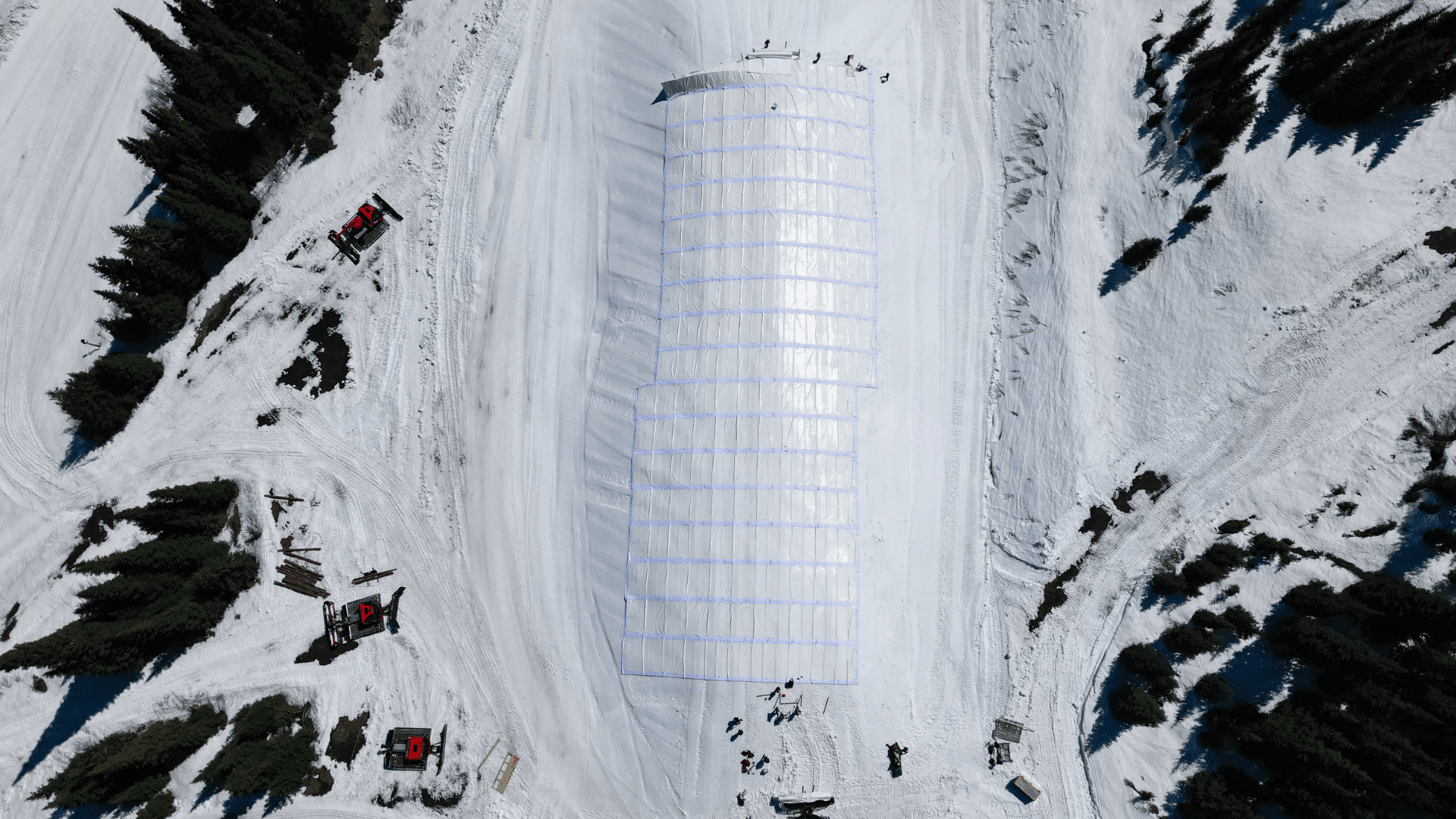
- Storage: The snow is pushed into massive piles—sometimes 30 feet tall—and covered with specialized insulation blankets.
- Preservation: These high-tech blankets reflect sunlight and insulate the snow from ambient heat without using any chemicals or additives.
Advertisement
Deployment: When autumn arrives, the covers come off, and the preserved snow is spread out to form a base layer, guaranteeing an opening day regardless of the temperature.
The results have stunned early adopters. At Sun Peaks Resort in British Columbia, crews expected to lose up to 30% of their stockpile to the summer heat. Instead, they retained nearly 80% of the snow, allowing them to open weeks ahead of their neighbors.
A Growing Footprint Beyond the Factory Floor
What started as a skeptical experiment is quickly becoming standard operating procedure. At Bogus Basin, the pilot program, called “Project X,” involved a snow pile 300 feet long and 80 feet wide. When the blankets were peeled back in early November, the resort had enough snow to coat a run while the rest of the mountain was still waiting for the first freeze.
“We were blown away by the price,” said Shake, noting that the system cost significantly less than expected. “Environmentally and economically, this is definitely the next major innovation for the North American skiing industry.”
The technology has already expanded beyond the Pacific Northwest. Systems are currently active at Tyrol Basin in Wisconsin, proving the concept works across different climates and altitudes.
The success of these pilot programs has triggered a wave of interest across the continent. Snow Secure has already confirmed new projects for the spring of 2026 at Ski Apache in New Mexico and Soldier Hollow in Utah.
For competitive athletes, this reliability is a game-changer. Sun Peaks was able to offer training grounds for race teams a full month earlier than competitors, turning a logistical advantage into a performance edge.
Source: Snow Secure
 Read Exclusive Stories
 Bookmark & Save Articles For Later