
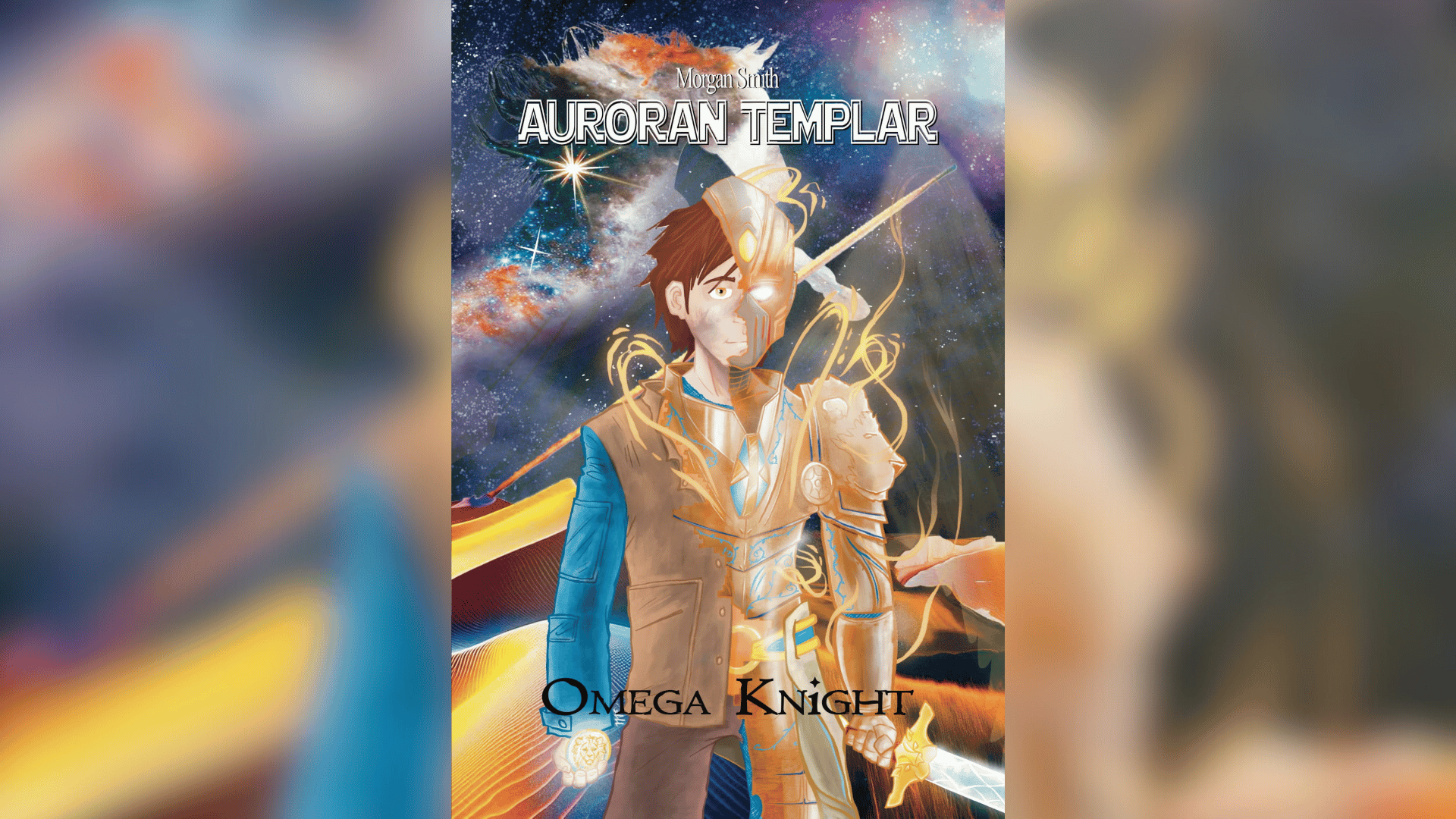
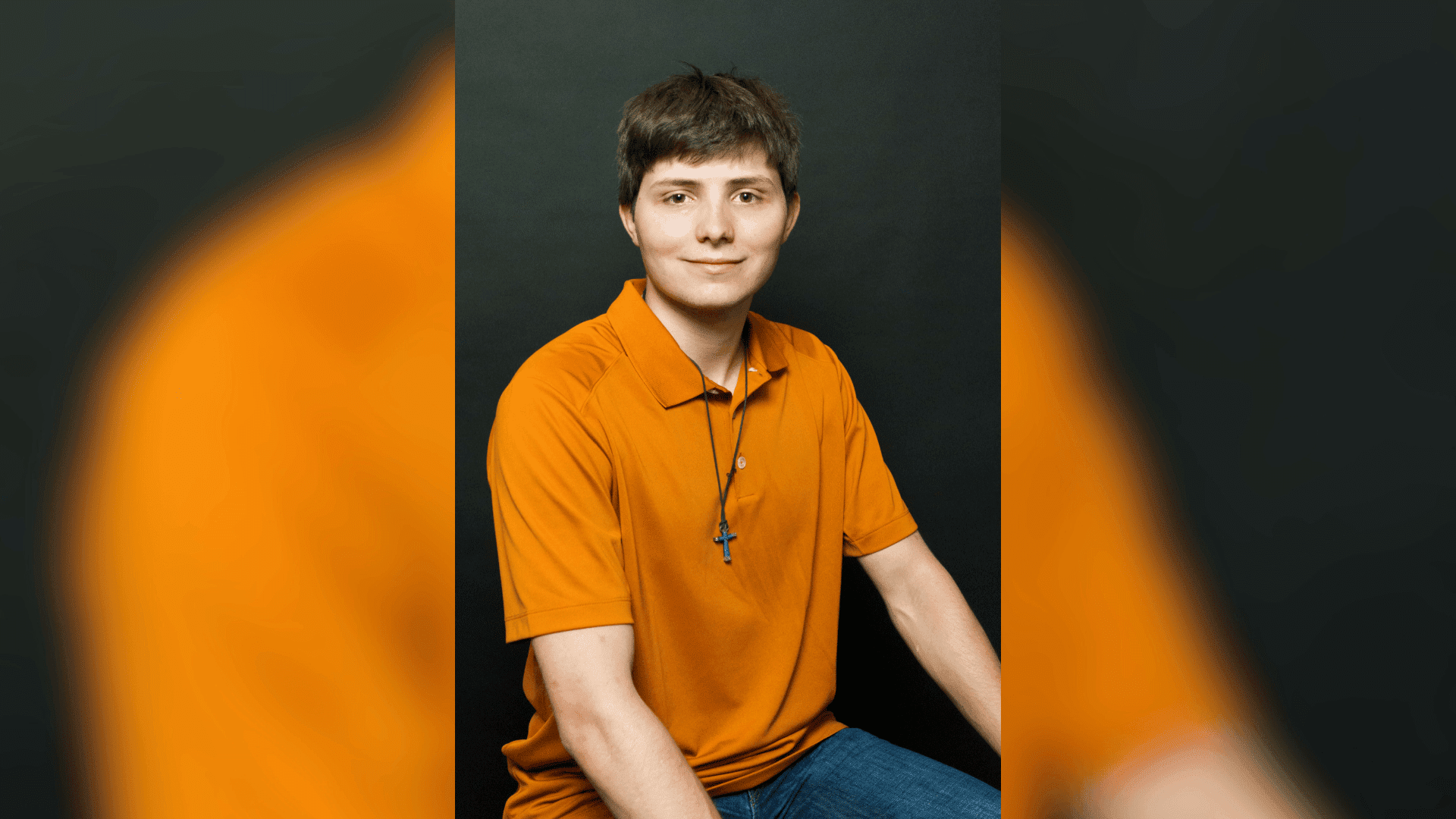
From childhood crayon sketches to cosmic battlefields, Morgan Smith has always lived with one foot in another world. A hometown writer from Dixon, Tennessee, Smith draws inspiration from classic sci-fi and fantasy, biblical symbolism, and quiet moments spent imagining something just beyond the horizon. In this interview with Tomorrow’s World Today, he opens up about the challenges and rewards of writing, and the influences and vision behind his epic, genre-blending book, Auroran Templar.
Tomorrow’s World Today (TWT): Tell us about yourself and what inspired you to begin writing.
Morgan Smith (MS): My name is Morgan Smith. I’m a hometown writer in Dixon, Tennessee. I was pretty much born and raised here. Honestly, I don’t know about a writer, but I’ve always lived, in part, in my own fantasy. I think I’ve always wanted to go into making that a reality or a visual for everyone else. The best example I can think of is when I was in kindergarten, when everyone else would be in their rows of desks, I’d be off on a little plastic table, doodling away little picture scenes with little crayons and colored pencils on cardboard paper. And then having my parents and teachers actually write out the dialogue as I envision each course happening in my head. Those became the first books that I started writing. Ever since then, I wanted to have a good story in my head. Whenever I saw or read something, I always played it out in my head, thinking about the changes I would make or how I would let it play out.
I really picked writing back up in high school and then in college, when I took literary courses in writing. I think that’s really where I started making more of a commitment or direct decision to try to write something original.
Any inspiration I have comes from stuff that my dad and I would usually hang out watching, like Jurassic Park, Back to the Future, Star Wars, all the general nerdy stuff. After school, I found myself working at my job as an intermission thing, working in landscaping, and having some time on my hands, riding in the back of a truck between jobs. I started keeping a journal with me and keeping a hard record of all my ideas. An actual story developed from there. And seeing the world around me, being outside, imagining where I am now and where I see myself, not somewhere in the future, but somewhere like another world. How I would handle each trial, but making it more visual, combative. And that’s how each sequence played out as I wrote it down.
TWT: How would you describe your style as an author?
MS: I look to some of my inspirations for writing or some of my favorite authors. I think back to two of my favorite guys, J. R. Tolkien, author of The Lord of the Rings and The Hobbit, and Christopher Paoli, author of Eragon and The Inheritance Cycle. I try to go by their inspiration to be more of an architect with my scripts and words, trying to dive into rich world-building and immersive sci-fi and fantasy collaboration. Trying to create a real epic sensation when you read. Just like when you read Lord of the Rings, you actually feel like you’ve been on that journey, been on that quest. That’s exactly how I’m trying to develop my stories. My series too, which is also no easy task, but that makes it all the more fun doing it.
My style is similar to Tolkien and also C. S. Lewis, incorporating biblical symbolism and absolutes into areas, into how the characters interact with one another, and into how the laws of physics coincide with one another.
TWT: What inspired the cosmic/cyberpunk themes/imagery in your book?
MS: Like I said before, my dad and I are huge nerds. So I love the classics or anything that has a star in the franchise. So, when it comes to cosmic, I couldn’t help but want to design my own Star Wars or Star Trek. Something that encompasses so much and therefore gives a plethora of great ideas, great worlds you can develop, see, try to interact with, and even how you get there or what you’ll find there. But it wasn’t just the famous sci-fi stuff, but also lesser stuff that goes back to when I was little. One great inspiration was when I was a little kid, a Disney movie called Treasure Planet, one of the lesser-known ones. But it’s honestly my favorite, and it encompasses what I was going for, which was more of a cosmic steampunk theme. The whole thought of 18th-century ships being able to fly through space, which is seen as more of an epic ocean of Stars.
That’s what I really loved about it, how travel is really meant to be not so sterile. Like you might see in Star Trek, people with valor, who aren’t afraid to combat the unknown. It’s in that style that I got my inspiration for this book, something that’s still large spaceships, but also seen as a more 18th-century type of naval travel at the same time. It’s even in the officer’s uniforms being really bold and vibrant as well, and the clothing of civilians, something that shows a cultural distinction, but also an emphasis on values then over values now. Keeping it in a time period that’s advanced, but also calling back to the past, when things weren’t so fast-paced. Trying to bring two different periods together to see how they interact, how it would work now.
My inspiration for the imagery was also from The Lord of the Rings, trying to develop that beautiful landscape of mountains and scenery, and putting that into different worlds. And another world emphasizing another point I’m trying to make, that’s more techno or industrial. Different worlds that have different themes, points, and messages. That’s how it promotes the messages or the outlooks we have in life, the contrasting views, positives, and negatives that we develop in life.
TWT: What do you find most challenging and rewarding about writing?
MS: The biggest challenge will probably always be me. It’s always finding the time or getting yourself to sit down and start writing. Because life is so fast-paced. You have to get up in the morning; you have family and household chores to take care of before you get to work; you have work; and you have all that in your mind. It’s anxieties that pick up during the day, and at some point, that brings it home with you. When you try to carve out enough time, I’m sometimes worked up, and it makes it difficult to sit down and try to get my thoughts in order. Which isn’t good, because this is something that I really want to develop more time, attention, focus, and devotion to. So the biggest challenge is myself: trying not to watch a Hulu or Prime show and sitting down to write instead.
But the reward is getting past all that and breaking that barrier in writing because there honestly is a peace to being able to get your thoughts down. Getting them down on paper, on the keyboard, and seeing them. Because at some point, you’re not even writing letters anymore. You’re actually looking through the window of that world you’re seeing. You’re going to be the first reader of that story yourself. And that feels like the greatest reward of all. It’s beautiful. It’s amazing. It’s almost as if you’re right there in the story yourself.
TWT: Tell us about a few of your favorite parts of the book. Why are they your favorites?
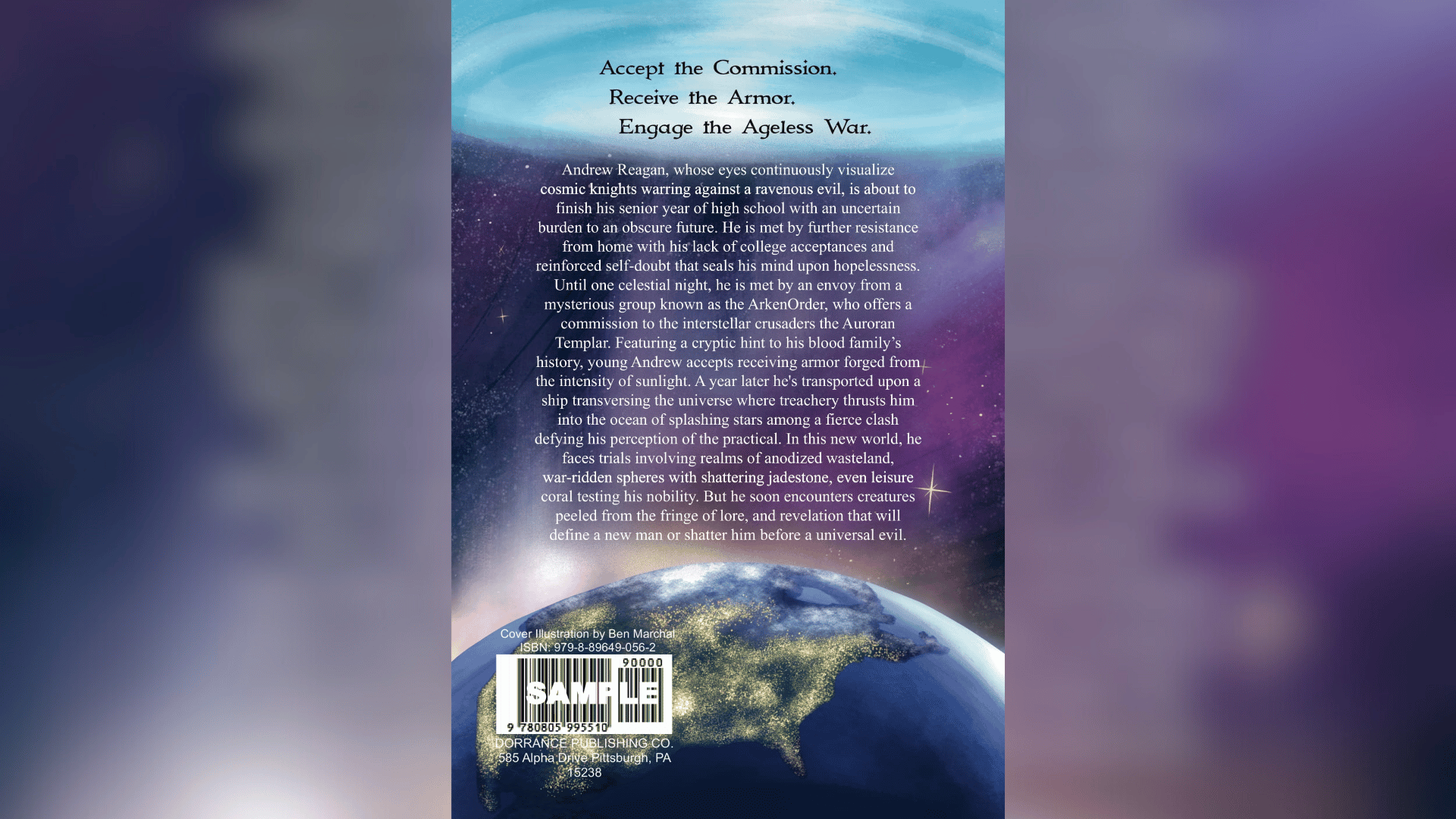
MS: One of my first favorite parts is in chapter two. It’s the first chapter where you take a step out of the setup of the story, the daily routine, and into this part where it’s basically magic, fantasy that’s literally out of the world. Andrew’s on a plane that’s overlooking the Earth, talking to this emissary from another organization. And it’s there that he receives his armor to combat evil. It’s more than a beautiful visual; it takes the first step into the epic journey. That part was the first scene where I felt like this story was becoming real and alive.
I was trying so many times to try to get this idea drawn out, laid out before me, because I was so excited to see it, to get him to that location that was overhanging in the world, looking out into all the stars and galaxies. He could touch it right there, reach out and pick up a star himself. And I was thinking, this is where he actually gets his arm. This is the part I’ve been waiting so much for. It was so exciting trying to draw that out to actually show him receiving each belt, each boot, each piece of the shield, sword, and helmet. It’s the first part that I had the first chance to incorporate a biblical analogy, showing that it’s more than armor. It’s the literal armor of God that he’s receiving right now. Give it an illustration for people to see the beauty, the power, a visual they can actually hold on to.
Another one is in chapter 16, where he’s off Earth. He’s already spent a few days traveling. He’s met his master at this point, or as I’ve dubbed him, his chief principal. And he’s come to this garrison for this universal organization of guardians for knights, called the Aurorean Templar. And the garrison itself is a little larger than a moon, but a huge geo next to a volcanic, raging hourglass world. At this location, he gets into his first real war-type of battle. This is where the enemy of that organization surprise attacks them, and he actually makes the real decision to intervene, to fight. Because every point leading up to then, I’m showing him being on the edge between fight or flight. This is the part where he actually makes the decision to use what he’s been given, the power that he’s been given to fight, to defend.
This was my first chance to try to write out a cosmic battle: flying everywhere, energy bolts coming all across the eyes, silent death everywhere, and actually seeing a battlefield for the first time. Trying not to be gruesome, but also truthful at the same time to the carnage that he sees, but at the same time making that fuel a fire in him to fight even harder. It shows what he’s capable of. He’s capable of more than the average soldier, and his sword and shield can do a fair amount of damage as well, almost incinerating whoever he strikes… This was my chance to not only show who the enemy is, the actual visual of the battlefield, but also a real look into what he’s getting himself into.
For more information about Morgan Smith and his projects, follow him on X and on bookstore.dorrancepublishing.com/products/auroran-templar. Smith requested to give a shoutout to Liberty University and his parents, sisters, and grandparents.