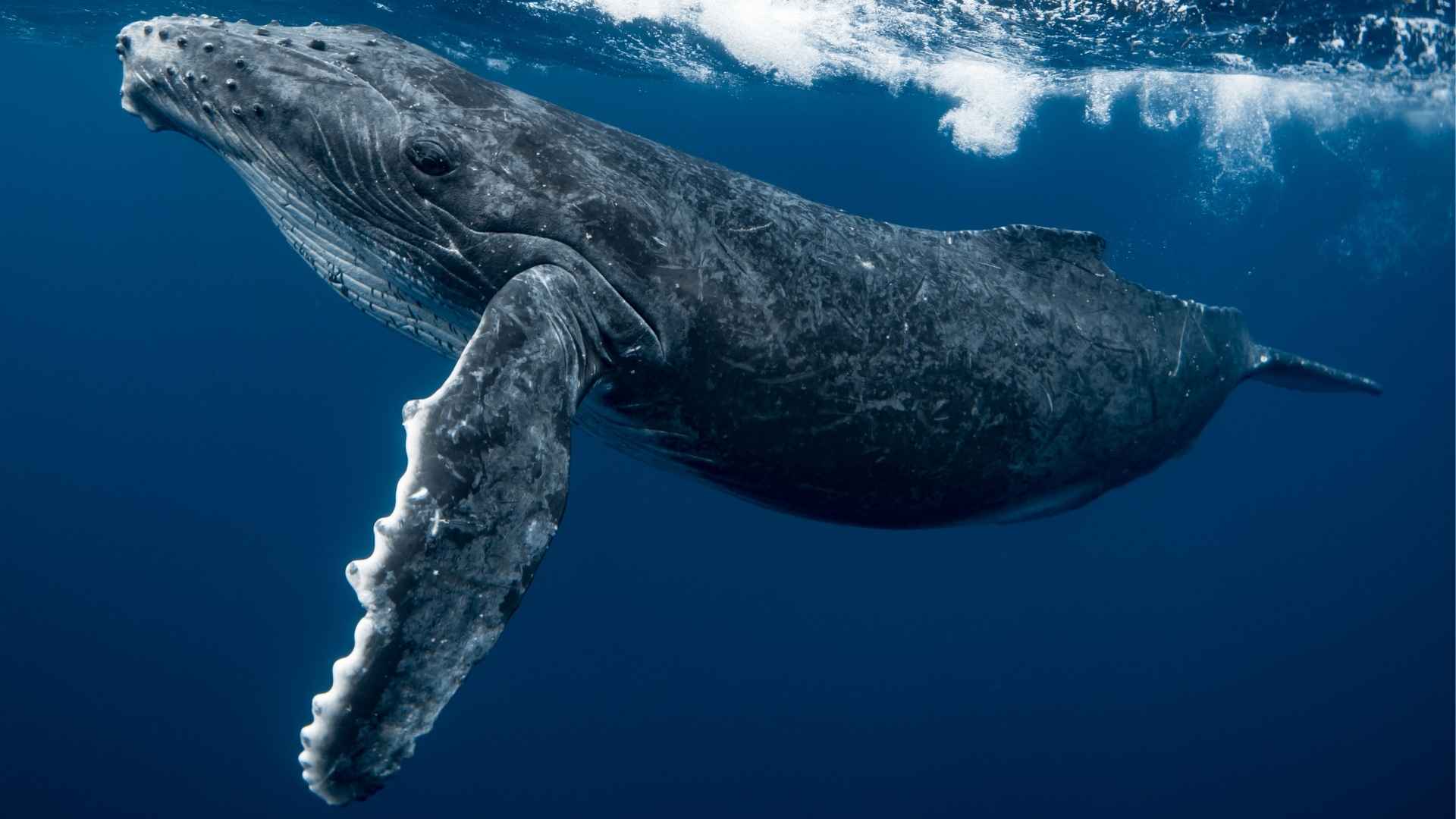
Humpback whales are the size of a school bus, weighing up to 40 tons. Despite their massive bulk, they are incredibly agile swimmers. They can dive down, pivot on a dime, and lasso fish by swimming in tight, upward spirals. For a long time, engineers who study aerodynamics were baffled. According to standard physics, a creature that large should stall and lose control, making such sharp turns in the water.
The secret was discovered by a marine biologist named Frank Fish. He noticed that the front edges of a humpback’s long flippers are not smooth. Instead, they are lined with large, bumpy ridges called tubercles.
The Hidden Physics of the Bump
It turns out those bumps change everything. When water flows over a perfectly smooth flipper at a steep angle, it becomes turbulent and breaks away, causing a sudden loss of lift. But a humpback’s bumps split the oncoming water into narrow channels. This creates tiny, swirling vortices of water that stick close to the top of the flipper.
This keeps the flow steady, allowing the whale to tilt its flippers at extreme angles without stalling. Frank Fish realized that this biological trick could completely change how we design land-based rotating blades. He helped found a company called WhalePower to bring this concept to the green energy sector.
Better Power from Lighter Breezes
Advertisement
Wind turbines usually have long, perfectly smooth blades. They work great in high winds, but when the wind drops, the blades cannot catch enough air to spin efficiently. If the wind is too calm, they stop completely.
By adding whale-inspired bumps to the front edge of wind turbine blades, engineers changed the airflow. The bumps allow the turbine blades to cut through the air at steeper angles without stalling. This means the turbines can start spinning and generating electricity in much lighter breezes.
Tests showed that these bumpy blades can increase aerodynamic efficiency and generate up to 20% more power than traditional smooth blades. Plus, the ridges help stabilize the blades, making them run quieter and reducing the structural strain caused by sudden gusts of wind.
The Catch with the Bumps
But scaling this up has some real-world manufacturing hurdles. Standard wind turbine blades are made using simple, smooth molds. Adding rows of precise, complex bumps significantly increases production costs and complexity. It also complicates maintenance, since dirt, ice, or bugs can get trapped between the ridges over time.
Even with those challenges, companies are finding uses for the design. The tech is already being used on commercial industrial ceiling fans, which move more air while using less electricity. As manufacturing methods improve, whale-inspired ridges could become a common sight on wind farms, proving that the future of renewable energy is swimming in our oceans.
 Read Exclusive Stories
 Bookmark & Save Articles For Later