One of the last things that firefighters want to deal with is a chemical accident in a factory or warehouse. These first responders face the challenge of ensuring everyone in the building is safe, while also ensuring their safety. This comes with protective suits when they walk through immediate danger zones just for basic measurements. It’s a costly procedure that puts their lives at serious risk.
A team at Graz University of Technology (TU Graz) decided that these duties are built for an emergency robot that doesn’t have to worry about breathing in toxins. The researchers built a four-legged walking robot to do exactly that. They worked with disaster control groups to attach standard fire service measuring devices to it, allowing the remote-controlled robot to take the initial risk.
“A lot of research has already been done in this area,” Gerald Steinbauer-Wagner, a robotics researcher at TU Graz, explained. “However, ready-to-use, field-ready systems are still rare.”
When designing and building the four-legged robot, they needed to keep practicality in mind. “The detection robot can be sent ahead on the mission,” Steinbauer-Wagner added. “It measures pollutant concentrations and delivers the data together with a camera image in real time from the danger zone. This allows the emergency services to assess the situation without having to enter the danger zone themselves.”
A Simple Design for Extreme Environments
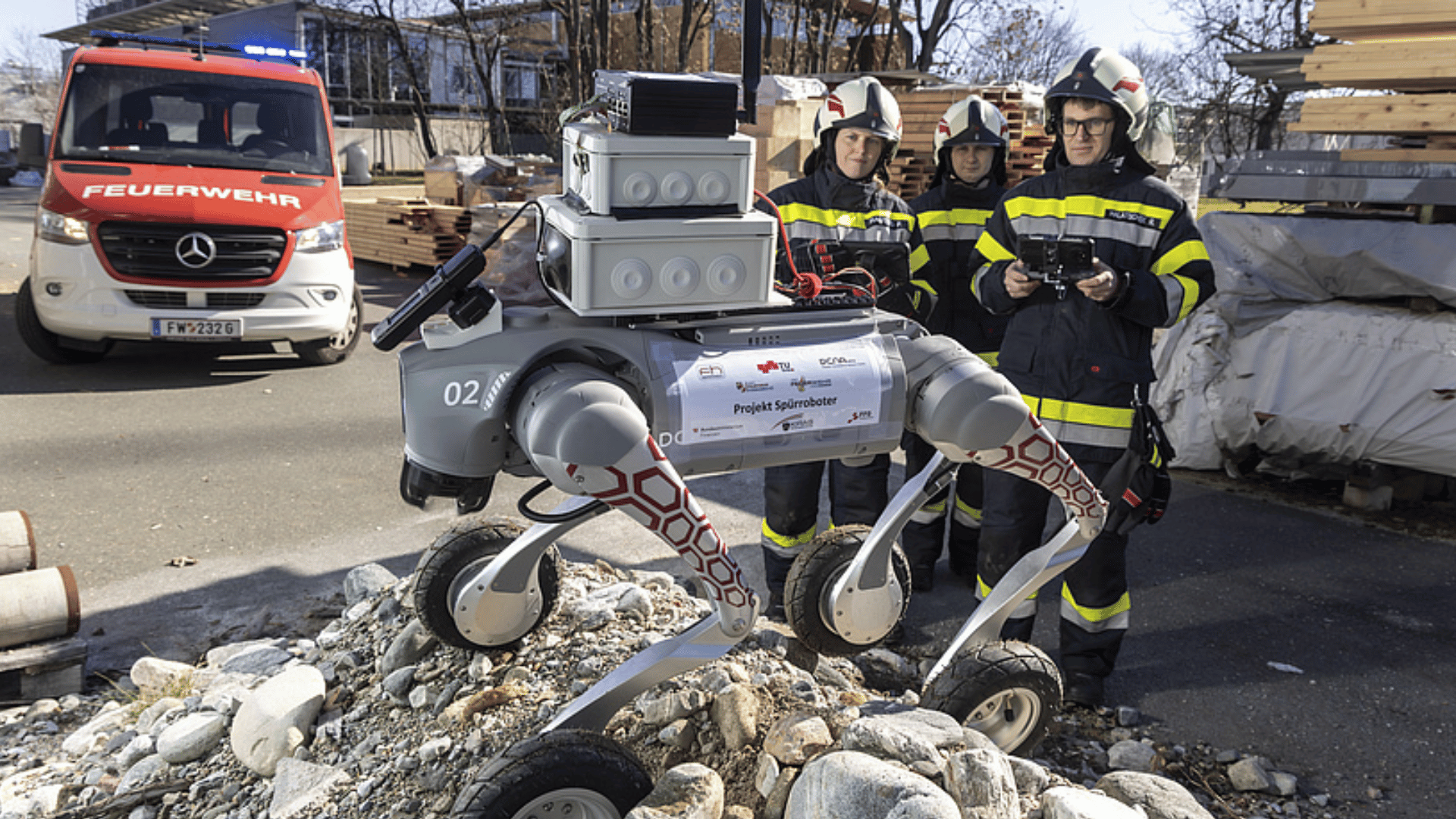
The team bypassed complex external networks and GPS setups and used commercially available parts for movement, sensors, and data processing.
Advertisement
“Based on a comprehensive requirements analysis, we developed an appropriate robotic strategy and integrated it into existing standard operational procedures,” Steinbauer-Wagner explained. “This should ensure seamless collaboration between man and machine during the operation.”
Fire service experts, like Gerald Czech of the Austrian Federal Fire Service Association, immediately saw the value, because who wouldn’t want to keep these first responders safe? “If there were a real hazardous materials incident tomorrow, I would send the robot into the danger zone first,” he said. “For the fire service, every minute counts during a hazardous materials operation.”
Czech continued, “If a robot can provide initial measurement data and images from the danger zone whilst the crew are still kitting up, we gain valuable time for assessing the situation. This increases the safety of the crew and improves operational command.”
The Robot’s Next Steps
Recent tests funded by the FFG showed great results. “The results of the field tests were extremely promising in terms of mobility, user-friendliness and effectiveness,” Steinbauer-Wagner said.
Despite the positive results, researchers noted that there is more room to grow. The robot itself needs better protection ratings, and the fire service measuring devices need digital upgrades. Still, specialists recommend standardizing this gear and training firefighters to use it.
“Our recommendation is therefore to close the gap between research and practice with these field-ready systems in order to make emergency services safer in the long term,” Steinbauer-Wagner emphasized.
 Read Exclusive Stories
 Bookmark & Save Articles For Later