Some of the coldest and darkest places in our solar system sit right on the Moon. Because the Moon does not experience daytime in these craters, the regions remain in constant shadow and have remained so since the formation of the solar system.
Despite the harsh nature of these environments, scientists believe that they are perfect for hosting a new type of laser. Jun Ye, a physicist at NIST and JILA, is proposing that the craters on the Moon that receive no sunlight are ideal for constructing lasers so stable that they could power the first GPS system on the Moon, among other scientific achievements.
The Perfect Deep Freeze
To create a laser that is perfectly stable, scientists use an optical cavity made of silicon. An optical silicon cavity is simply a block of silicon with mirrors at each end. Within the silicon, the light that passes through the mirrors reflects back and forth. To maintain the laser’s stability, the distance between the mirrors must remain exactly the same. On Earth, this can be challenging due to the planet’s movement. However, on the Moon, there is no air or vibration that could disrupt this process.
Furthermore, the craters are located in temperatures that hover around 50 degrees above absolute zero. At these temperatures, the silicon does not expand or contract, meaning the distance between the mirrors remains constant without the need for costly equipment to maintain them.
Advertisement
A GPS for the Moon
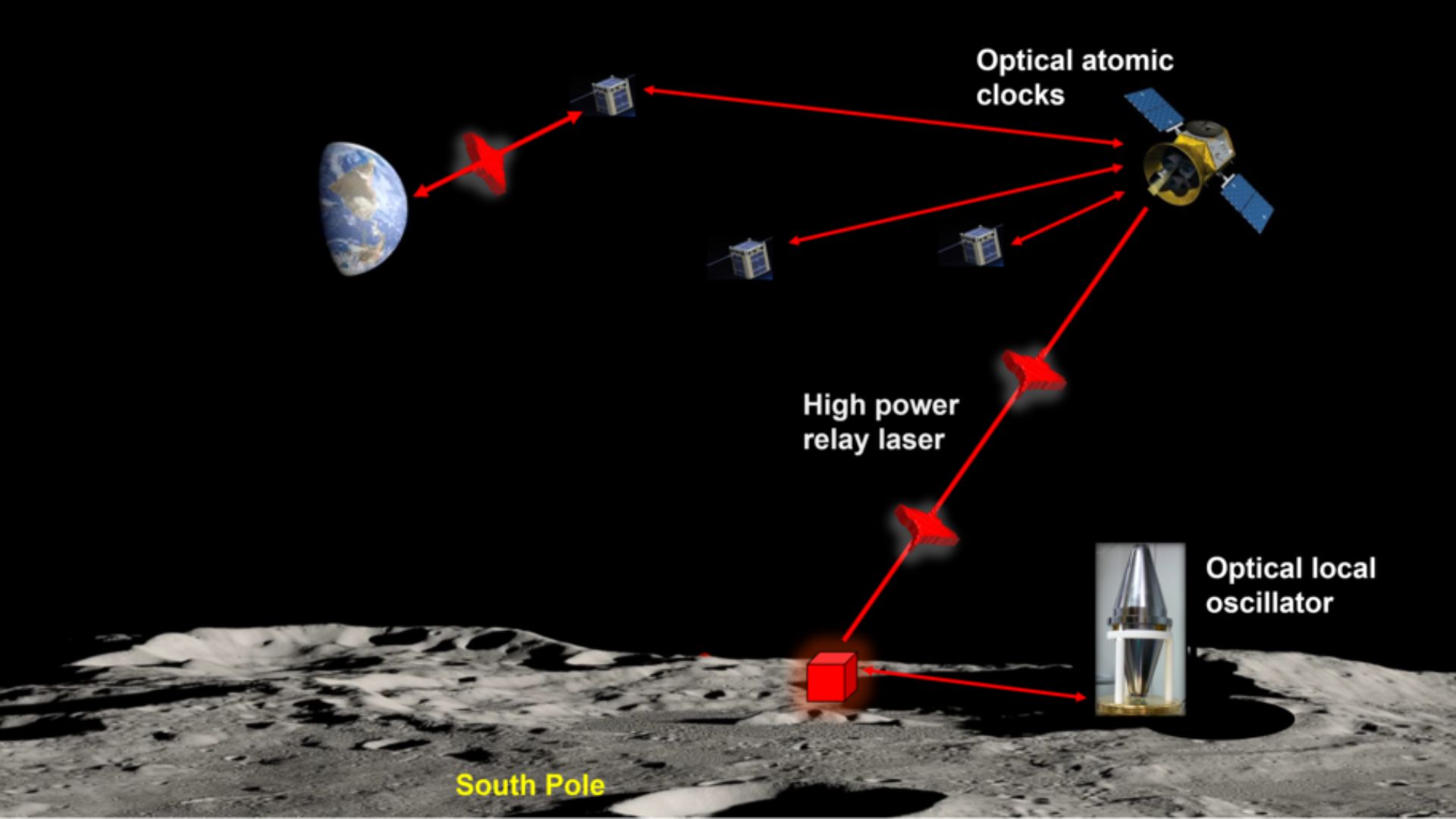
One of the main uses for these lasers on the Moon would be navigation. NASA’s Artemis missions will travel to the lunar south pole, an area with dim lighting that can be dangerous for landers and spacecraft. The lasers would create a lighthouse signal to assist these landers. Additionally, these lasers could interact with the atomic clocks present on the Moon’s orbiting satellites, creating the first timekeeping system on another planet in our solar system.
Spotting Ripples in Space
These lasers would also allow scientists to explore space. Due to the stability of these lasers, the distance between objects on the Moon can be measured to a microscopic level. If a gravitational wave passed through the Moon, the distance between objects would change. By detecting these changes, scientists could use the Moon to detect gravitational waves from deep into the cosmos.
Though still conceptual, scientists estimate that implementing this technology in Earth’s orbit will be possible within approximately 2 years, and that a lunar mission will be possible soon thereafter.
 Read Exclusive Stories
 Bookmark & Save Articles For Later