

Incat Tasmania recently finished a successful trial of the Marine Evacuation System (MES) on its newest project, Hull 096. This impressive system involves three 22-meter inflatable slides that connect to giant liferafts. It’s essentially a high-tech escape route designed to get hundreds of people off a ship quickly and safely.
Where It All Started
At the core of Incat’s work is the development of optimal, lightweight ship solutions for global ferry operators. The company is known for its advanced catamaran designs, which are lighter than equivalent steel ships. As a result, the catamarans have up to 40% less power consumption and lower emissions.
The company has a diverse product line that includes commuter ferries, large passenger and freight ships (Ro-Pax), military and coast guard craft, and work boats for the offshore industry. Additionally, the company’s shipyard has emphasized sustainability. According to Incat, 100% of its energy needs are met by renewables.
Global Impact
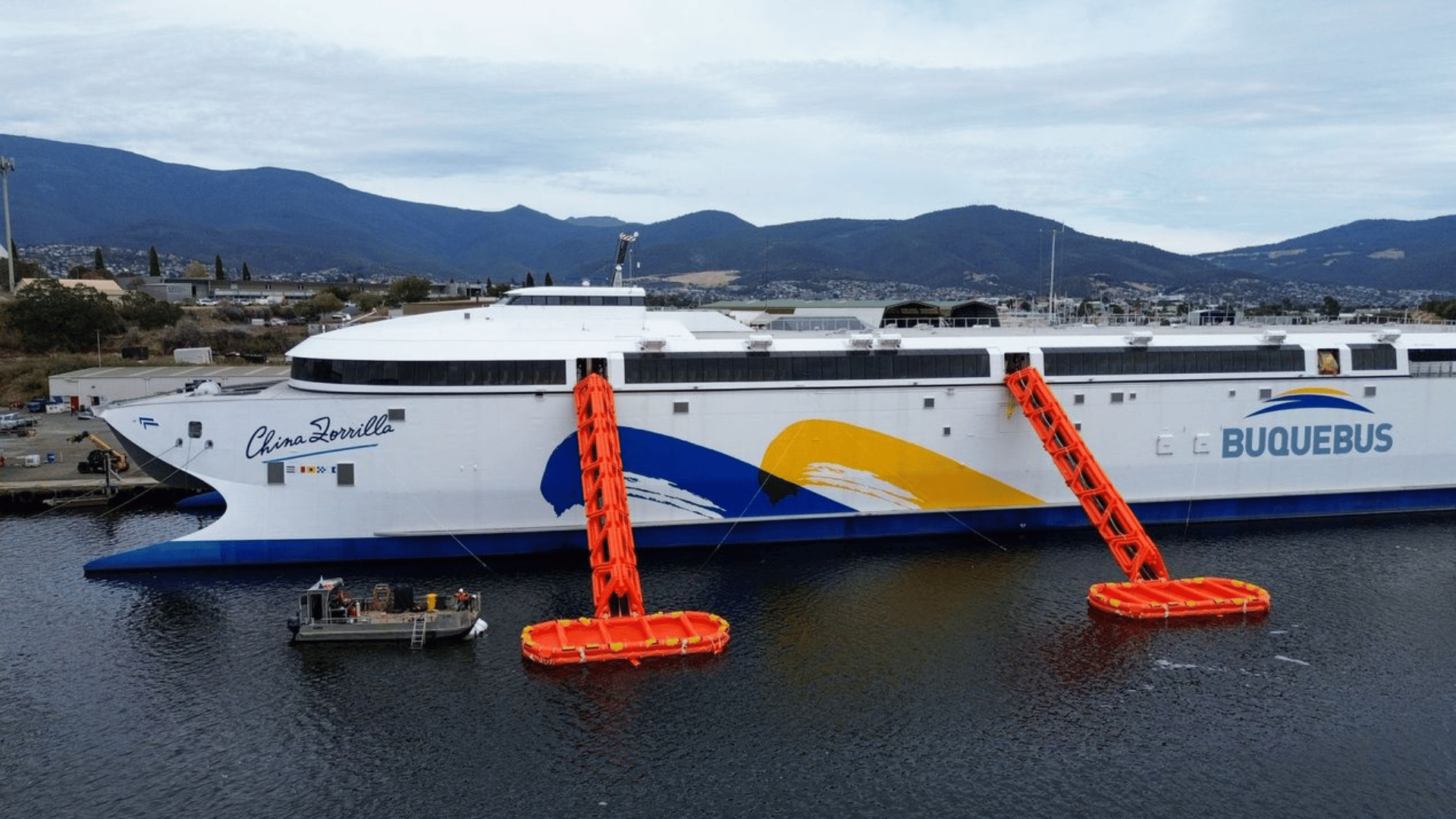
The safety gear was designed and built by Liferaft Systems Australia (LSA), another Tasmanian company. It’s an example of two neighbors working together to build something that will eventually head halfway across the world.
When this ferry is finished, it will be the largest battery-electric ship in the world. To keep that many people safe, the final setup will include six of these evacuation units and 13 linked liferafts. Altogether, that provides enough space for 2,432 people.
“Safety is fundamental to every vessel we build at Incat,” said Incat Chairman Robert Clifford. “The successful deployment of the Marine Evacuation System on Hull 096 demonstrates the depth of engineering, planning and collaboration required to deliver vessels of this scale.
“We are proud to continue our partnership with another industry leading Tasmanian company in Liferaft Systems Australia to deliver world-class safety capability, showcasing the expertise that exists right here in our state,” Clifford added.
What’s Next for the Electric Giant
The deployment is just one piece of a long checklist. Now that the slides and rafts have proven they work, the team will move on to more testing and commissioning.
For the people at LSA, seeing the system in action on a ship this size is a big win.
“Our long-standing relationship with Incat is built on a shared commitment to quality, reliability and passenger safety,” Managing Director Mike Grainger said. “Seeing these systems successfully deployed on a vessel of this size is a proud moment for our team and a testament to what Tasmanian industry can achieve together on the global stage.”
Once all the tests are wrapped up, the ferry will leave Tasmania and head to its new home in South America.