
A double blast of dying stars may be the first observed case of the unproven “superkilnova”. Although astronomers are still searching for concrete answers, a study published in The Astrophysical Journal Letters may detail the historic explosion about 1.3 billion light-years from Earth.
Is This the First Observed ‘Superkilnova’?
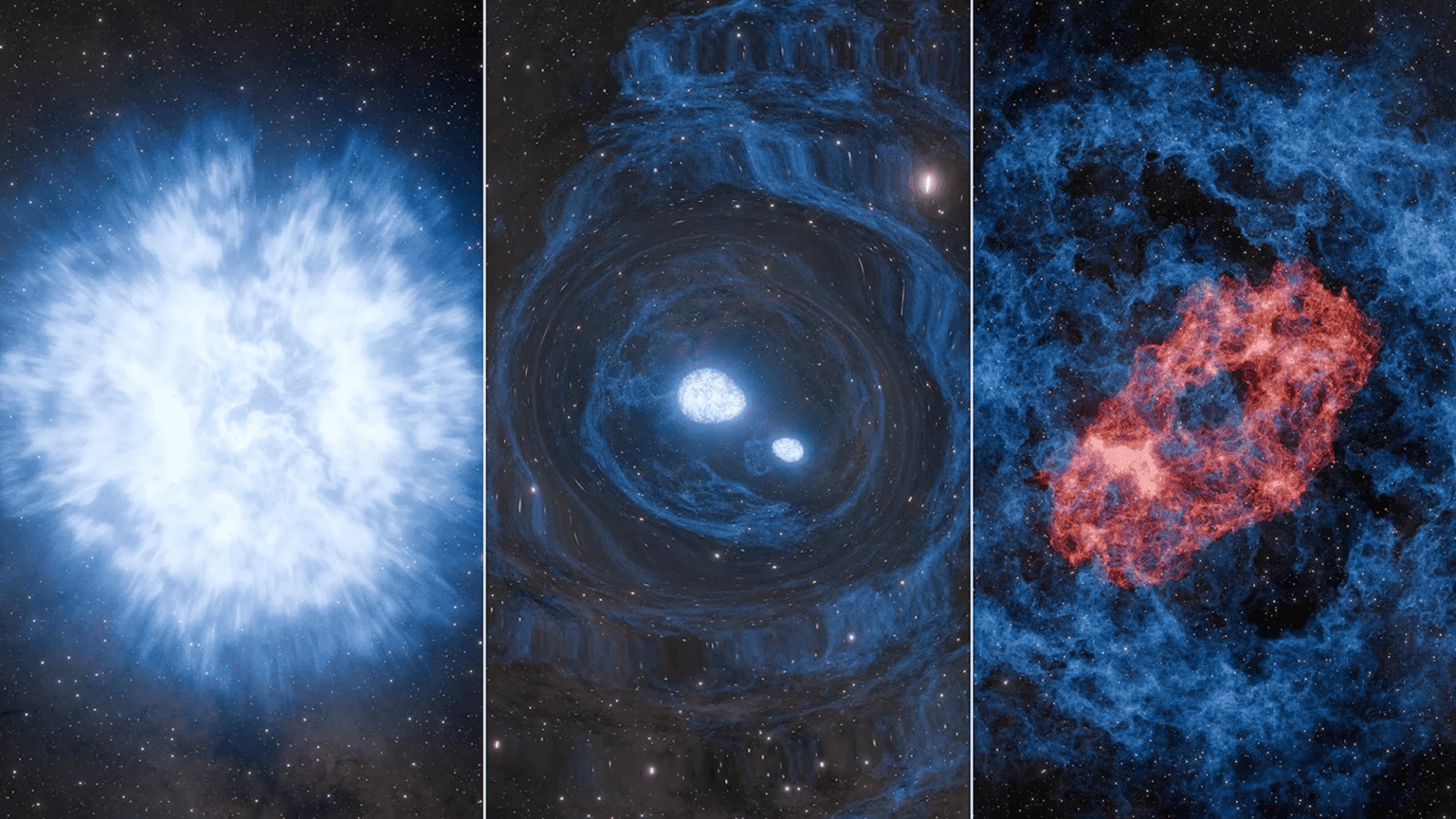
Stars end their lives with an explosion known as a supernova. And, when two dense neutron stars collide and produce a bigger explosion, this is called a kilonova. Astronomy’s most definitive kilonova example, GW170817, was discovered in 2017 when the National Science Foundation’s Laser Interferometer Gravitational-wave Observatory (LIGO) and the Virgo gravitational-wave detector spotted light and gravitational waves traceable to a collision of two neutron stars.
A team at Caltech’s Palomar Observatory thinks they may have another kilonova candidate. On August 18, 2025, both LIGO and Virgo detected gravitational wave signals, setting off an alert system for the global astronomical community.
Researchers at the Palomar Observatory’s Zwicky Transient Facility soon identified a fading red body about 1.3 billion light-years away. The object, later classified AT2025ulz, displayed similar fading red wavelengths as GW170817.
“At first, for about three days, the eruption looked just like the first kilonova in 2017,” Palomar Observatory director and study co-author Mansi Kasliwal said in a statement.
AT2025ulz began to brighten again a few days later, but this time it turned blue to indicate the presence of hydrogen. This led many to speculate that the blast wasn’t another rumored kilonova, but rather a regular supernova. This left scientists puzzled, as the cumulative data on AT2025ulz did not resemble the kilonova GW170817 but also didn’t align with a classic supernova.
Gravitational waves also suggested that at least one of the two neutron stars was smaller than the sun. It’s possible that a quickly spinning star went supernova before fissioning into two, sub-solar neutron stars. Or this could have begun as a supernova, but instead of fission, a disk of debris started forming around the collapsing star. This material eventually combines into a small neutron star.
Given the possible sub-solar neutron star implied by the gravitational wave data, researchers hypothesize that a supernova’s two newborn neutron stars orbited into one another to generate a separate kilonova.
“Everybody was intensely trying to observe and analyze it, but then it started to look more like a supernova, and some astronomers lost interest,” Kasliwal said. “Not us.”