Autonomous robotics has become increasingly more reliable and capable in several industries. On Earth, autonomous welding robots are used on ships, and industrial robots operate in factories. Researchers and engineers want to take that technology and its capabilities to space. Specifically, the robotic welders are designed to repair and maintain critical satellites.
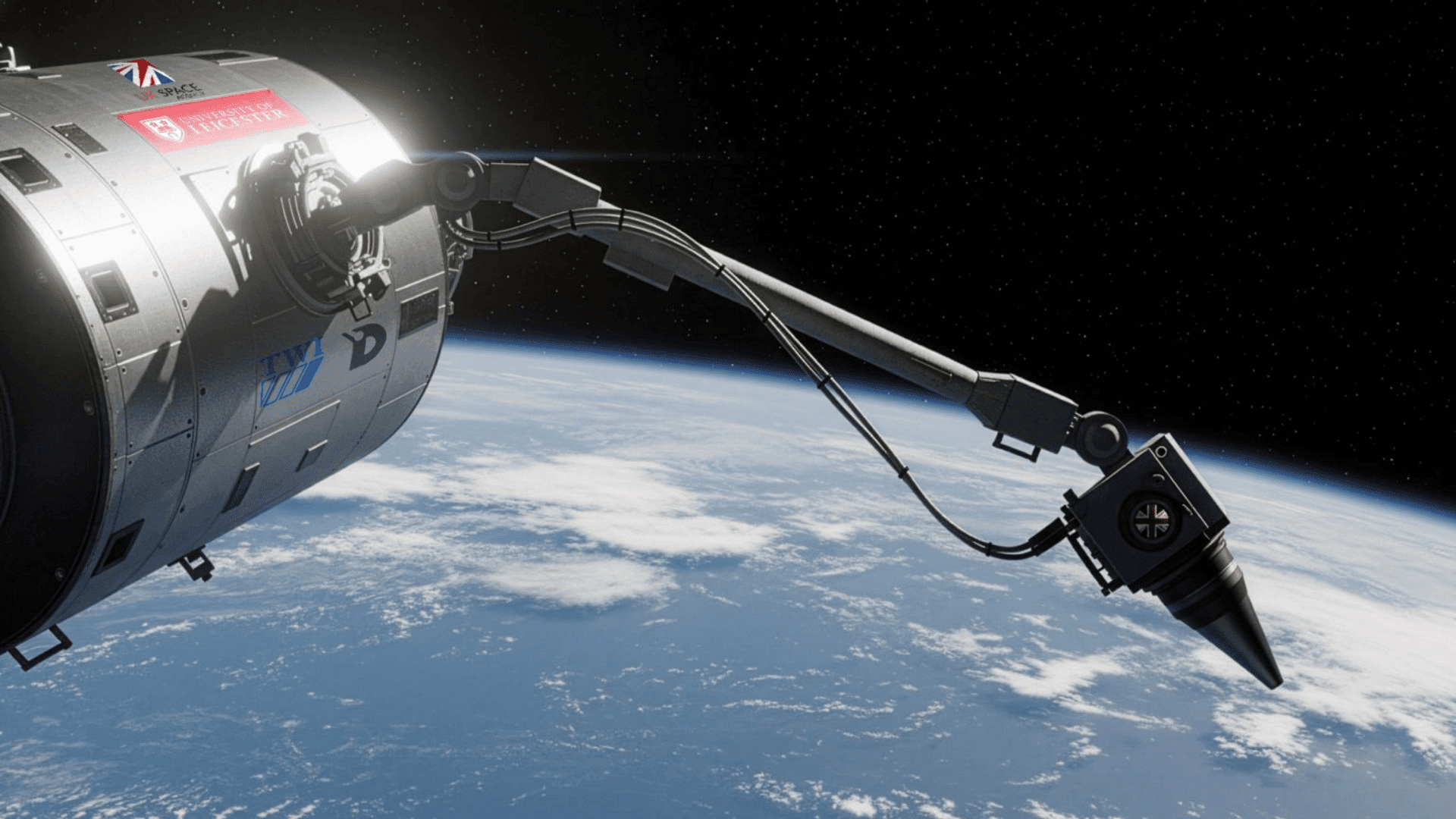
The University of Leicester in the U.K., in partnership with welding specialist TWI Ltd, secured significant funding to develop ISPARK, the Intelligent SPace Arc-welding Robotic Kit.
Essentially, ISPARK is a robot-mounted arc-welding system for autonomous in-orbit repair, joining, and future orbital manufacturing.
First In-Space Robotic Welder
Advertisement
Space has extremely harsh conditions, which challenge welding capabilities. For example, the harsh environment consists of vacuums, microgravity, and thermal instability. Historically, these elements have made the technology rare and difficult to deploy. Additionally, traditional in-space repair is dangerous and is physically demanding for astronauts. However, ISPARK is designed to overcome these hurdles because it enables autonomous repair and construction with a space-qualified robotic system.
The project combines the University’s AI-powered robotics, autonomous control, space engineering, and digital twin weld modeling with TWI’s welding and materials joining technology.
“ISPARK advances the UK’s and the world’s capability for in-space repair and manufacturing,” said Principal Investigator Dr. Daniel Zhou Hao, from the University of Leicester. “By combining Leicester’s strengths in AI robotics and space engineering with TWI’s world-leading welding expertise, we are developing an enabling technology that could redefine how large structures are built and maintained in orbit.”
Before deployment, the robotic welding system will undergo vacuum trials, which will be monitored using digital twin modeling. The trial process will provide key insight into the technology’s capabilities before it is exposed to the thermal, radiative, and dynamic conditions of spaceflight.
“Space technology benefits people’s lives every day – from checking the weather to navigating your car journey home from work,” Space Minister Liz Lloyd added. “By supporting our space sector, we’re strengthening the UK’s position as a world leader in space innovation and building technologies that will benefit people across the country for years to come.”
 Read Exclusive Stories
 Bookmark & Save Articles For Later