The Hubble Space Telescope’s new portrait of the Trifid Nebula features horns, speckles, and a series of glowing ridges. Also known as Messier 20, the nebula is a star-forming region approximately 5,000 light-years from Earth. The zoomed-in portion of the nebula, nicknamed the “Cosmic Sea Lemon,” is home to several stellar galaxies that have formed the region for 300,000 years.
New Hubble Image
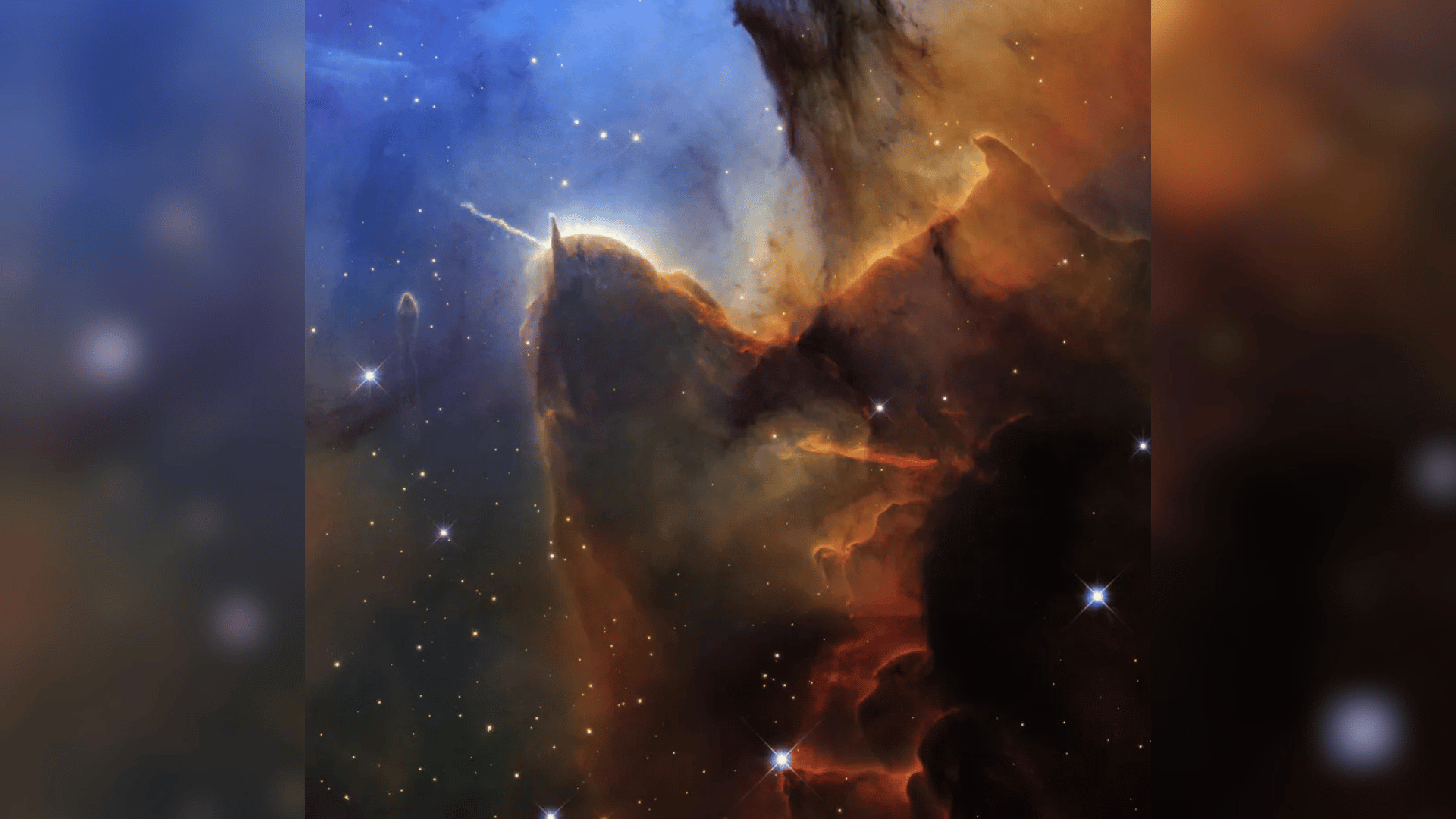
This image is even more spectacular because the Hubble first photographed this exact portion of space in 1997 using its Wide Field and Planetary Camera 2. The Hubble took a second look at this scene 29 years later for its 36th anniversary with its significantly more powerful Wide Field Camera 3.
Advertisement
The new image shows orange cloud linings where ultraviolet radiation from stars has stripped electrons from nearby gas, causing a glowing effect. It also appears stellar winds have cleared some of the surrounding dust, indicated by the bright-blue areas in the photos. The dust is the densest in the far right corner, which looks almost pitch black.
The brown-shaped structure in the center left is the “head” of the cosmic sea lemon, and the “body” is a rust-colored cloud of gas. Yellow gas moves outward between the two “horns.” According to the European Space Agency, these are regions where the ultraviolet light is eroding gas and dust.
Left of the sea lemon’s head is a jet of gas ejected by a baby star in a region part of the Herbig-Haro (HH) object called HH-399. When comparing the new images to the 1997 images, researchers could see the jet expand, which allowed scientists to measure the jet’s speed.
Researchers also noticed a thick streak of material in bright orange and blazing red that appears to expand to the right, which may be a jet shooting from another newly formed star.
 Read Exclusive Stories
 Bookmark & Save Articles For Later