Just before May 4th, AKA Star Wars Day, researchers at Australia’s University of New South Wales offered up 27 possible dual-sun planets as proof that their new technique for finding them works.
Dual-Sun Planets Discovered
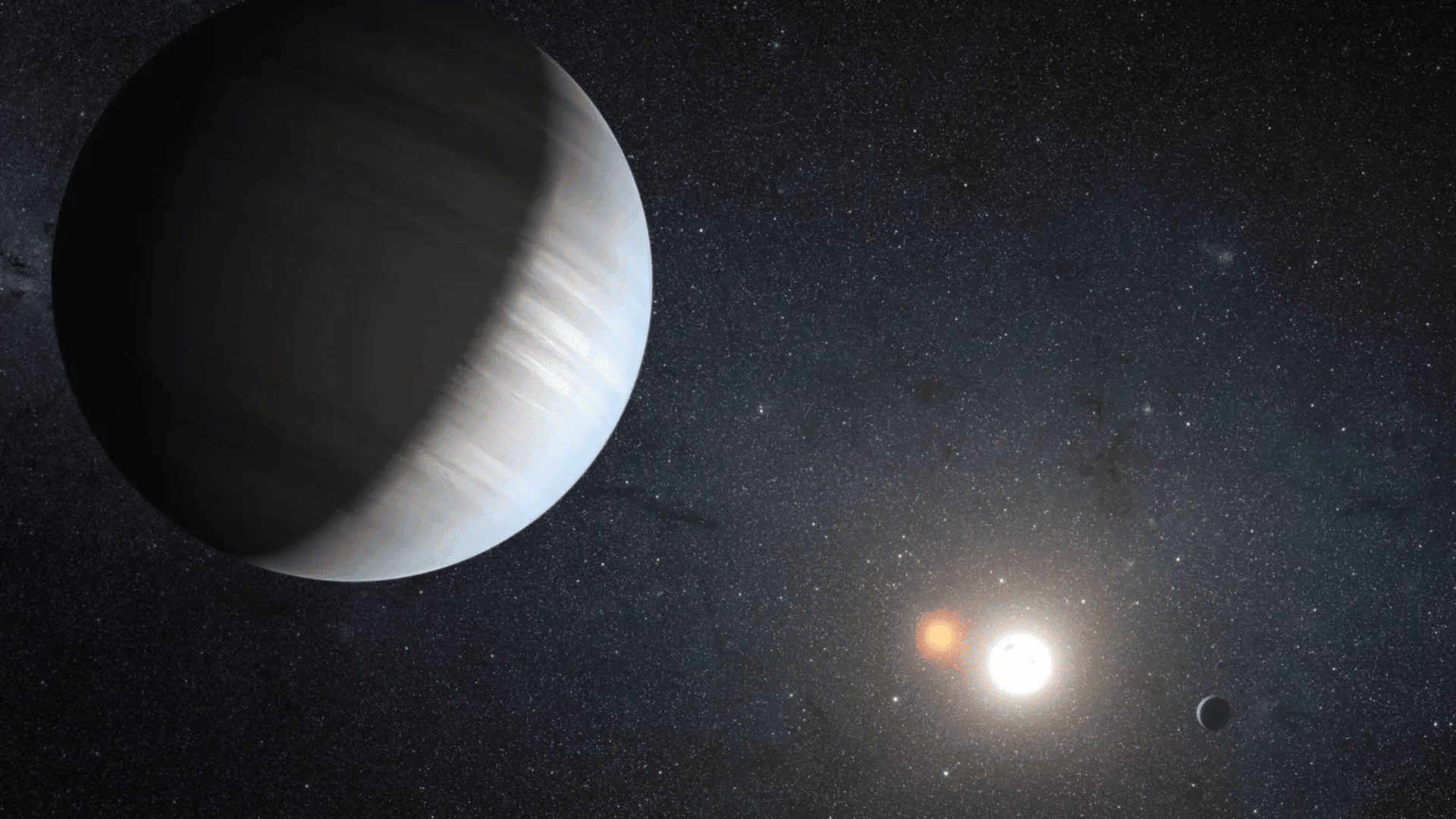
Of the 6,000 exoplanets known to science, only 18 have been proven to be circumbinary planets or those with dual-suns.
“Most of our current knowledge on planets is biased, based on how we’ve looked for them,” Margo Thornton, a UNSW astronomer, said in a statement. “We’ve mostly found the easiest ones to detect.”
According to the study, which was published in the Monthly Notices of the Royal Astronomical Society, they utilized a technique called apsidal precession. Astronomers use aspidal precession to observe binary stars and how they orbit and eclipse one another over periods of time.
Advertisement
The research team theorized that they could use this technique to spot tiny variations in stellar eclipses, which could indicate the existence of a planet. This differs from the transit method, which identifies exoplanets by the mini-eclipse they cause as they pass in front of a star.
The transit method is limited as planets are only visible when passing between Earth and their star, so those with irregular orbits won’t be spotted.
“This new method could help us uncover a large population of hidden planets, especially those that don’t line up perfectly from our line of sight,” Thornton said. “It could help reveal what the true population of planets in our universe might look like.”
Ranging in size, the potential dual-sun planets go from about the mass of Neptune to 10 times as large as Jupiter. The closest one is 650 light-years away, while the furthest is 18,000 light-years away.
“I wasn’t expecting to find 27 already at this point from the pilot study,” said study coauthor Ben Montet. “Now we get to start the really fun project of figuring out which ones are real planets.”
 Read Exclusive Stories
 Bookmark & Save Articles For Later