
John Tse, an engineer and filmmaker who runs the I Build Stuff YouTube channel, has invented an autonomous flying umbrella that follows users, shielding them from rain or sunlight.
Autonomous Flying Umbrella
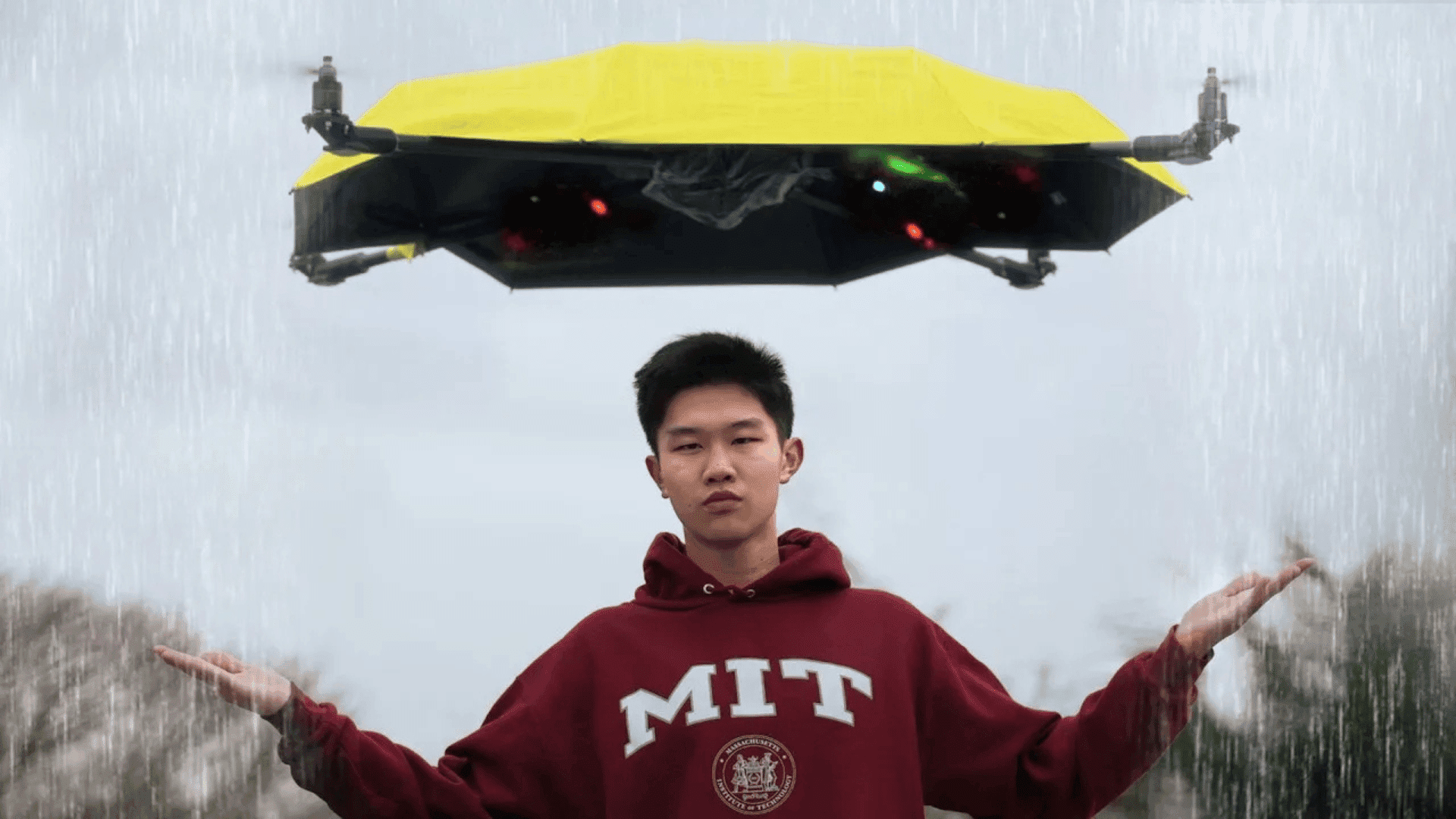
Tse’s invention uses drone technology to keep your head covered without the need to hold, wear, or strap anything. Though the project was originally designed and prototyped in 2024, Tse recently provided a behind-the-scenes video update.
The video walks viewers through Tse’s prototyping process. He explains how he had originally relied on a handheld controller, which made the design more impractical and less usable. As a response to customer feedback, he decided to add a tracking system, which would allow the umbrella to follow the user around as they walk.
Over the course of development, Tse tested different types of tracking systems to see what worked best, including cameras, LiDAR (Light Detection and Ranging) sensors, and a remote human operator.
The method that worked best was a time-of-flight depth camera. This works by sending light out, measuring how much of it reflects back, and creating a depth image rather than a flat picture. Through this process, the system is able to detect a person’s position in 3D, even in low light.
A Raspberry Pi processes this depth data and determines the position of a person’s head. It then sends instructions to the flight controller, telling the umbrella where to move so the device remains centered above the person.
The structural parts were mainly constructed using 3D printing and robust materials like carbon-fiber nylon. The device contains a series of electronic components and a flight controller that acts as the brain.
The project faced many challenges, such as broken parts, disconnected components, and entire systems that needed to be replaced. But Tse turned those challenges into successes, creating a working prototype after a year of development.
As Tse explains at the end of the video, “I’d be lying if I said this project turned out perfect, but at the same time I would also be lying to say that this moment didn’t bring us joy.”