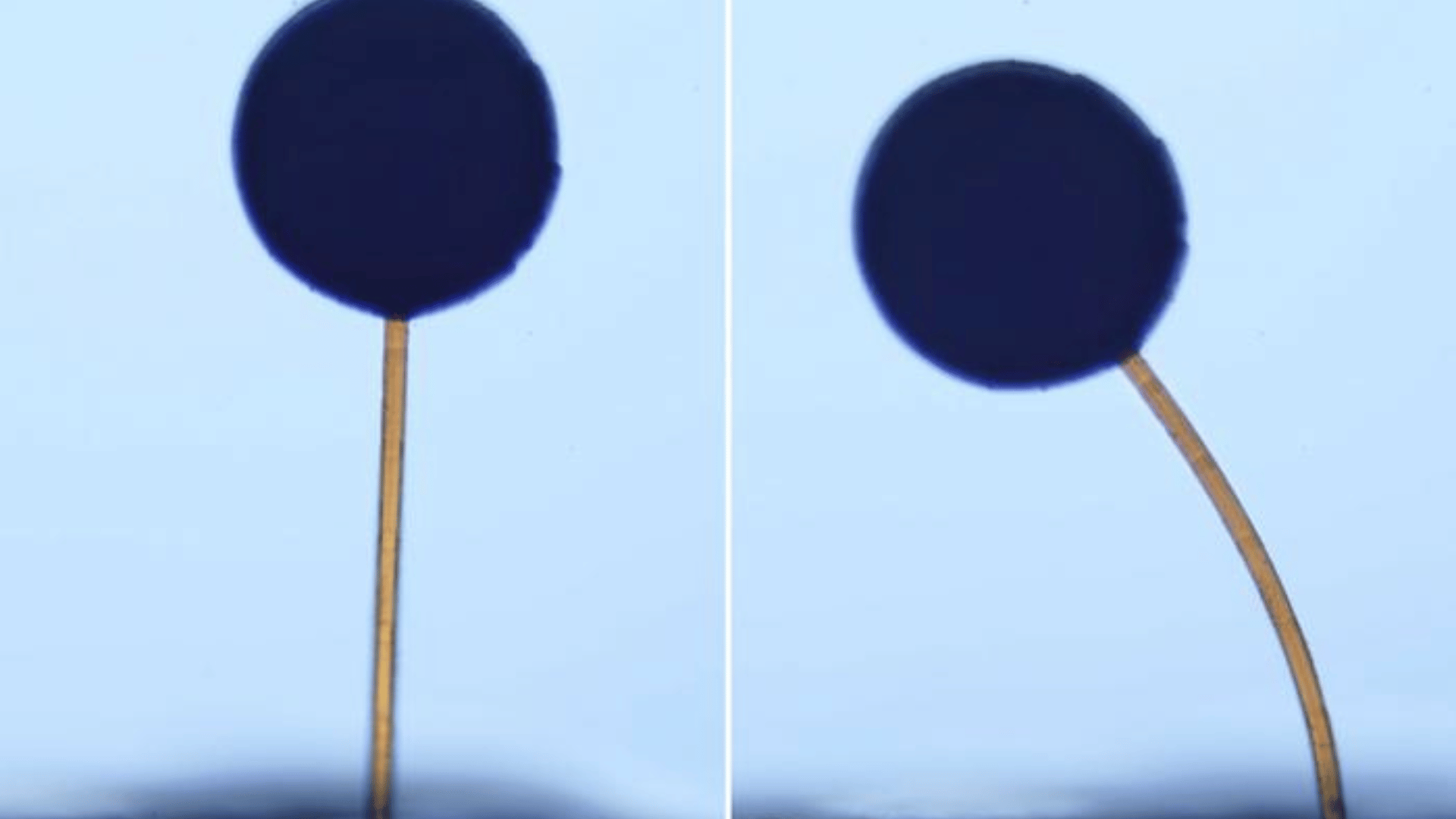
A team of engineers at MIT has developed tiny, flexible robots that snap into action with the wave of a magnet. These “magno-bots” are smaller than a grain of sand and look a bit like microscopic lollipops. While they might look simple under a microscope, they can grip, flip, and move in ways that could eventually help doctors perform surgeries or deliver medicine deep inside the human body.
Designing the Right Robot
Making things move with magnets isn’t new; we do it every day with fridge magnets and paper clips. However, when you try to shrink that technology down to a microscopic level, it gets challenging. Usually, scientists try to mix tiny magnetic metal bits into 3D printing resin.
The issue is that those metal bits block the lasers used in high-tech 3D printing. The laser light bounces off the metal, making the final structure weak or ruining the print entirely. To get around this, the team from MIT, EPFL, and the University of Cincinnati decided to change the order of operations.
Advertisement
A Way Around
Instead of putting magnets in the “ink” before printing, the researchers printed the structures first using a standard polymer gel. Once the shape was finished, they used a two-step soaking process. First, they dipped the gel into a bath of iron ions. Then, they dipped it into a second solution that turned those ions into magnetic nanoparticles right inside the gel.
“We can now make a soft, intricate 3D architecture with components that can move and deform in complex ways within the same microscopic structure,” said study author Carlos Portela. “For soft microscopic robotics, or stimuli-responsive matter, that could be a game-changing capability.”
Additionally, they can choose which parts of the robot are more magnetic than others. By changing the laser’s power during the printing stage, they can make some parts of the gel “tighter,” so they absorb fewer magnets. This allows one part of a tiny robot to stay still while another part reaches out to grab something.
“You could imagine a magnetic architecture like this could act as a small robot that you could guide through the body with an external magnet, and it could latch onto something, for instance to take a biopsy,” Portela said. “That is a vision that others can take from this work.”
 Read Exclusive Stories
 Bookmark & Save Articles For Later