Two marsupial species thought to have gone extinct around 6,000 years ago have been found on the island of New Guinea.
The ring-tailed glider (Tous ayamaruensis) and the pygmy long-fingered possum (Dactylonax kambuayai) were recently confirmed alive in the remote rainforests of the Vogelkop Peninsula in Papuan Indonesia. The discovery has been 27 years in the making, with the first evidence of the creatures emerging in 1999 without photos to confirm.
Extinct Marsupial Species Found Alive
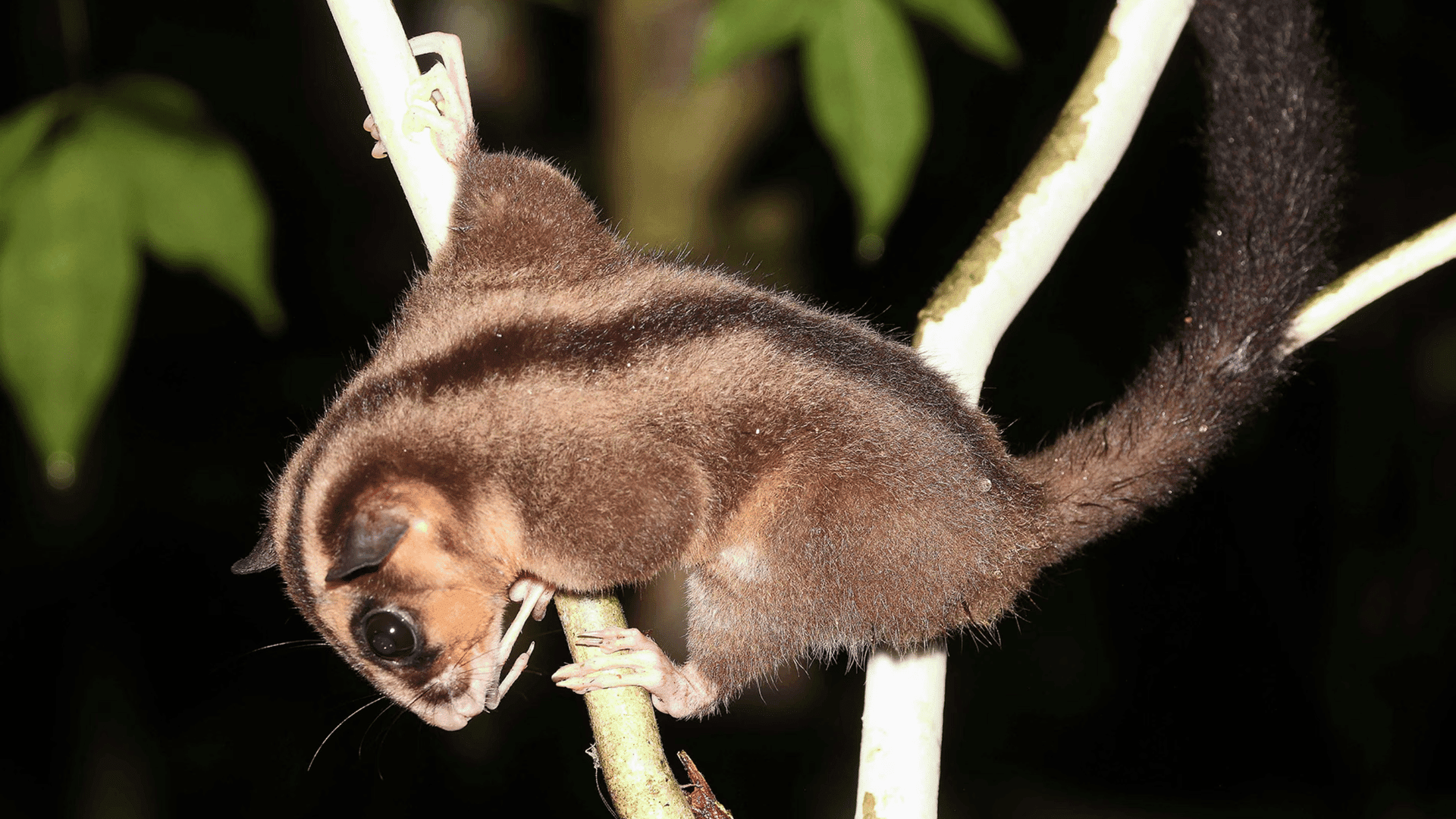
“The Vogelkop is an ancient piece of the Australian continent that has become incorporated into the island of New Guinea,” Tim Flannery, a professor at the Melbourne Sustainable Society Institute and a distinguished visiting fellow at the Australian Museum who led the research, said in a statement. “Its forests may shelter yet more hidden relics of a past Australia.”
These marsupials, or mammals with a characteristic pouch for holding newborns, were previously only known to scientists from fossils in Australia from the last ice age and the early Holocene epoch (the current period of geological time). The pygmy long-fingered possum and the ring-tailed glider are what scientists call “Lazarus taxa,” or animals that vanish from the fossil record and seem to go extinct for an extended period before reemerging as living species.
Advertisement
Researchers were able to locate the species with the help of Indigenous communities in Papuan Indonesia, specifically elders from the Tambrauw and Maybrat clans.
“The discovery of one Lazarus taxon, even if thought to have become extinct recently, is an exceptional discovery,” Flannery said. “But the discovery of two species, thought to have been extinct for thousands of years, is remarkable.”
Ring-tailed gliders form lifelong pair bonds, raise approximately one young per year, and nest in tree hollows. The pygmy long-fingered possum has ears thata can be adapted to detect low-frequency sounds, including noise from wood-boring beetle larvae, which the possum digs out from rotting wood with its fingers to eat.
What is known so far about the marsupials was published March 6 in two peer-reviewed studies in the journal Records of the Australian Museum.
“The findings underscore the critical importance of preserving these unique bioregions and the value of collaborative research in uncovering and protecting hidden biodiversity,” Flannery said in the statement.
 Read Exclusive Stories
 Bookmark & Save Articles For Later