Scientists at EPFL recently upgraded a printing method called tomographic volumetric additive manufacturing, or TVAM for short.
Instead of printing an object layer by layer, TVAM uses laser light to harden a rotating vial of liquid resin all at once. By using a new device to control the phase of light beams, the team made this process 70 times more efficient than previous techniques.
Faster Printing
In their tests, the researchers used the new system to print small, millimeter-scale objects in just a few seconds. Larger, centimeter-scale objects took only a couple of minutes.
Because the system manages light waves so precisely, it can use “self-healing” beams. These beams can pass through messy, light-scattering liquids, like fluids mixed with living cells, without losing their shape. With this new technology, the future of medicine is bright.
Advertisement
“Our method’s demonstrated efficiency and precision finally makes it possible to bioprint tissue-like structures at near-clinical scale,” said Christophe Moser, head of the Laboratory of Applied Photonic Devices (LAPD). “We have printed structures substantially larger than those achieved with previous holographic approaches, despite increased light scattering caused by the embedded cells.”
Making Real Implants Possible
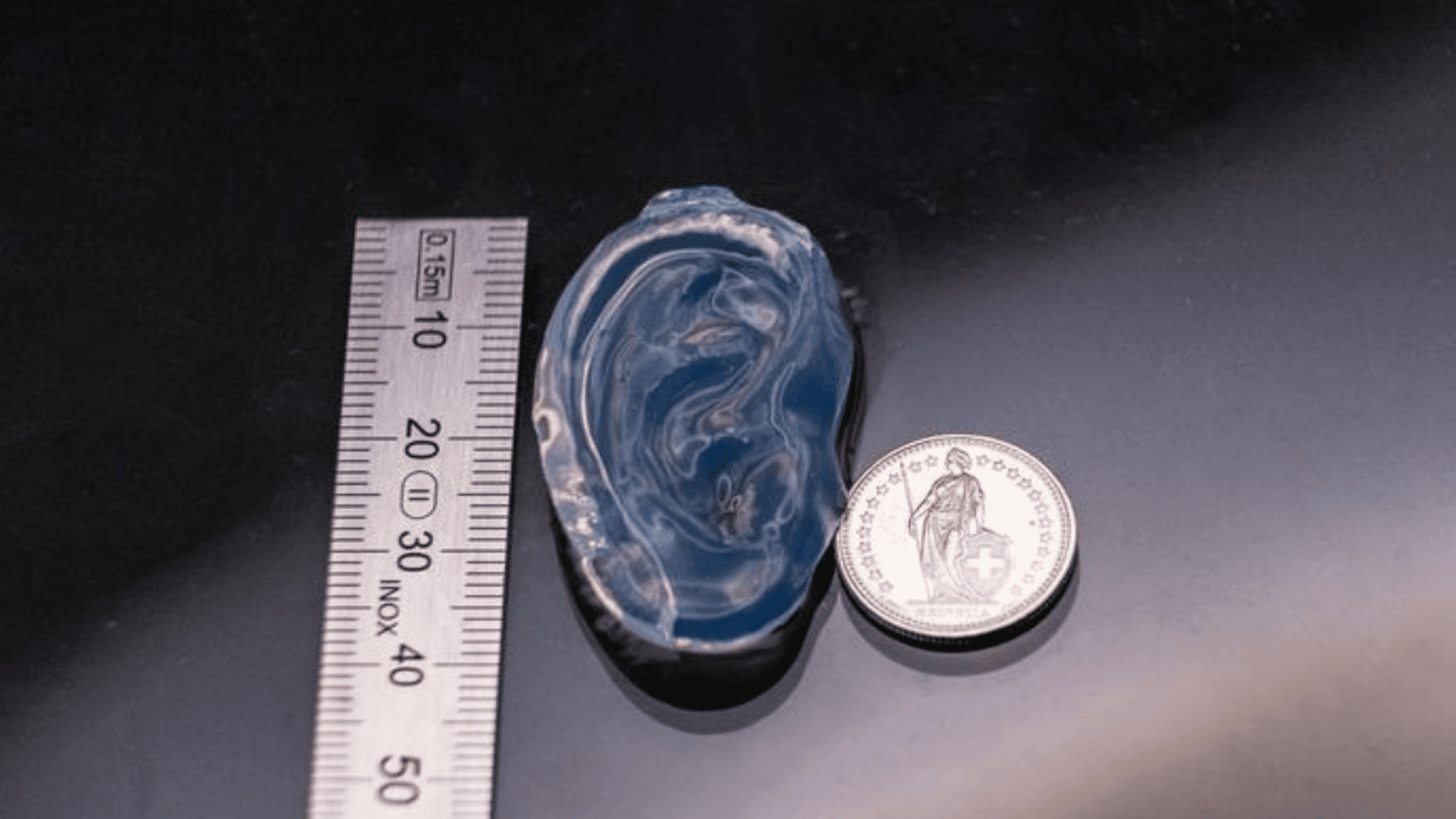
To show what the system can do, the researchers used a small, low-power laser to print a life-sized human ear. This is a promising first step toward creating real implants for reconstructive surgery.
The team also tested how safe the process is for living things. They printed a tiny structure filled with living cells and checked on it six days later. According to the researchers, the cells had started growing together into organized networks.
Additionally, the team fixed a common issue with light-based printing: grainy surfaces caused by light interference, known as speckle. By smoothing out these rough edges, the final printed objects look and feel much better.
“Our approach brings volumetric printing closer to real-scale implants, and biologically compatible manufacturing using low-power laser sources,” added lead author and LAPD PhD student Maria Alvarez-Castaño.
 Read Exclusive Stories
 Bookmark & Save Articles For Later