Designing an airplane wing is a constant battle against invisible air molecules. When air flows smoothly over a wing, planes use less fuel. However, when that air gets chaotic, it creates drag that slows the plane down.
Boeing researchers recently partnered with the U.S. Department of Energy’s Oak Ridge National Laboratory to tackle the problem head-on. The agencies used Frontier, the world’s most powerful supercomputer for open science, to simulate how air and ice behave around wings during takeoff and landing.
“We want to fly in the laminar regime as long as possible because that’s the most fuel-efficient way of flying, where airflow is smooth and steady,” said Adam Clark, an aerodynamics engineer at Boeing. “Reducing fuel consumption helps lower the operational costs for the airline, which could also translate to less expensive tickets for consumers.”
Better Simulations with the Most Powerful Supercomputer
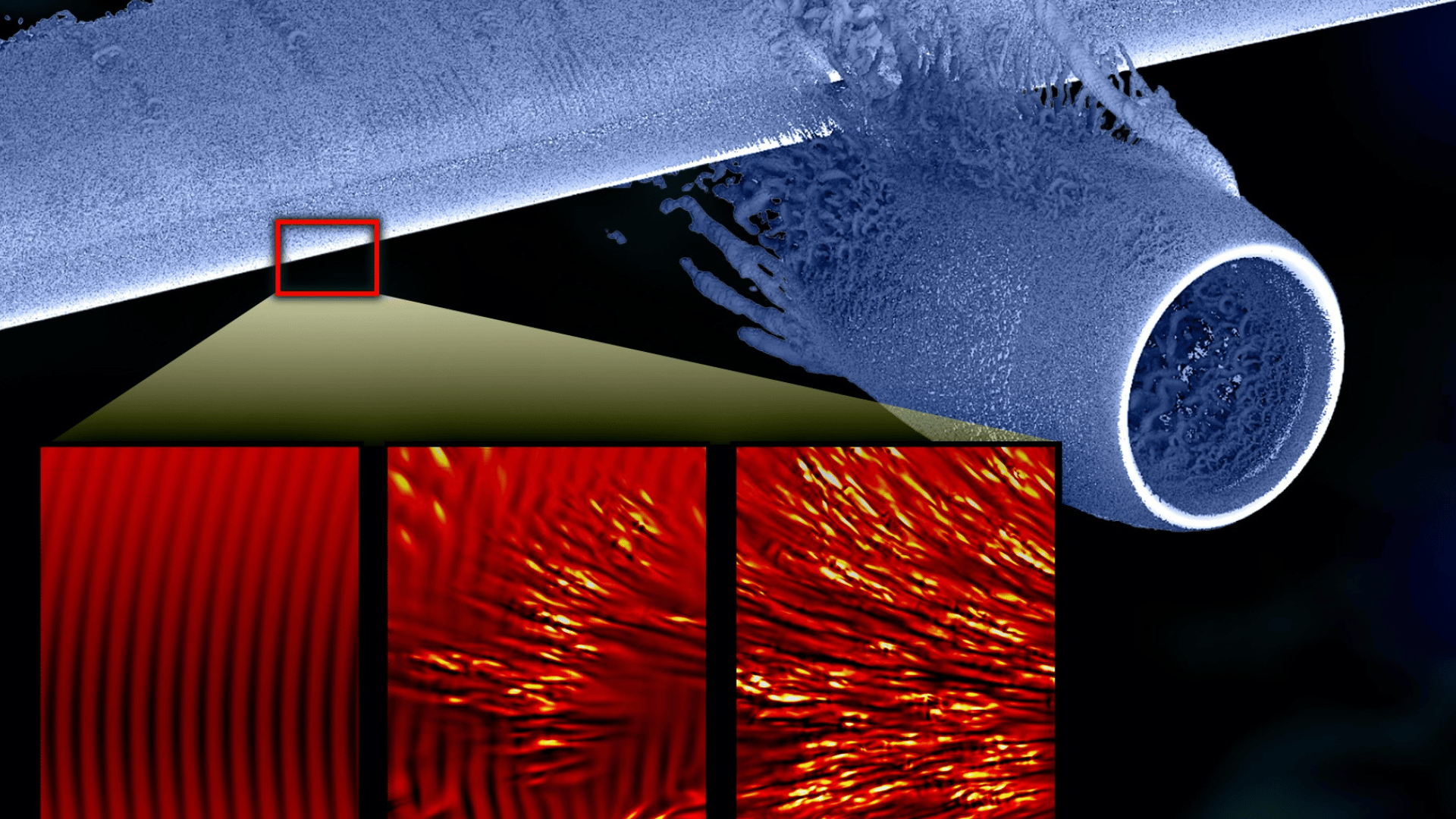
Turbulence is one of the few problems traditional physics still cannot fully solve. Even cutting drag by just 1 percent during cruising conditions lowers fuel use by about 0.75 percent. On a commercial flight, small tweaks can result in significant cost savings.
“Imagine a bunch of marbles on a table. If you push them slowly with two hands, they will kind of stay together, but if you move them impulsively, they will interact in a complex and chaotic way,” explained Boeing aerodynamics engineer Konrad Goc. “That’s a very basic way to describe the difference between air molecules in laminar and turbulent flows, except we’re dealing with millions and billions of marbles.”
Advertisement
Months of Work in Days
In the past, engineers relied heavily on physical wind tunnels and test flights. Those tests are expensive and sometimes produce unusual results that engineers cannot explain. Computer simulations help fill in those gaps, though standard company computers hit a wall when modeling tiny air interactions.
Frontier is the world’s first exascale supercomputer, capable of 2 quintillion calculations per second. Boeing used that speed to test how different ice shapes, textures, and wing-heating tech affect flight through freezing clouds. They predicted the upward lift force on an aircraft to within 1 percent accuracy.
“Not only did Frontier allow us to run simulations that we couldn’t do before, but we were also able to get results in a matter of days, which would have taken months using a typical industrial-scale computing system,” Goc concluded.
 Read Exclusive Stories
 Bookmark & Save Articles For Later