On March 31, a heavy and expensive piece of German engineering finally finished its journey from the sea to a mountain in Virginia. The DSA-2000 radio telescope weighs 5,000 pounds and spans 5 meters, but getting it to its new home at the Fan Mountain Observatory was more about finesse than strength.
It took about three hours for a technician to drive the telescope up the mountain on a large forklift. While he drove, a small team of astronomers walked alongside the machine, using hand signals to help him dodge low-hanging vines and soft spots in the dirt.
Fishing for Dark Matter
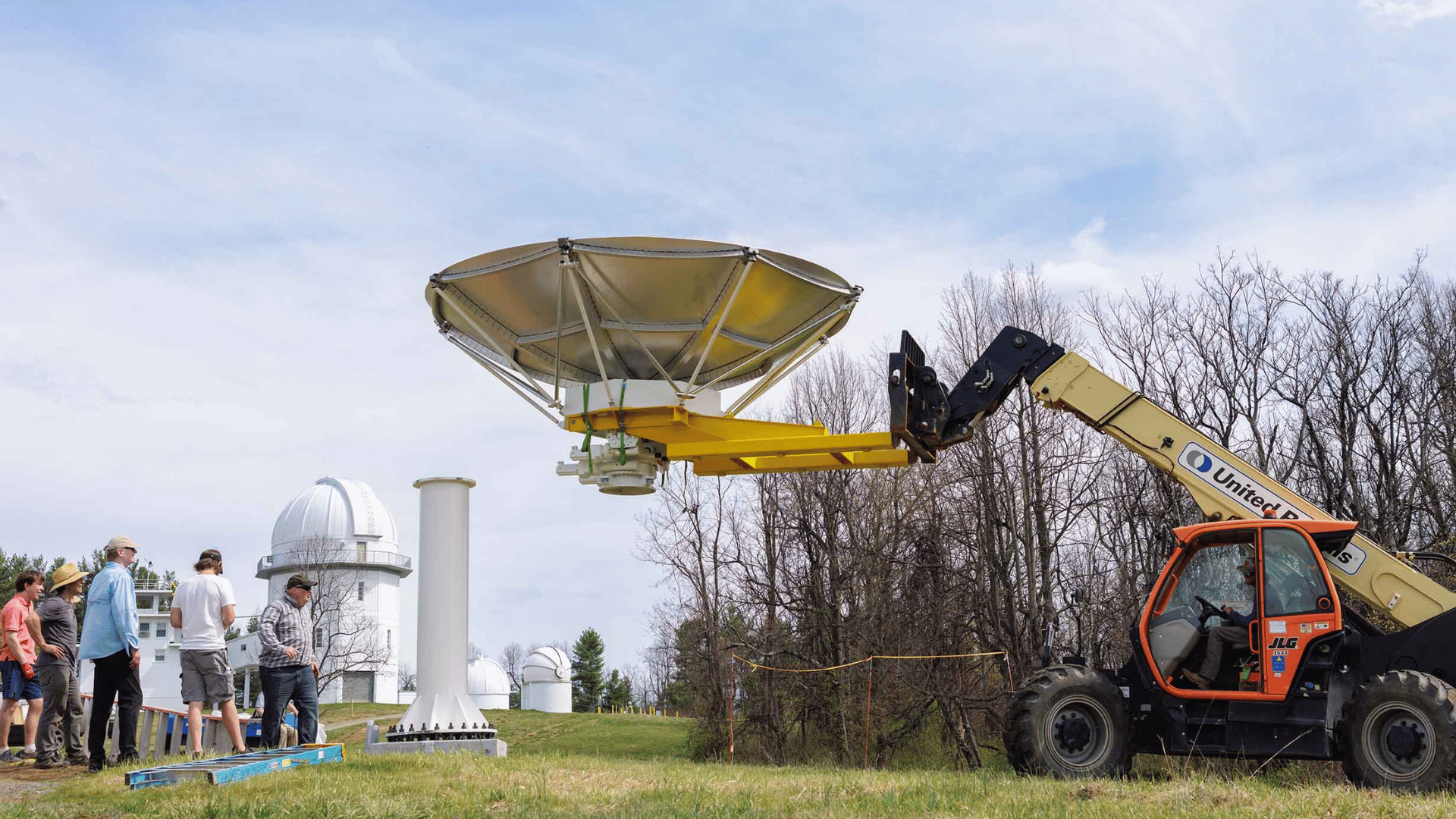
Now that it has arrived, the telescope, funded by a grant from the Jefferson Trust, has a big job to do. It is going to look for “dark matter,” mysterious invisible “glue” that astronomers believe holds the universe together, even though nobody can actually see it.
Advertisement
“The universe is made up of particles,” said Brad Johnson, an associate professor of astronomy at the University of Virginia. “We call one of these particles ‘dark matter,’ and it’s intentionally provocative. We don’t know what it is, but it acts gravitationally, influencing the universe in a detectable way.
“But it doesn’t interact with light in the same way that the protons, neutrons and electrons do,” Johnson added. “We can’t see dark matter with our eyes or with light, but we can see it gravitationally.”
Using Dead Stars as Magnets
The team is specifically looking for particles called axions. They are invisible, but their weakness is that if they hit a strong magnetic field, they turn into microwaves. To find them, the team is using neutron stars, the collapsed, magnetized remains of exploded stars, as giant natural bait.
“We know where some neutron stars are, so we can observe those for sure. We can also look in places where they should be, given our understanding of star formation,” Johnson said. “It’s kind of like fishing. You can’t see all of the fish, but you can guess where they are if you know the lake well enough.”