Preparations for upcoming spacewalks kicked off this week aboard the International Space Station, with two astronauts preparing to install a roll-out solar array at the end of October. Biomedical research, including portable biological sampling in microgravity and 3D cell printing, topped the science schedule for the Expedition 75 crew.
Flight engineers Anil Menon of NASA and Joshua Kutryk of CSA (Canadian Space Agency) are prepping for the first of two spacewalks to install roll-out solar arrays on the space station’s truss structure.
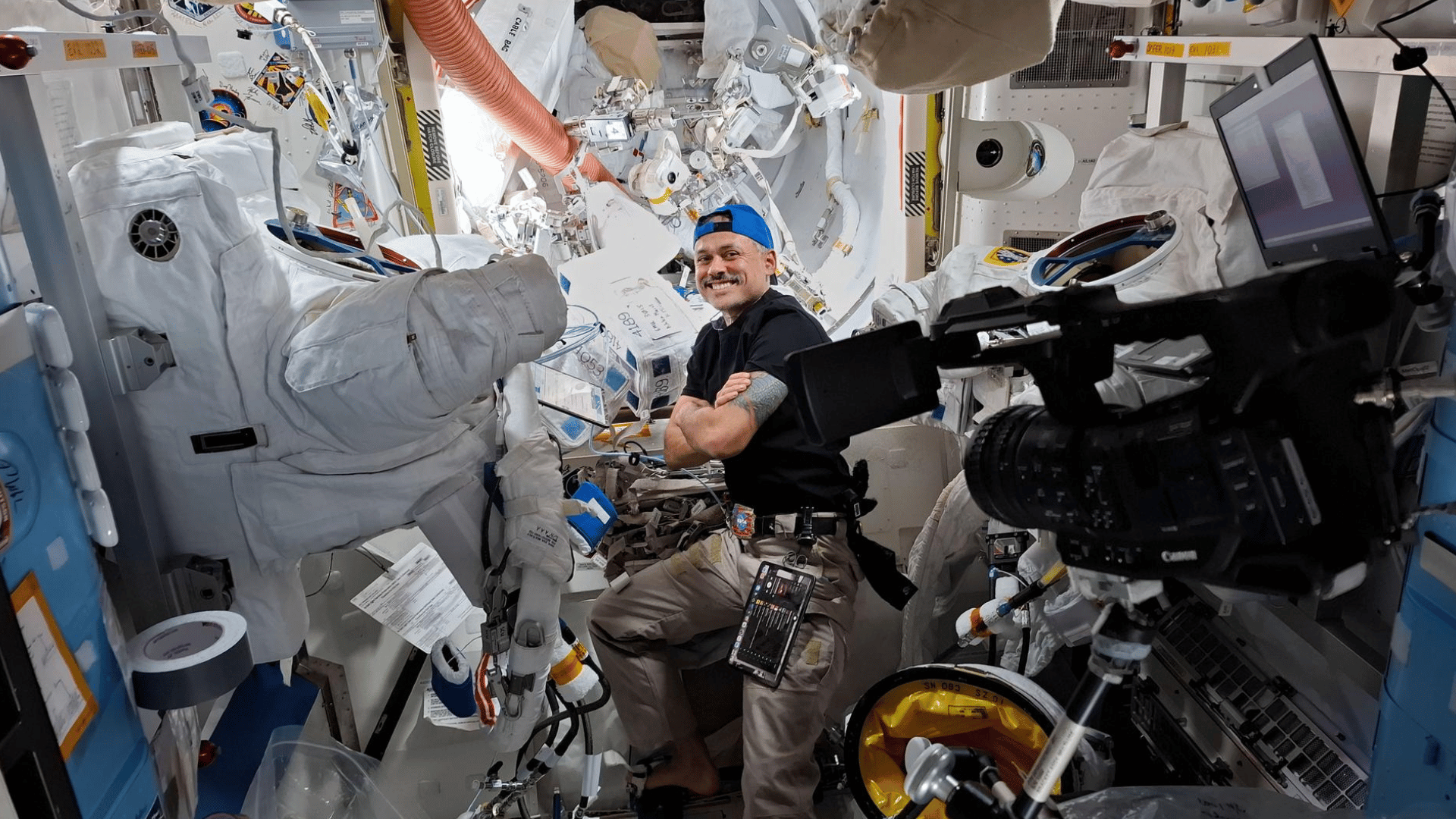
The first spacewalk is scheduled for Oct. 29, when the two astronauts will install a roll-out solar array on the truss structure’s port side. The second spacewalk will take place on Nov. 5 when the duo will install the station’s eighth and final roll-out solar array on the truss structure’s starboard side.
According to NASA, Menon worked inside the Quest airlock on Monday and cleaned cooling loops in a pair of spacesuits that keep the suits thermally conditioned and astronauts comfortable during a spacewalk.
Afterward, Kutryk filled the spacesuit tanks and liquid cooling and ventilation garments with clean water. The pair also joined NASA flight engineers Luke Delaney and Jessica Watkins and called down to mission controllers for a pre-spacewalk conference.
Advertisement
Testing Medical Tools and Physics in Space
Delaney is working on a new experiment, recently delivered aboard a SpaceX Dragon, that seeks to demonstrate the analysis of crew biological samples in space, rather than on Earth, for quicker health insights. Rather than relying on costly return missions and large laboratories, the study is exploring the use of portable, compact tools on the station to speed up medical testing, possibly leading to personalized treatments in space.
Watkins began her shift in the Kibo laboratory module, servicing delicate sample processing hardware and stowing its sample-containing fluid loops in a science freezer. Afterward, Watkins set up the BioFabrication Facility in the Columbus laboratory module to print blood vessels during the week, using cells from patients with a rare genetic disorder that causes rapid aging. Observations in weightlessness may provide deeper insights into the cellular affliction, potentially leading to advanced therapies for accelerated aging.
The space station’s three cosmonauts from Roscosmos worked throughout Monday on physics, artificial intelligence, and inventory duties.
Station commander Pyotr Dubrov explored complex plasmas, or mixtures of ionized gas, neutral gas, and microscopic particles, that become highly charged, interact strongly with one another, and may form plasma crystals. Results may influence the design of future spacecraft and lead to new research methods.
Flight engineer Sergey Teteryatnikov studied the use of artificial intelligence tools that may boost crew efficiency aboard a spacecraft and transcribe crew reports for review by mission controllers on Earth.
 Read Exclusive Stories
 Bookmark & Save Articles For Later