Rats and mice are great at getting through dark, tight spaces like sewers and caves. Their secret? Whiskers. Researchers at Delft University of Technology in the Netherlands are giving tiny drones that same ability.
Drones that weigh less than 100 grams have difficulty navigating. These robots usually rely on cameras and sensors to “see,” but these parts are too heavy for small drones. As a result, they stop working well in low-visibility areas like dark caves or smoke-filled rooms.
Dr. Salua Hamaza and her team created a lightweight sensor that lets drones feel their way around instead.
How Drone Whiskers Work
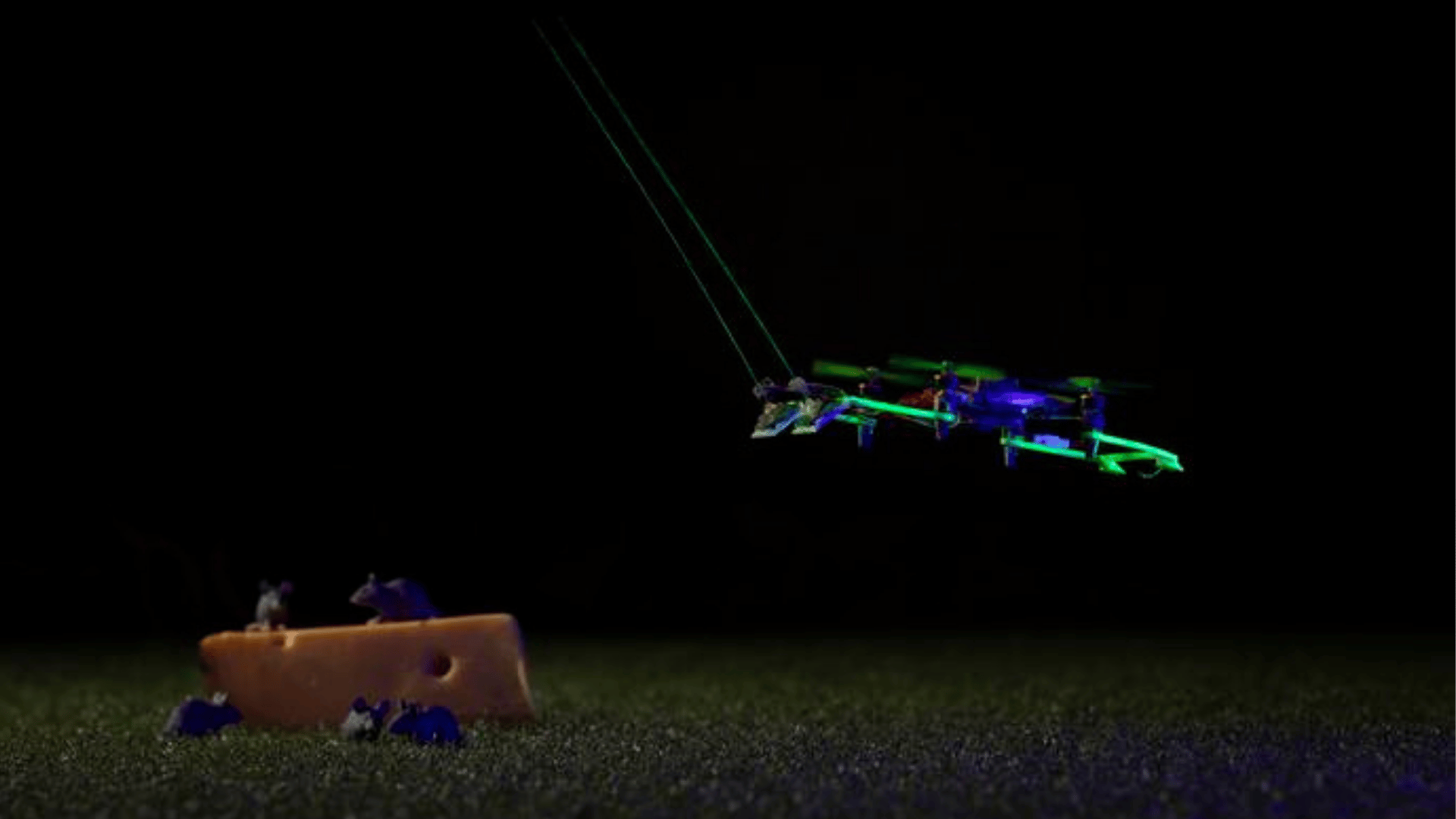
The team put a pair of artificial whiskers on the front of a small drone. Each whisker has three tiny pressure sensors at its base. When the drone bumps into a surface, the whisker bends. The sensors measure that bend to figure out exactly where the object is in three dimensions.
Advertisement
With these bio-whiskers, drones can avoid walls, follow surfaces, and map out an area by touching things.
“Here, we aim to equip drones with rich tactile sensing—not for manipulation in the air, but for a novel concept of tactile navigation: using touch to explore and fly through the unknown,” Dr. Hamaza, Associate Professor of Aerial Physical Interaction & Embodied Intelligence in Aerial robots at Delft University of Technology, explained. “But this comes with a challenge: for tactile sensing to work on drones, it needs to be lightweight, low-latency, and low-power. Inspired by nature, we found the answer in whiskers.”
Fixing the Wind Issue
One of the biggest challenges that the team ran into is how the propellers blow air around, easily tampering with the whisker sensors. To fix this, the team wrote onboard software that ignores the wind and only pays attention to real bumps, getting depth estimates down to the millimeter.
“We wanted to show that touch does not have to come at the cost of size or computational power,” Chaoxiang Ye from Delft University of Technology added. “Our entire tactile perception pipeline runs onboard using just 34 kilobytes of memory, allowing a tiny drone to sense and respond to its environment in real time.”
During tests, a drone flew in total darkness. It followed hard walls and soft surfaces, mapped out unknown rooms, and found the exit without using a single camera. Touch alone got the job done.
 Read Exclusive Stories
 Bookmark & Save Articles For Later