Researchers at North Carolina State University developed some interesting soft robots that jump when exposed to infrared light. These teardrop-shaped soft robots keep hopping as long as the light is shining on them. But why?
How the Robots Work
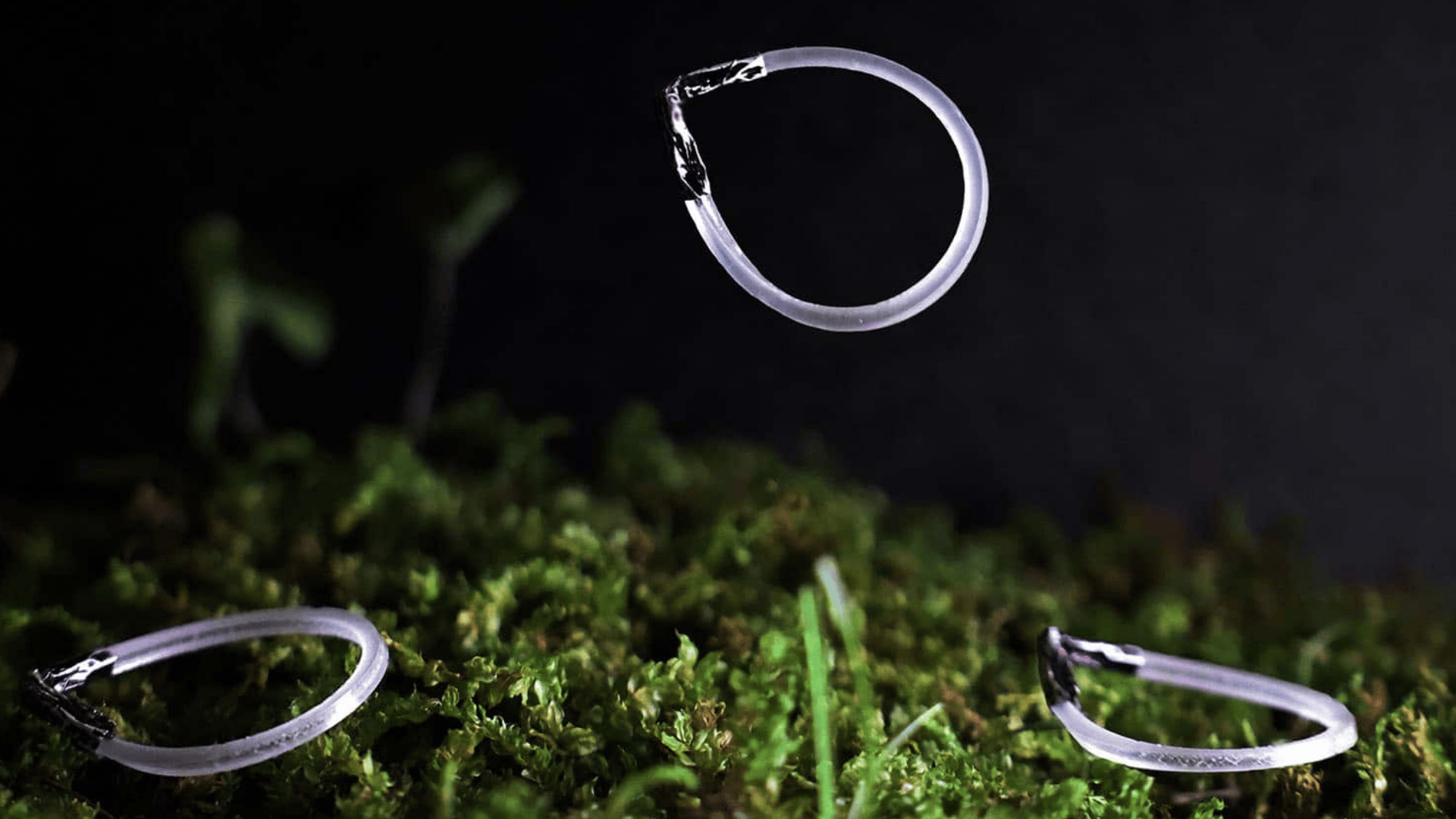
The robot is made of a liquid crystal elastomer, a stretchy polymer ribbon bent into a teardrop shape. At one end, there is a thin aluminum tube shaped like a V.
When infrared light hits the robot, the ribbon contracts and tries to rotate. The stiff aluminum V, however, stops it from rolling over. So, the ribbon twists tighter and tighter, building up energy until it hits a breaking point. Then, the V snaps down, hits the ground, and launches the whole robot into the air. Once it lands, it goes back to its normal shape and starts over.
“This ‘ring leaper’ design is very simple,” Jie Yin, a professor at NC State, explained. “We use torsion to store elastic energy and then release that energy all at once. And the nature of the design means that it does not need to be reset between jumps. It resets itself.”
Changing How it Moves
The team found they could change what the robot does simply by tweaking the V-shape.
Advertisement
“We found that we can control the nature of the robot’s movement by making minor design changes,” Fangjie Qi, a postdoctoral researcher, added. “If the V at one end of the teardrop is very wide – an angle of 120 degrees – the robot simply crawls forward. If you reduce the angle to 90 degrees, it jumps forward. And if you reduce the angle further to 50 degrees, the robot leaps vertically. In other words, a single geometric parameter determines whether it crawls, jumps forward, or leaps upward.”
The researchers found that adding weight adds to the robot’s jumping capabilities.
“We could also improve the robot’s jumping distance by adding a small amount of weight to the rounded end of the teardrop,” says Qi. “This changes the robot’s center of mass and leads to a more powerful and stable forward motion – much like a swimmer leaning forward as they dive off the starting block.”
According to the researchers, like weight, the intensity of the light is a significant factor.
“It has to be strong enough to induce the jumping behavior, but not too strong – because that can cause the robot to jump erratically and in unpredictable directions,” Qi explained.
So far, the robots can cross sand, mulch, grass, rocks, and hurdles. As of now, there is no commercial use for the robots, but they do demonstrate the capabilities of soft robotics.
Yin said, “There are no immediate applications for this work, but it’s a fundamental advance that is worth exploring for potential use in environmental navigation, swarm robotics, and unstructured terrain navigation.”
 Read Exclusive Stories
 Bookmark & Save Articles For Later