Flying “robots” come in different shapes and sizes, such as airplanes and drones. However, how these vessels fly relies on propellers or wings. Drones use propellers that enable them to hover, but it burns through its battery quickly. Fixed wings on airplanes are efficient, but it can’t hover.
Researchers from the Max Planck Institute for Intelligent Systems (MPI-IS) and the University of Stuttgart built a shape-changing robot named Floaty that does it all without these flying components.
A Robot Rides the Wind
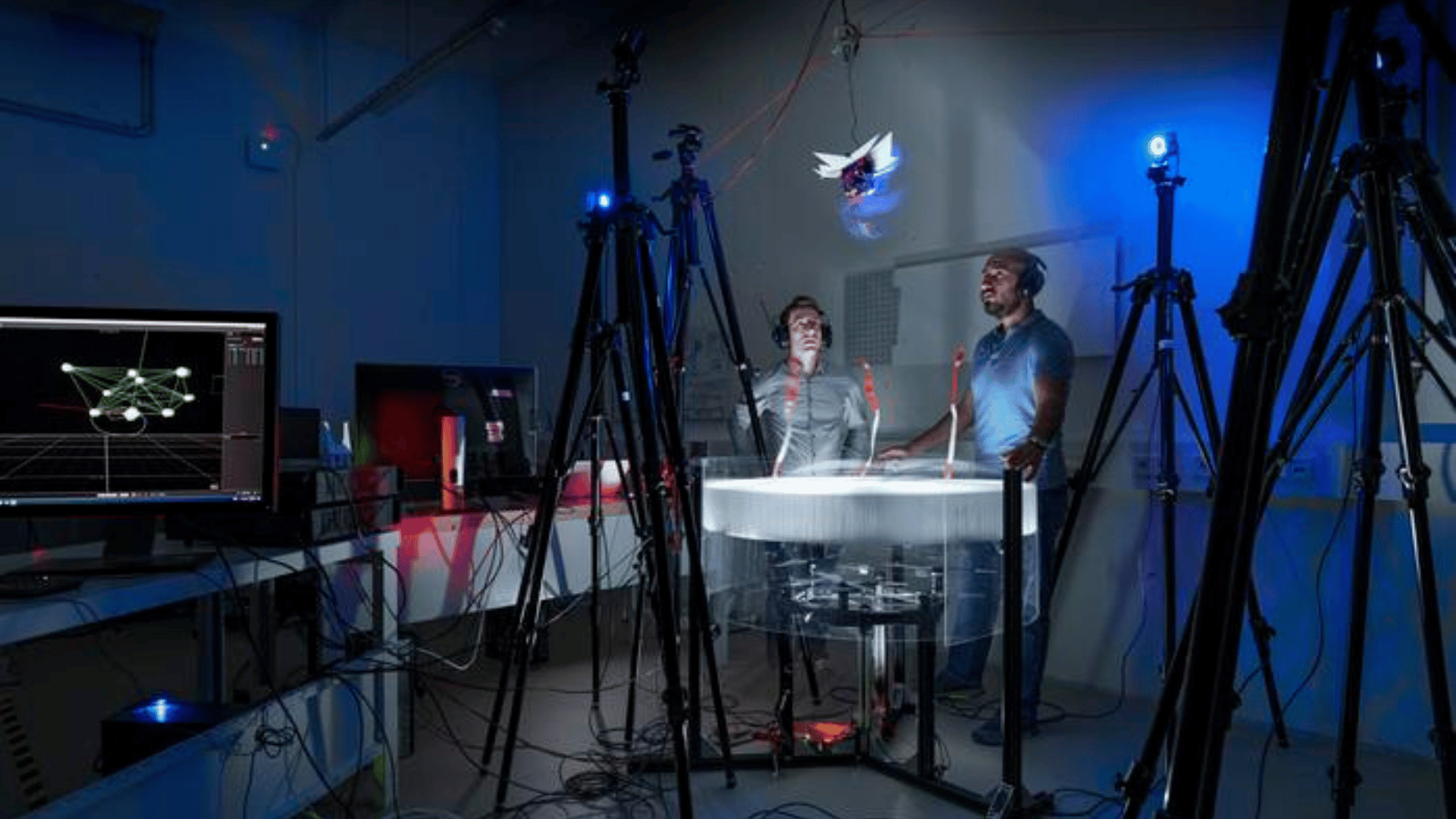
Instead of using propellers to fly, Floaty uses wind currents to stay airborne. The details of the design were published in npj Robotics on June 21, 2026.
During tests in a wind tunnel, the robot handled wind speeds up to 10 meters per second, or roughly 33 feet per second. Floaty takes advantage of fast-rising air from below and quickly moves four flaps on its top. By rotating these flaps, the robot changes its air resistance. This lets it balance and hover in place based on a learned aerodynamic model. It can even recover from being pushed sideways, all without needing a motor.
Advertisement
“We believe our work opens up new ways of building flying robots that are more efficient and more sustainable,” said Ghadeer Elmkaiel, who is first author of the publication and a Ph.D. student in the Learning and Dynamical Systems Group at MPI-IS. “Instead of relying on thrust-generating motors, Floaty shows that robots can ride the wind intelligently, just like birds – saving a lot of energy while still staying controllable.”
Fixing the Balance
Early on, the team of researchers ran into an issue. The original flat shape caused Floaty to tip over sideways instead of righting itself. To fix this, the researchers lowered the robot’s center of gravity and bent the rigid flaps. With these adjustments, Floaty now stays stable naturally and automatically corrects its balance in the air.
“Our Floaty robot could be useful in many real-world situations where there are updrafts,” said Michael Mühlebach, who leads the Learning and Dynamical Systems Group and who is co-author of the publication. “Floaty could inspect factory smokestacks where there is strong upward airflow. It could potentially work there with little modification.”
Mühlebach continued, “Similar technology could perhaps also help control rockets during re-entry, or it could help guide weather balloons. There are many ways in which the robot can take advantage of upward airflows to save energy.”
 Read Exclusive Stories
 Bookmark & Save Articles For Later