Industrial robots are getting stronger every day, and investors are pouring billions into the market. Funding jumped to $47.4 billion in the first half of the year, an 80 percent increase over last year.
Robots are moving past simple tasks like bolting and packing. Experts think the next big step is to put high-tech tools directly on the robot’s arm.
Take femtosecond lasers, for example. These tools use extremely short pulses of light to process materials without damaging nearby structures. They are great for delicate jobs in electronics, medicine, and semiconductors. But there is a catch.
Most femtosecond lasers are too big and complex to mount on a moving robotic arm. Nikolajus Gavrilinas, co-founder and CEO of LITILIT, notes that size is the main obstacle.
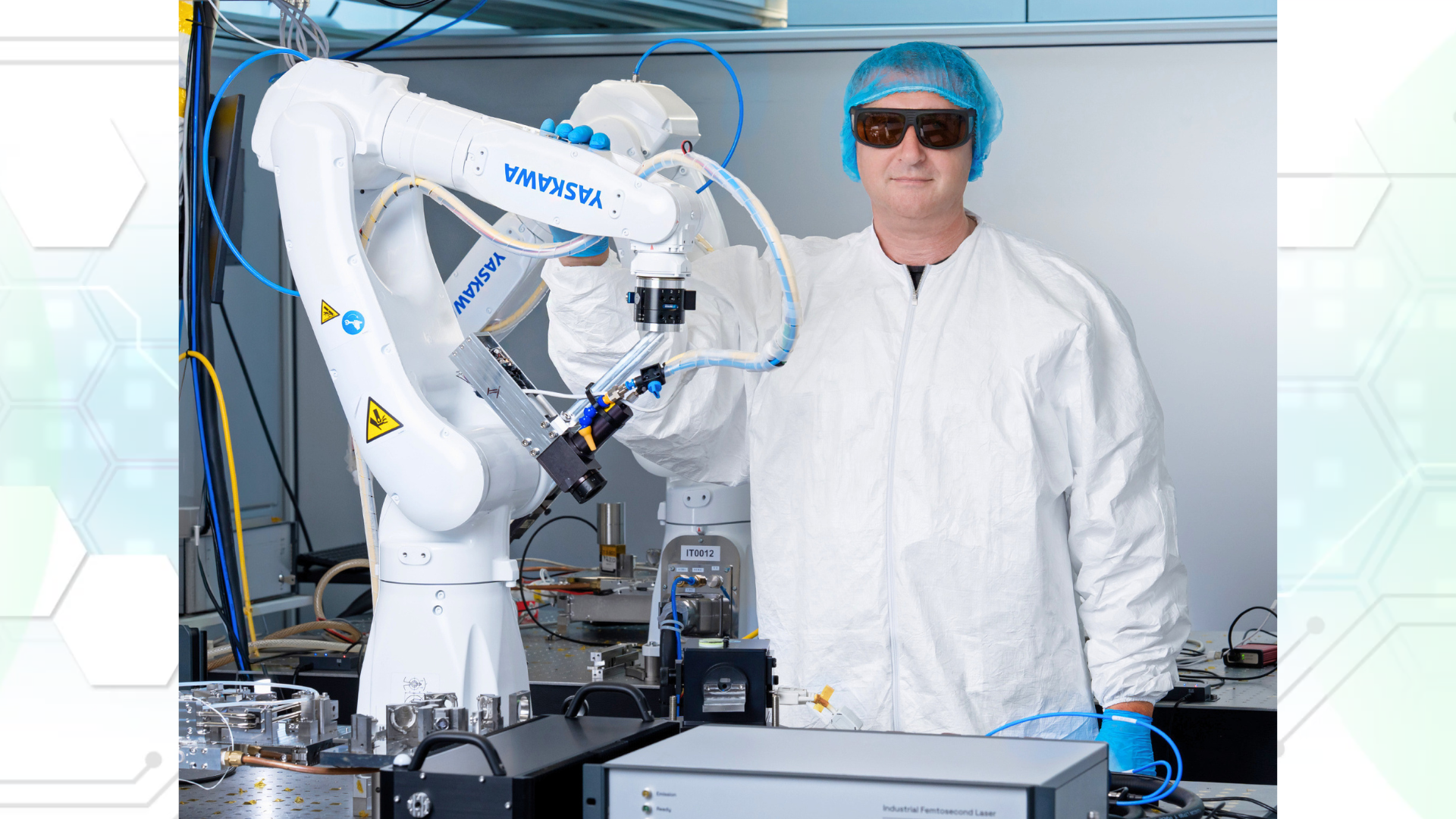
“Most femtosecond lasers historically came from scientific systems,” Gavrilinas explains. “They can deliver strong performance, but they are often large, complex, and require periodic maintenance.”
Trading Screwdrivers for Lasers on the Factory Floor
Advertisement
His team decided to build smaller lasers. LITILIT uses a modular design, automation, and reduced component complexity to shrink its units. Their lasers are 1.5 to 2 times smaller than those in a typical model.
“Our lasers use a modular design, a high level of automation, and reduced component complexity, making them compact enough for robotic integration and practical enough for industrial use,” Gavrilinas says.
Once you put a precision laser on a robot, the machine moves into a totally different category of work.
“Most industrial robots today are used with tools for gripping, screwdriving, bolting, drilling, packing, or similar tasks,” Gavrilinas notes. “Once you equip the same machine with an advanced laser, it can move into a different category of work: precision manufacturing.”
That means the machine can cut curved glass, drill tiny holes, and mark traceability codes on electric vehicle batteries with extreme accuracy.
To keep up with demand, LITILIT is opening a new factory in Vilnius this October. The company plans to scale up production to build up to 3,000 lasers a year. That volume will make it one of the largest femtosecond laser factories in the world.
 Read Exclusive Stories
 Bookmark & Save Articles For Later