Researchers launched a new battery production line at the Department of Energy’s Pacific Northwest National Laboratory (PNNL).
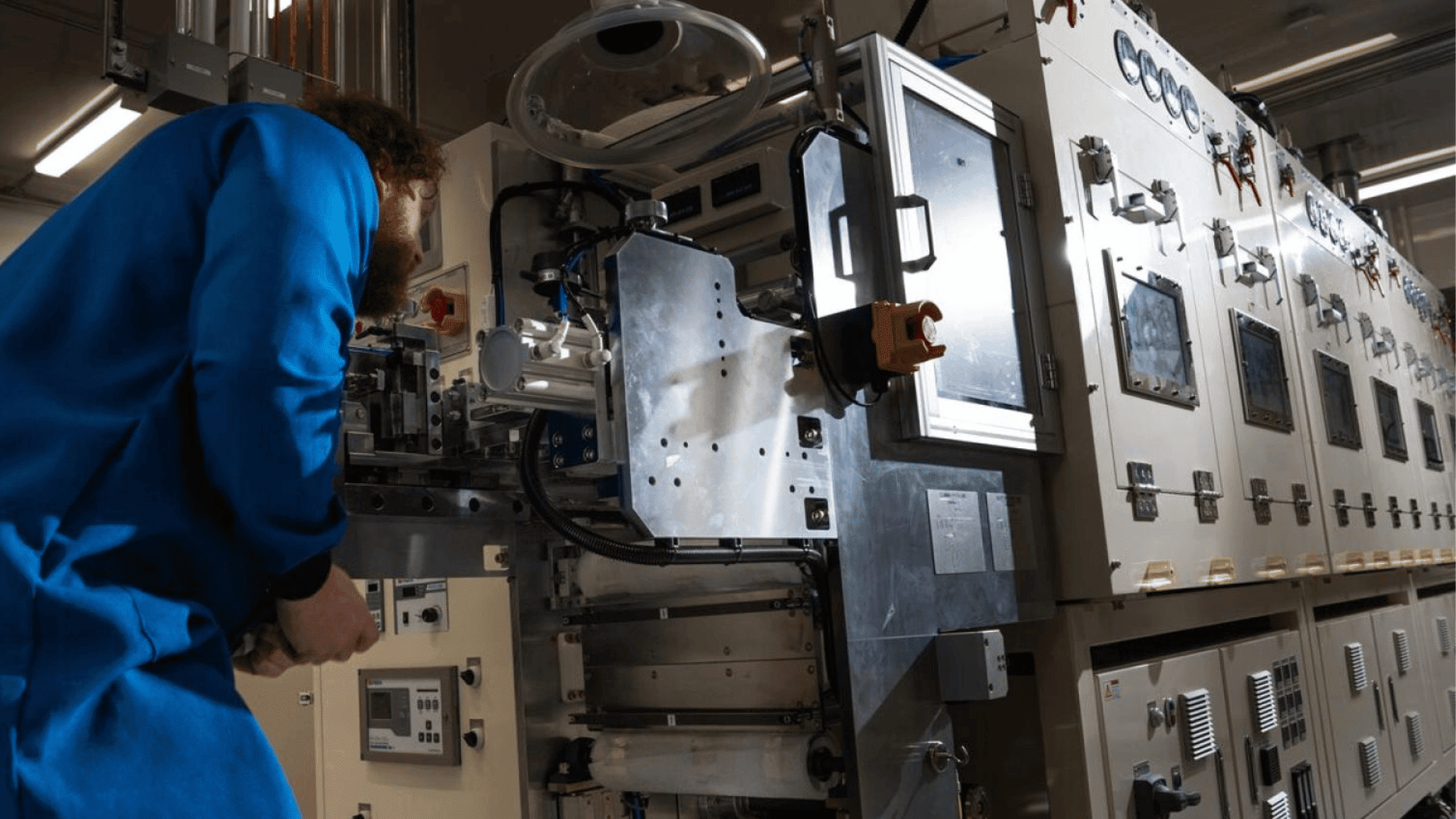
The new setup uses 16 pieces of equipment that fill a 1,400-square-foot lab to build a type of battery cell called a prismatic cell. This is a first for the national laboratories that will enable researchers to test new energy storage technology that could help run the power grid. Because even the smallest bit of water could damage a battery, the whole system sits in a dry lab where the humidity is lower than the driest places on Earth.
A Different Shape of Battery for More Energy
Batteries come in many shapes and sizes for different devices. For example, coin cells go into wristwatches, while pouch cells power electric drills. There are also cylindrical batteries, like the ones in your TV remote or electric cars.
But prismatic cells are gaining popularity for the grid because of its ability to stay cool in tight spaces. They are rectangular, like a large 9-volt battery that use a heavy metal casing that keeps them from overheating. Additionally, stack tightly, fitting more energy into a smaller space.
“With the new prismatic line, we can create, test and demonstrate real-world prismatic cells at an industrially relevant scale. This helps our researchers bridge the gap between science and industry,” said Adam Jivelekas, operations manager of DOE’s Grid Storage Launchpad. “We can help external researchers or industry partners test and validate their prismatic cell designs.”
Advertisement
Scaling Up the Science
The team is currently working with two battery types: sodium-ion and lithium-iron-phosphate. Both types of batteries use materials that are easy to find and safer than traditional options.
“If you have better heat transport, if the cells are more mechanically uniform, if they’re packed more efficiently, all those things can translate to not just higher safety, but lower cost.” Mark Weller, a materials scientist at PNNL, explained.
Moving from small to large batteries is challenging because it’s not a “one size fits all” kind of deal. “Making a coin cell takes a few milligrams of material; making a prismatic cell takes at least a kilogram,” Weller added. “When you scale up like that, you can’t assume that a chemistry that worked well in a coin cell will work just as well in a prismatic cell.”
The team will test these cells to set a baseline for future partners. “Because of the benefits of the prismatic cell design and the categorically larger scale of cell fabrication and testing, we see PNNL’s prismatic line as a unique way to bridge the gap between new battery concepts and prospective industry partners. With this capability, we can do the research and development and pilot-scale testing that is difficult for companies to justify and help facilitate a smoother handoff to get advanced battery concepts to market,” Weller said.
Now that the line is running, the lab hopes to work with private companies to test their own battery ideas.
 Read Exclusive Stories
 Bookmark & Save Articles For Later