3D printing is becoming so advanced that you could practically print anything. It’s used to make something as advanced as rocket parts, or something as simple as a desk accessory. For sustainability’s sake, people enjoy the ability to recycle the plastic into new prints.
However, the highest-quality 3D printing method, called stereolithography, makes incredibly precise structures by using ultraviolet light to harden liquid resin. This light permanently changes the chemical bonds. Once it is printed, you cannot melt it down or reuse it. As a result, it becomes useless waste.
Recycling Resin For Sustainable 3D Printing
A research team at Yokohama National University decided to create a new kind of resin that can be printed, melted down, and printed again. The team published their results in the journal ACS Omega.
“Photocured 3D models cannot be recycled, so there are concerns about the negative environmental impact of discarding 3D-printed resin parts,” said Shoji Maruo, a professor at Yokohama National University. “Research into reusable photocurable resins is progressing, but conventional resins form irreversible cross-linked networks.
Maruo added, “As a result, previously proposed ‘recyclable’ resins either require the addition of chemical additives for reuse or rapidly degrade after one or a few reuse cycles.”
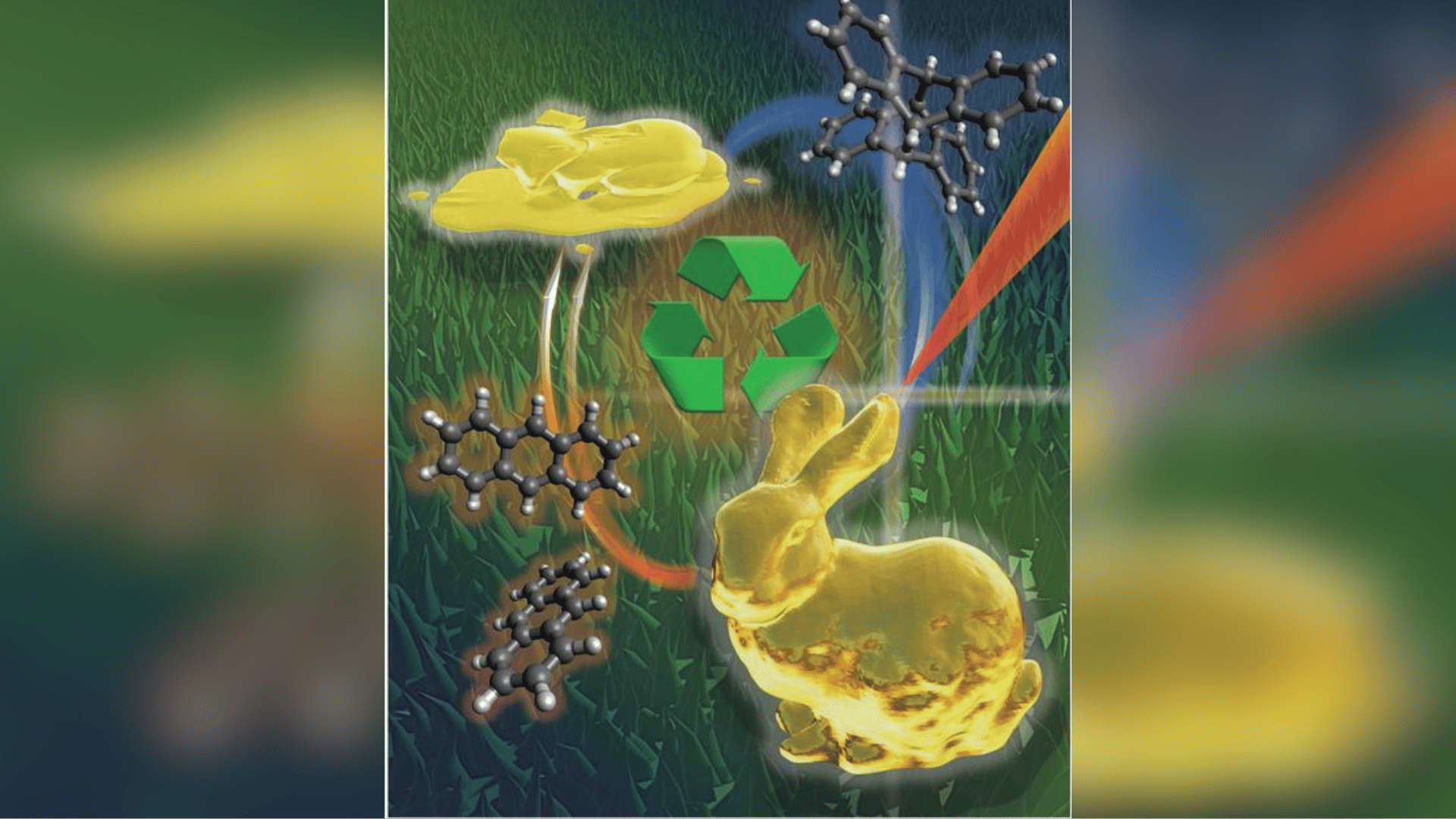
To solve this, the team used a chemical called anthracene. When light shines on it, the molecules bond together to form a solid 3D shape. But when you heat it up, those bonds break, and it turns back into a liquid.
“We found that the reversible photodimerization reaction of anthracene could be a practical method for developing a truly reusable resin free from initiators, or chemicals used to induce a reaction, that can maintain performance through multiple recycling cycles while supporting high-precision stereolithography,” Maruo said.
Advertisement
Printing and Erasing 10 Times
Most recyclable resins need extra chemicals to trigger the hardening process. This new resin does not need them, which keeps the material pure and prevents it from wearing out quickly.
To test it, the team printed a tiny cube, heated it to 150 degrees Celsius for 15 minutes, and turned it into a disc. In addition, the team printed letters, melted them down, and reprinted new ones 10 times in a row with very little damage to the plastic.
“These results demonstrate that the recyclable resin can be precisely patterned in arbitrary shapes using laser scanning, confirming its suitability for two-photon lithography,” said Masaru Mukai, an assistant professor who worked on the study.
The team also successfully printed a detailed butterfly shape to show that the new resin works just as well as standard, non-recyclable options.
“Reversible photodimerization of anthracene provides a practical route toward recyclable materials for light‑based 3D printing,” Mukai said. “By using an initiator‑free, step‑growth mechanism, we show that a photocurable resin can be recycled multiple times with comparatively small changes in material performance, while remaining compatible with both two‑photon and single‑photon stereolithography.
Mukai concluded, “Our results indicate that reusability and high‑precision fabrication can be combined more effectively than in previously reported recyclable resins.”
Next, they plan to test this resin on larger 3D printers and make the material even more stable for long-term use.
 Read Exclusive Stories
 Bookmark & Save Articles For Later