In a new study in the journal Science, researchers are presenting evidence of an ancient colossal octopus similar to the Kraken legend, which they believe to be the largest invertebrate ever described.
Giant Kranken in Ancient Oceans
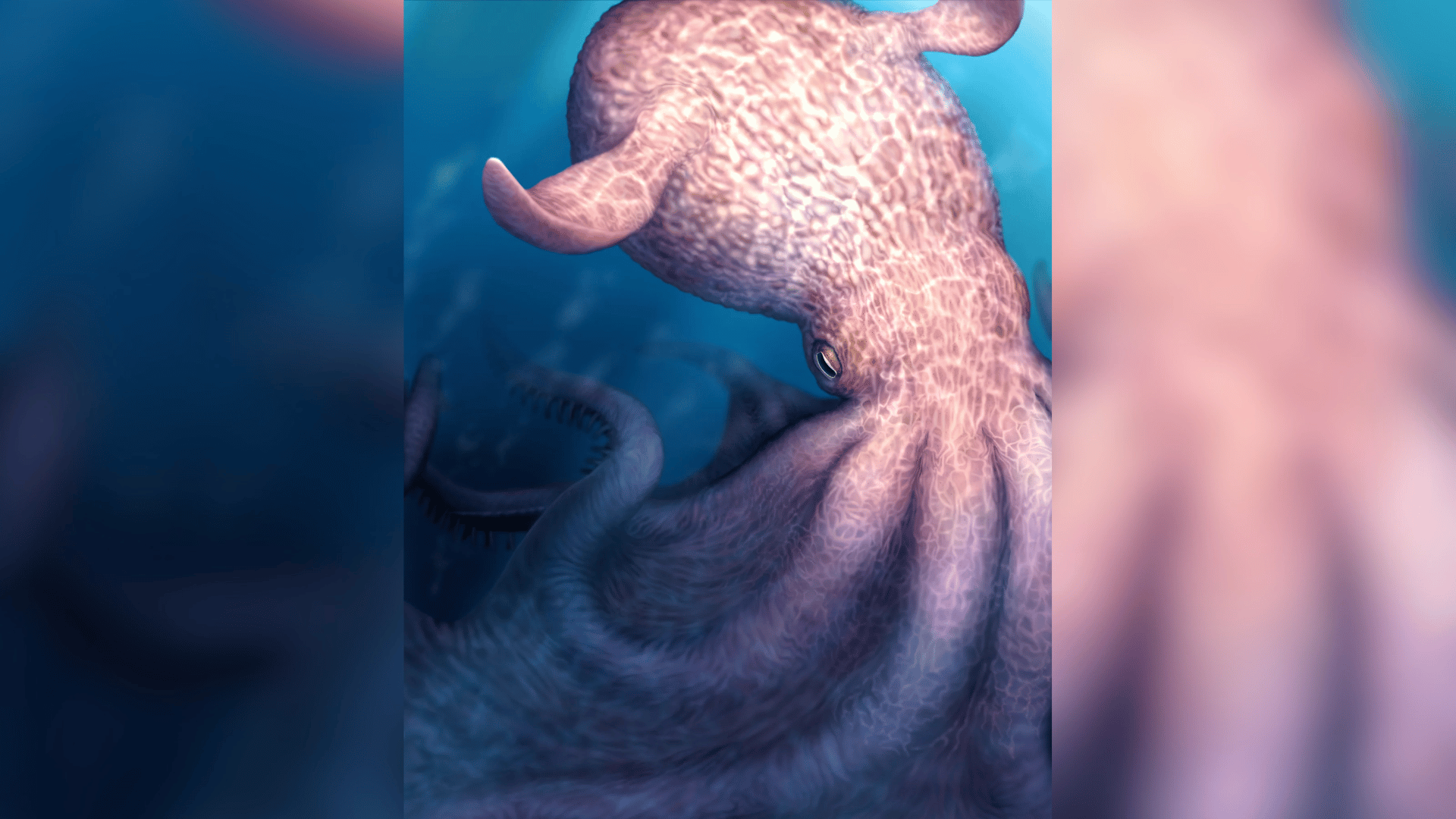
During the late Cretaceous period, approximately one hundred million years ago, there were large sea creatures filling the oceans, including the mosasaur and large sharks. Researchers used fossil reconstruction techniques to reveal the remnants of two extinct species trapped within large rocks.
Compared to the Kraken legend, the creature appears to have been approximately 60 feet long, which is longer than an average school bus.
“I wasn’t expecting any octopus of this magnitude at all,” stated Fernando Ángel Fernández-Álvarez, a zoologist at the Spanish Institute of Oceanography who wasn’t involved in the study. “And we now have the proof that they were living in the past.”
Advertisement
The study also revealed that the creatures likely ate prey items like lobster and shrimp and favored one side of their jaws. This finding is particularly exciting because octopuses don’t generally preserve well since they’re made up almost entirely of soft tissue, rather than bones.
“There are very few, very rare records about the octopus and their evolution,” says Jörg Mutterlose, a paleontologist at Ruhr University Bochum in Germany and one of the researchers.
It was around a decade ago when Yasuhiro Iba, a paleontologist at Hokkaido University and lead author on the new publication, originally approached Mutterlose with the idea of examining the fossilized contents of rocks called concretions that formed on the seafloor around 100 million years ago in northern Japan.
“We thought there was a real possibility that octopus remains might also be hidden inside them,” says Iba, “even if nothing was visible from the outside.”
They used a new technique called digital fossil mining in which they cut the concretions into thin slices, took pictures of any preserved fossils, and created 3D reconstructions using an AI model.
“I already thought octopuses were extraordinary animals,” says Yasuhiro Iba, a paleontologist at Hokkaido University and lead author on the new publication. “But this study made me feel even more strongly that their uniqueness has deep evolutionary roots.”
 Read Exclusive Stories
 Bookmark & Save Articles For Later