Researchers at Washington State University have created an electronic skin that can sense pressure and temperature. This could eventually help amputees actually feel what they touch with their prosthetics. According to the researchers, it works at a scale ten times finer than the glove sensors you can buy today.
Right now, the electronic skins available are expensive. They also have low sensing resolution and usually don’t fit people very well. Often, when these skins are custom-shaped for a person, their sensing ability actually worsens. Plus, the huge amount of data they generate means they tend to lag and don’t work well in real time.
“Often these devices are forced to compromise between comfort and mechanical reliability,” said Hongyi Shen, a WSU graduate student and the paper’s first author.
A Custom Fit Made Simple
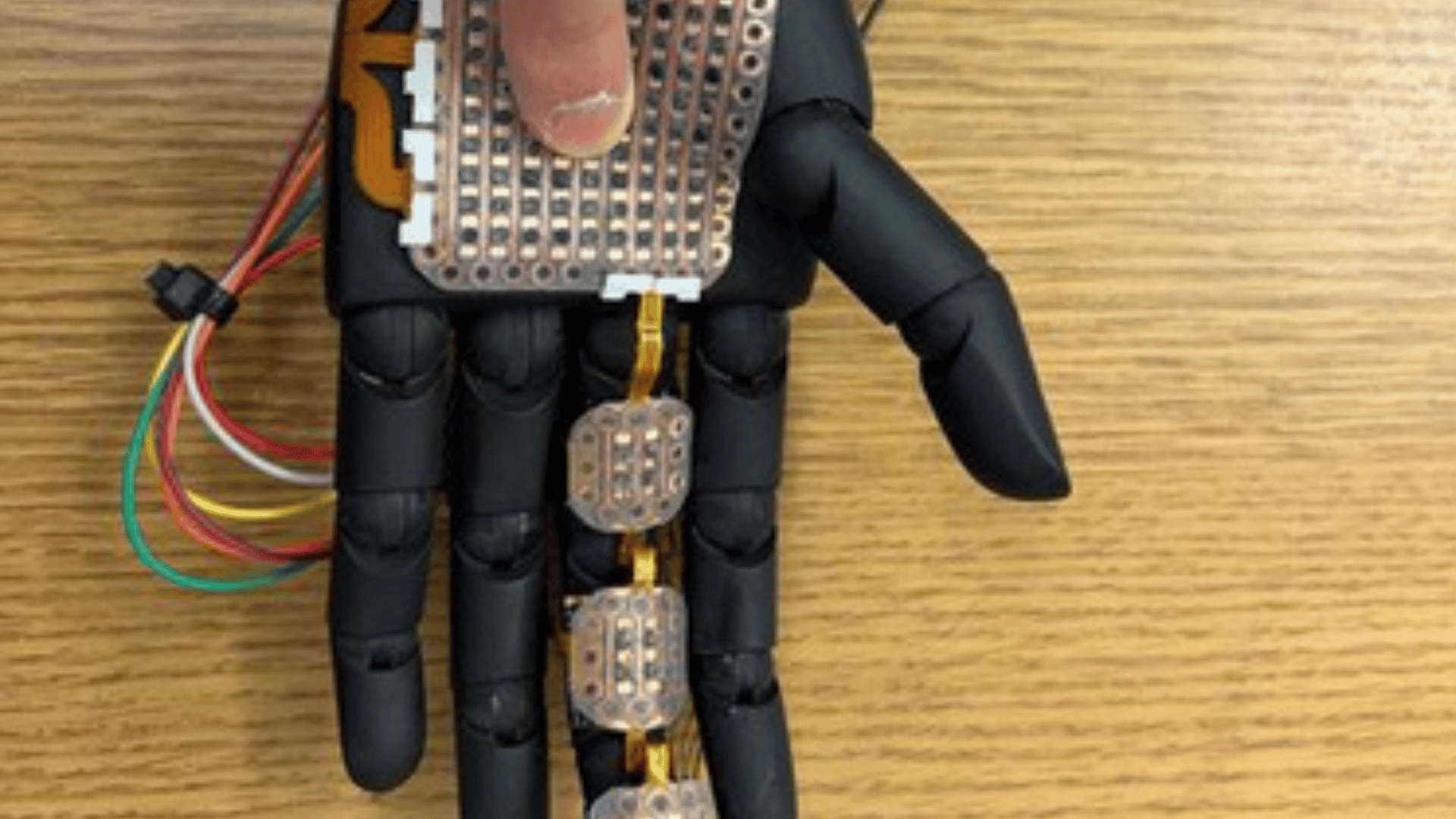
To fix this problem, the team made a sensing system that actually fits the unique, freeform shapes of different limbs. The sensor modules are built like thin sandwiches. They contain temperature and pressure sensors that enable the skin to reliably identify textures and materials, much like real human skin.
The researchers used a simple “scan-model-print” method to build the skin. They 3D print and laser cut the materials, and the sensor modules snap together like Legos without needing adhesives.
Advertisement
“The scanner basically scans the prosthetic and then, based on the geometry, we map our sensors as a multimodal sensing system with that geometry,” said Kaiyan Qiu, an assistant professor at WSU and corresponding author on the paper. “This enables our sensing system to have seamless coverage over the freeform region on the prosthetics.”
Because the manufacturing process relies on standard tools, it stays practical.
“Our main manufacturing method using 3D printing and laser cutting is relatively simple, so that it could be relatively low cost and convenient,” said Qiu.
The Future of Electronic Skin
This is just a first step, and the team has already submitted an invention disclosure for a provisional patent. Next, they are working on an actuator. This part would take the signals from the e-skin and convert them into stimulation for nearby nerves, letting the user know exactly what they are touching.
“This approach democratizes the production of medical-grade e-skins, making advanced tactile feedback viable for widespread clinical adoption,” said Shen. “This work lays a crucial foundation for a full bionic skin with both sensing and haptic stimulation functions on prosthetics.”
 Read Exclusive Stories
 Bookmark & Save Articles For Later