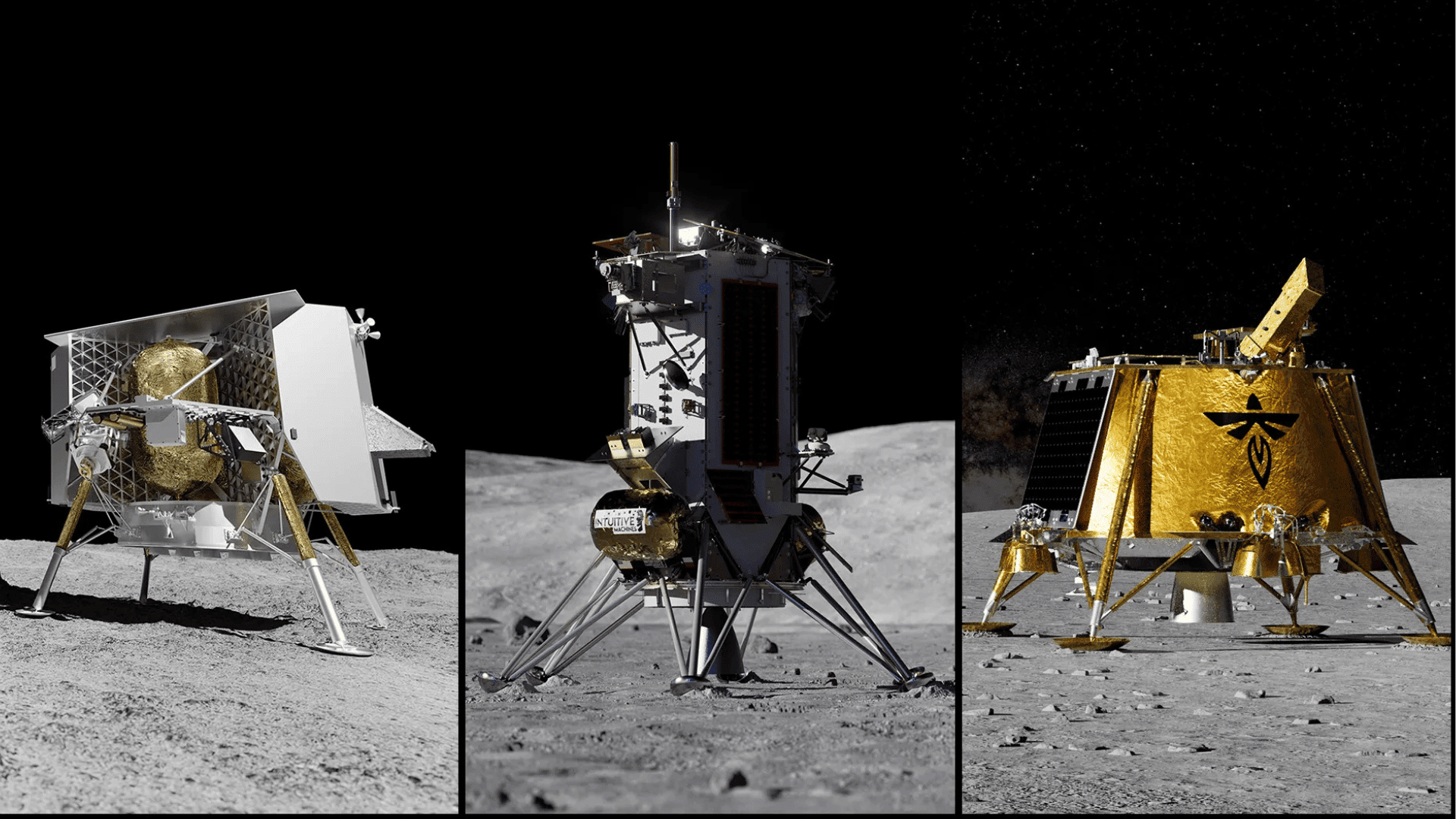
NASA picked three companies to run four new moon landings in late 2028. Astrobotic, Firefly Aerospace, and Intuitive Machines are getting nearly $600 million combined to deliver science payloads and help build NASA’s Moon Base.
Astrobotic gets $297.9 million for two deliveries. Firefly gets $144.2 million for one, and Intuitive Machines gets $148.3 million for another. They will all use updated versions of landers that have already flown.
Lori Glaze, associate administrator for the Human Spaceflight Mission Directorate, explained, “These new awards to our commercial partners, totaling nearly $600 million to land more missions on the Moon with science payloads, demonstrate our commitment to accelerating our effort to build a long-term presence on the lunar surface, and give us more opportunity to develop the skills we need to prosper there.”
Getting the Tools to the Moon
Each delivery will carry three specific tools to the lunar surface.
First is SCALPSS, a set of four cameras that takes 3D pictures of the dust kicked up by engine exhaust when a ship lands. This helps NASA predict erosion so bigger ships can safely land near each other later.
Advertisement
The LRA is a passive, cookie-sized device that reflects laser beams to help future spacecraft navigate without power or maintenance.
Finally, they are sending LETS, a tiny sensor that measures space radiation. This is important to NASA because the agency needs detailed radiation data to design safer missions and protect astronauts.
“By flying the same science instruments on multiple landers, we will better understand potential hazards during landing and build out a global network of environmental data and location markers on the Moon,” Joel Kearns, deputy associate administrator for exploration, said. “It’s akin to having weather stations in different locations on Earth. These three payloads are flight-proven and their data is critical to supporting safe human exploration of the lunar surface.”
Looking Forward
NASA is also looking at sending a rover called PROMISE, a hybrid based on the Mars Curiosity and Perseverance rovers, meant to map the area and look for resources. Soon, NASA will also ask for proposals for new technology, like a South Pole camera and a lunar communication network.
“We’re building a proving ground for Moon Base operations,” said Ryan Stephan, NASA’s Moon Base acting director of cargo landers. “Accelerating our Moon mission ordering cadence and launch opportunities enable us to move quickly to learn, iterate, and improve.”
 Read Exclusive Stories
 Bookmark & Save Articles For Later