Hyundai Motor Group recently shared a look at its new Unmanned Firefighting Robot in a video titled “A Safer Way Home.” While the name might sound like something out of a sci-fi movie, the tech is already taking on real-world tests.
The robot is a joint project between Hyundai, Kia, Hyundai Rotem, Hyundai Mobis, and the National Fire Agency. The goal is to send a machine into places that are too dangerous for people, especially to spots with extreme heat, toxic gas, or a high risk of explosions.
A Robot Built for the Heat
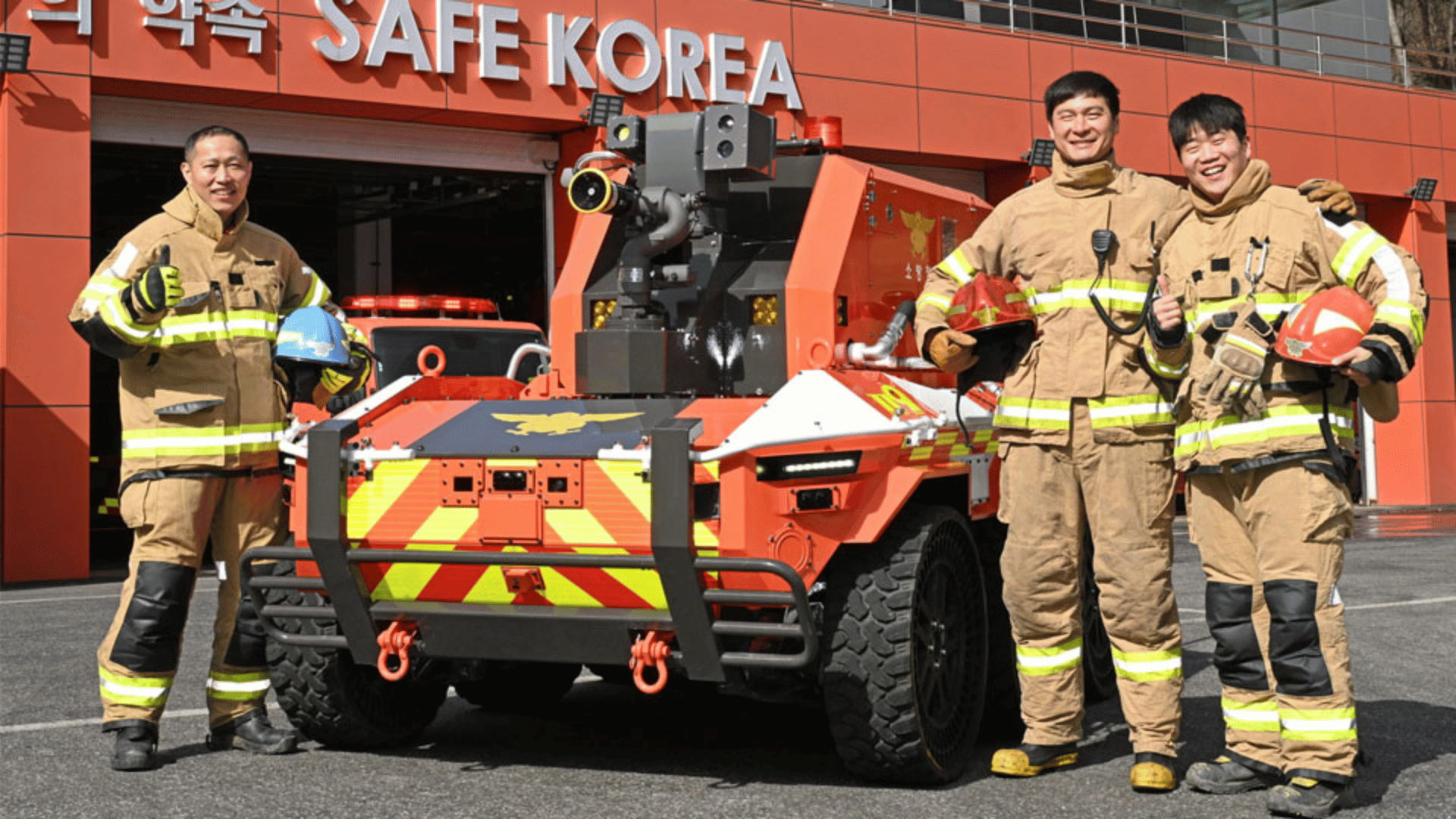
The firefighting robot is based on a military vehicle called the “HR-SHERPA” and can handle temperatures up to 1,472 degrees Fahrenheit (800 degrees Celsius). To keep its internal electronics from melting, it actually uses a self-spraying water system to cool itself down while it works.
Thanks to a six-wheel motor system, it can spin 360 degrees in one spot, climb steep ramps, and crawl over curbs or barriers. To help firefighters see through thick smoke, it uses thermal imaging cameras that send a clear video feed back to the team. It also has a glowing hose that lights up in the dark, giving human crews a literal lifeline to follow if they need to find their way out of a dark building.
Advertisement
A New Partner for Firefighters
Right now, a person still operates the robot remotely, but the long-term plan is for the robot to learn from every fire it encounters. By analyzing data like smoke density and temperature, it could eventually decide the best way to put out a fire on its own.
“The true value of this robot is not merely its heat resistance or fire suppression power, but its role as a ‘Physical AI’ that operates in actual disaster sites,” Seung-ryong Kim, Acting Commissioner of the National Fire Agency, explained. “In extreme environments where firefighters cannot enter, it will collect and learn from real-world operational data to develop into a sophisticated disaster response platform.
“This will usher in an era of hybrid convergence where humans and robots overcome their respective limitations, marking a ‘paradigm shift for AI in firefighting,’” Kim added.
For now, the robot acts as a high-tech scout and first responder, keeping human firefighters a safe distance away from the most dangerous parts of the job.
Would you like me to find more examples of how this “HR-SHERPA” platform is being used in other industries?