Paul Buxton, a 62-year-old living in Gibraltar, was originally supposed to travel 1,500 miles for a surgery after he was diagnosed with prostate cancer in January. However, instead of boarding a plane to London, Buxton stayed at home.
On March 4th, Professor Prokar Dasgupta sat in London and performed a prostatectomy on Buxton, who was lying in a surgical suite at St. Bernard’s Hospital in Gibraltar. Using the Toumai Robotic System by Microport, the professor guided the tools in real-time from a different country.
Staying Home for Better Care
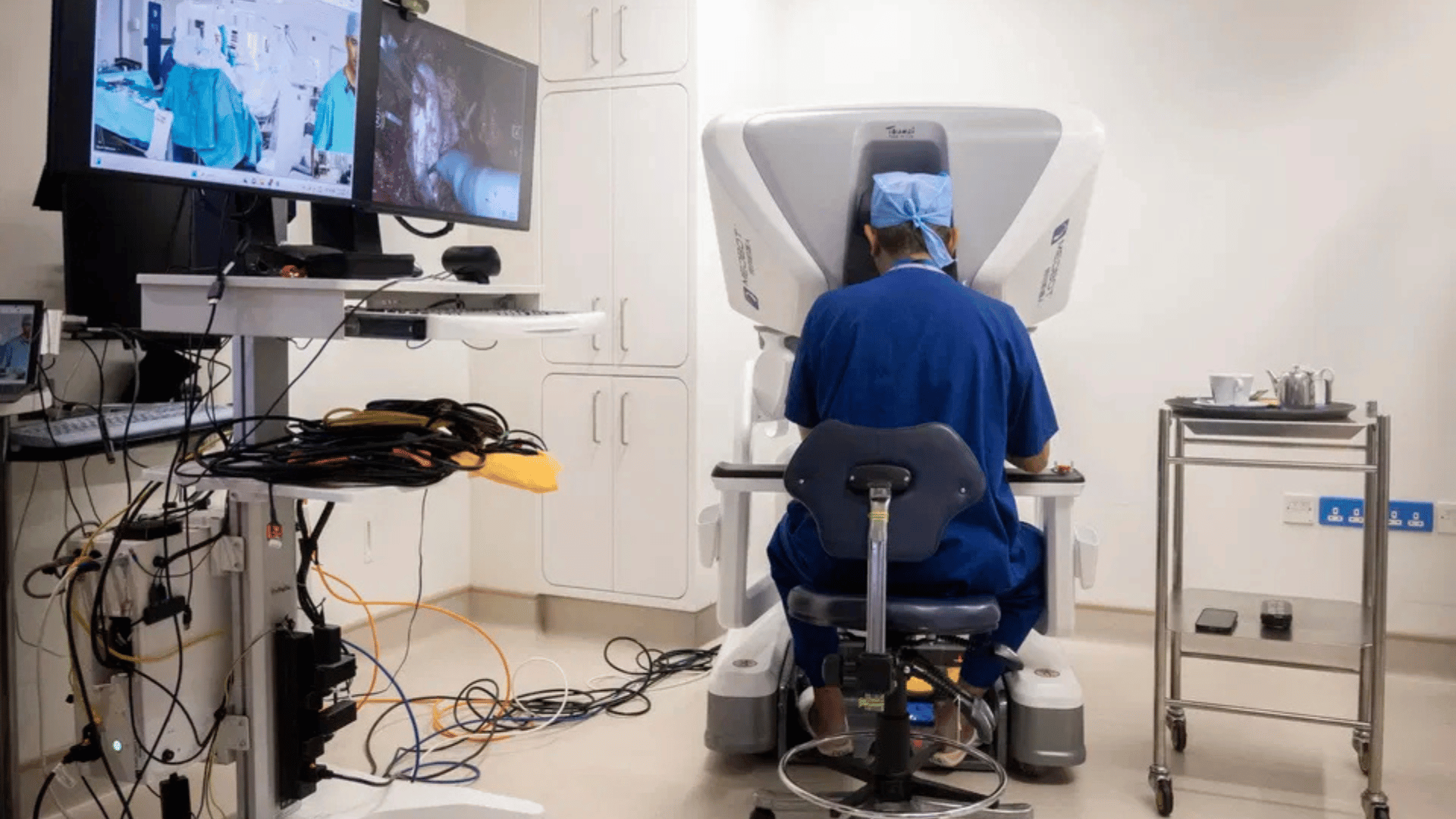
The two locations were connected by a high-performance network built by a company called Presidio. To make the procedure safer, the connection had to be incredibly fast. The delay between the doctor’s hand moving in London and the robot moving in Gibraltar was 48 milliseconds, which is faster than the blink of an eye.
Professor Dasgupta, who leads the Robotic Centre of Excellence at The London Clinic, saw no reason for his patient to travel if the tech could bridge the gap.
Advertisement
“I explained to Mr Buxton that we now have the technology to perform this remotely. Why waste time, energy, money and inconvenience to fly over? I stay in London, he stays in Gibraltar,” said Professor Dasgupta. “It is very exciting to be part of this UK first telesurgery, a first for the UK and The London Clinic and St Bernard’s Hospital in Gibraltar.”
The Future of Telesurgery
The success of the procedure, which was a collaboration with surgeons James Allen and Paul Hughes in Gibraltar, shows that distance might not be the barrier it used to be. For Buxton, being the first person in the UK and Gibraltar to undergo this trial was an honor. He said that he felt “privileged to be part of medical history.”
“The London Clinic is proud to be part of medical history and we have a strong reputation for medical firsts. Congratulations to Professor Dasgupta and the Gibraltar Health Authority and Dr Allan and his team at St Bernard’s,” Al Russell, Chief Executive at The London Clinic. “We hope more patients will be able to benefit from this incredible medical breakthrough.”
On March 14th, they plan to live-stream another telesurgery procedure to an audience of 20,000 surgeons to show exactly how it’s done.