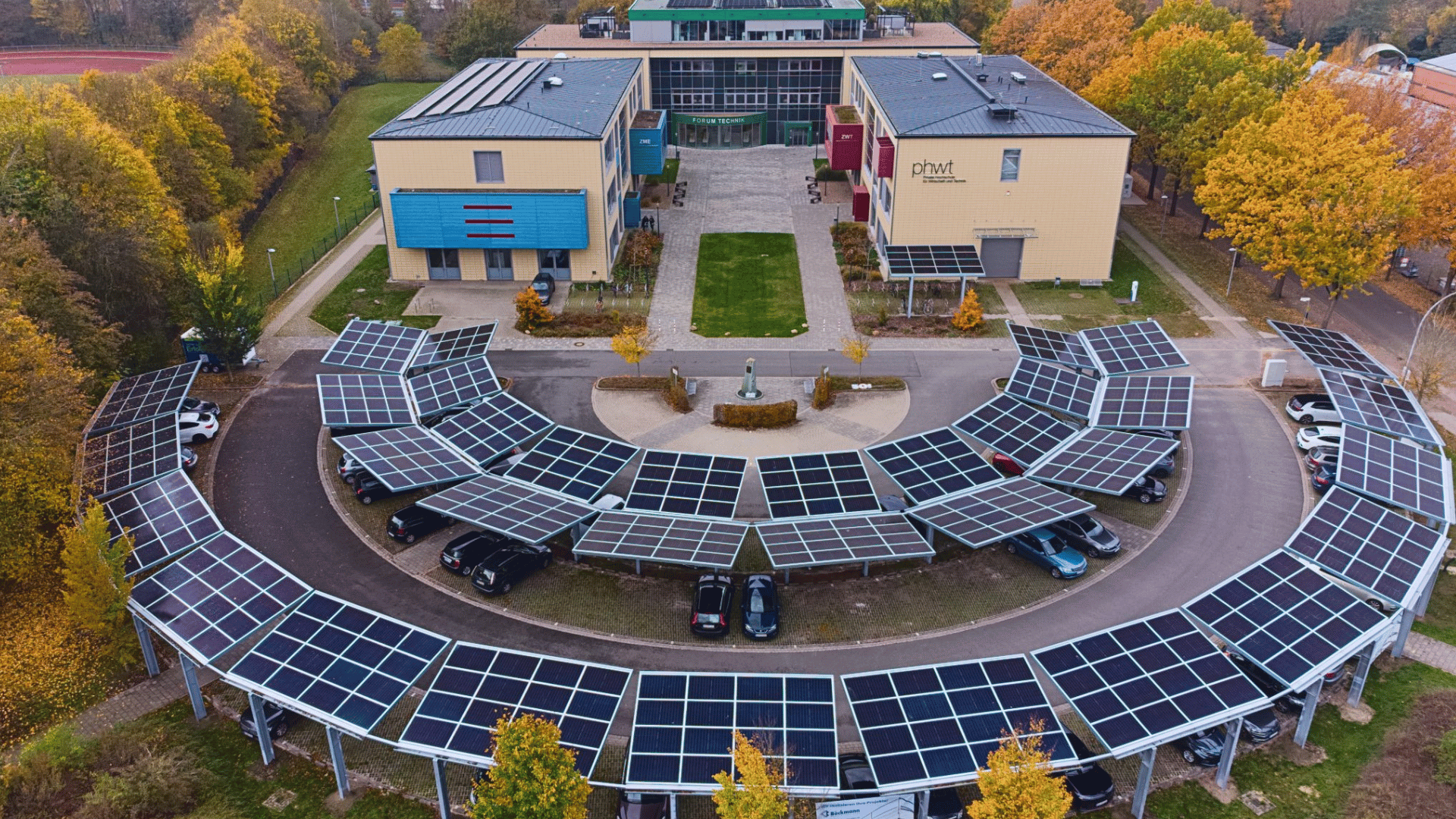
The Private University of Applied Sciences for Economics and Technology (PHWT) in Diepholz, Germany, has a parking lot that now generates power. The school officially opened a new solar carport system that covers 90 parking spaces and a 20-bike shelter.
The lot itself has a unique layout that’s arranged in a semicircle with two rows of spaces. Instead of fighting it, the school built around it. Southern German company PfefferKnecht, working under its LICHTKRAFT brand, designed a special metal structure to fit the semicircle. Local partner Böckmann handled the construction.
Overhead, glass-glass solar panels cover about 1,150 square meters. The panels act as a seamless, waterproof roof, so builders did not need a separate roof membrane. Built-in LED strips also keep the spaces lit. Together, the carports and bike shelter produce around 237 kWp of solar power.
Solar Power and Energy Storage
The university also needed a way to store the generated power. Additionally, they skipped standard lithium-ion batteries. Instead, PHWT installed the first sodium-ion battery storage system in Lower Saxony, and only the third in all of Germany.
Advertisement
The setup uses two storage cabinets from PHENOGY, offering 200 kWh of storage capacity, allowing the campus to save its own solar energy to use later during peak hours, cutting down on expensive grid electricity.
Sodium-ion batteries rely on common salt found in Germany. They do not need lithium, graphite, or cobalt, so the batteries are almost non-flammable and handle extreme heat and cold without losing performance.
A 10-Week Construction Sprint
The idea started with PHWT President Prof. Dr. Dennis De and PfefferKnecht Managing Director Andreas Knecht. Getting permits and planning took 18 months, helped along by the City of Diepholz’s Building Authority. Once approved, crews had to work quickly. They finished the foundation work, steel frames, solar roofs, and tech setup in just ten weeks during the semester break so spots were ready for returning students.
The new system joins an existing ice storage system that already heats and cools the campus.
 Read Exclusive Stories
 Bookmark & Save Articles For Later