When you flip your holiday wreath over, you’ll notice what’s actually doing the job. There’s a wire around the stems, a base below the greens, and a row of small bundles all going in the same direction. From the front, it almost looks like one big circle. But when you look from the back, you can see where each bundle starts.
A Frame That Holds Its Shape
Instead of using a single piece of wire formed into a frame, the crafter can use multiple rings connected with short pieces of wire to create a wreath. Using multiple rings gives the crafter more area to tie onto and helps the frame maintain its shape as bundles are added.
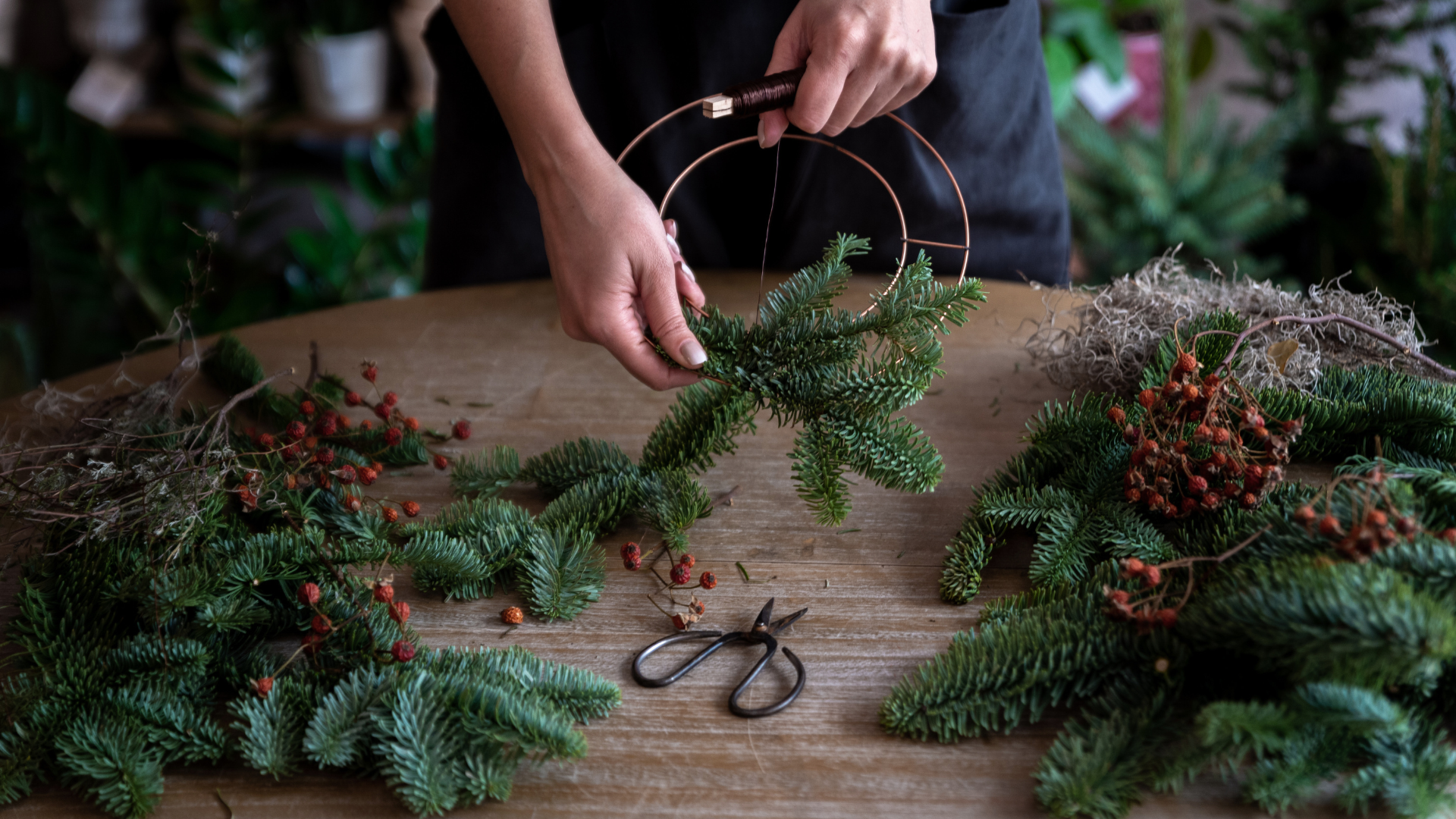
It’s important to note that some frames can be wide or narrow. If the frame is wide, there will be more need for greens to cover it. In contrast, if the frame is narrow and flexible, it can become an oval when enough branches are added to its weight.
Before placing any bundles on the frame, the crafter will attach a spool of wire to it. As the wreath is constructed, this wire will remain attached to the spool, allowing the crafter to place one bundle and then move on to the next without having to cut a new piece of wire each time.
Choosing Greens Based on Texture and Shape
Advertisement
Depending on the type of green being used, some will sit differently on the frame. For example, fir can provide each bundle with some “structure.” Other greens, like cedar, will drape to create a softer overall look, while pine will have longer needles than shorter ones. One option would be to use fir for every bundle and then add some pine or cedar on top. By using the same base, the frame can still appear uniform despite different textures.

Aside from choosing what greens to use, the size of the bundles is also important. Using only small bundles at the beginning, then larger ones later, will make one half of the wreath appear fuller than the other. By having an additional bundle on the table for reference, the crafter will have something to compare every handful against.
Overlapping Bundles to Conceal the Wire
For the first bundle, the wire will be wrapped around both the end of the bundle and around the frame directly below. The following bundle will be slightly farther along the frame, so it will overhang the stems and wire of the bundle before it. Each bundle will conceal the wire of the bundle in front of it.

The final bundle to add is the most challenging because the stems will be placed beneath the first bundle so no one can see a “patch.” After tying off the final bundle, the wreath can be picked up and held upright to examine any part that may appear too thin or have a sprig extending out. At this point, a minor adjustment can make the circle appear uniform when it is eventually hung on the door.
 Read Exclusive Stories
 Bookmark & Save Articles For Later