Pennsylvania officially put its name in the hat to become the home of the nation’s newest service academy. State leaders, Penn State University, the Keystone Space Collaborative, and Pittsburgh International Airport submitted a formal proposal to host the permanent United States Space Academy (USSA) in Southwestern Pennsylvania.
If selected, the USSA would be the first new U.S. service academy since 1955. The state is backing the pitch with $285 million, including $85 million in state funds for construction and transit, plus a planned $200 million private endowment.
“The Commonwealth of Pennsylvania powered the first industrial revolution nearly 200 years ago and made the arsenal of democracy the most powerful manufacturing base in the world. Pennsylvania is now uniquely positioned to welcome the United States Space Academy – building off our robust space industry and world-class research universities – to launch the next generation of America’s scientists, engineers, astronauts, and servicemembers and ensure America remains the global leader in space,” said Governor Josh Shapiro. “Pennsylvania’s application provides the federal government with an opportunity to strengthen and diversify America’s space industry.”
The governor added, “My Administration is all in and we’ve assembled a bipartisan team of Pennsylvania leaders who are committed to the Space Academy’s success here in our Commonwealth.”
A Two-Step Campus Plan
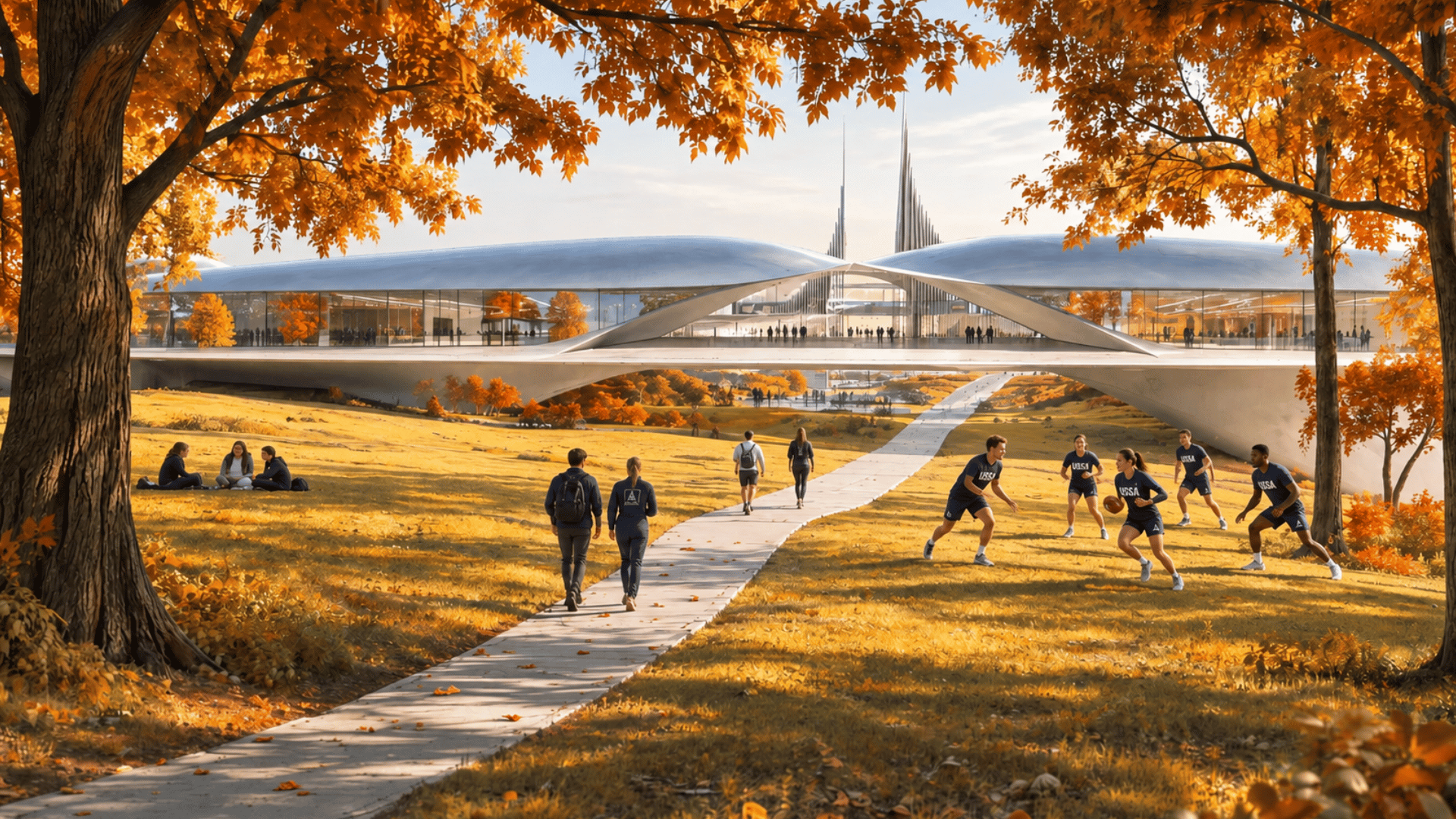
Under the plan, the first 300 space students would start classes in 2028 at an interim campus at the former Pittsburgh Technical College in North Fayette Township, roughly 15 miles outside of Downtown Pittsburgh. The site is already prepared to host an interim site with its labs, classrooms, and housing for up to 384 students.
Advertisement
Meanwhile, crews would break ground in 2027 on a permanent, 300-acre campus at Southfield Business Park right next to Pittsburgh International Airport. That main campus would open in Fall 2031 for 1,200 students, with room to grow to 4,000. Once it opens, the North Fayette site would become an innovation district with labs, business incubators, and faculty housing.
“The Pittsburgh region is a global leader in technology, artificial intelligence, advanced manufacturing, energy, aerospace and more. Powered by our world-class universities and unmatched workforce, this region is uniquely suited to be the home of the United States Space Academy,” said Pittsburgh International Airport CEO Christina Cassotis. “Our airport is known around the world as an innovation leader. Coupled with our abundant real estate options and proximity to two military bases on-site, this proposal presents a compelling opportunity to develop a transformational campus.”
Built on Local Tech and Talent

Southwestern Pennsylvania already has 126 space-related businesses working on spacecraft, propulsion, software, and robotics. Across the state, the space sector has generated $8.6 billion over the last four fiscal years.
Penn State and six other top Pennsylvania research universities would lead the academy’s curriculum. In 2025, these seven schools awarded more than 60 percent of the degrees in the nine fields most common among NASA workers, like mechanical engineering and computer science.
“Penn State is honored to have been selected to support the Commonwealth’s pursuit of this initiative and to lend our expertise in research, academics, and workforce development,” said Neeli Bendapudi, President, Penn State University. “Working in collaboration with research institutions across Pennsylvania, we can provide the framework needed to train the next generation of astronauts, scientists, engineers, operators, entrepreneurs, and civil servants. Our proposed curriculum would provide students with critical hands-on experience and the skills they need to meet the rapidly changing workforce needs.”
 Read Exclusive Stories
 Bookmark & Save Articles For Later