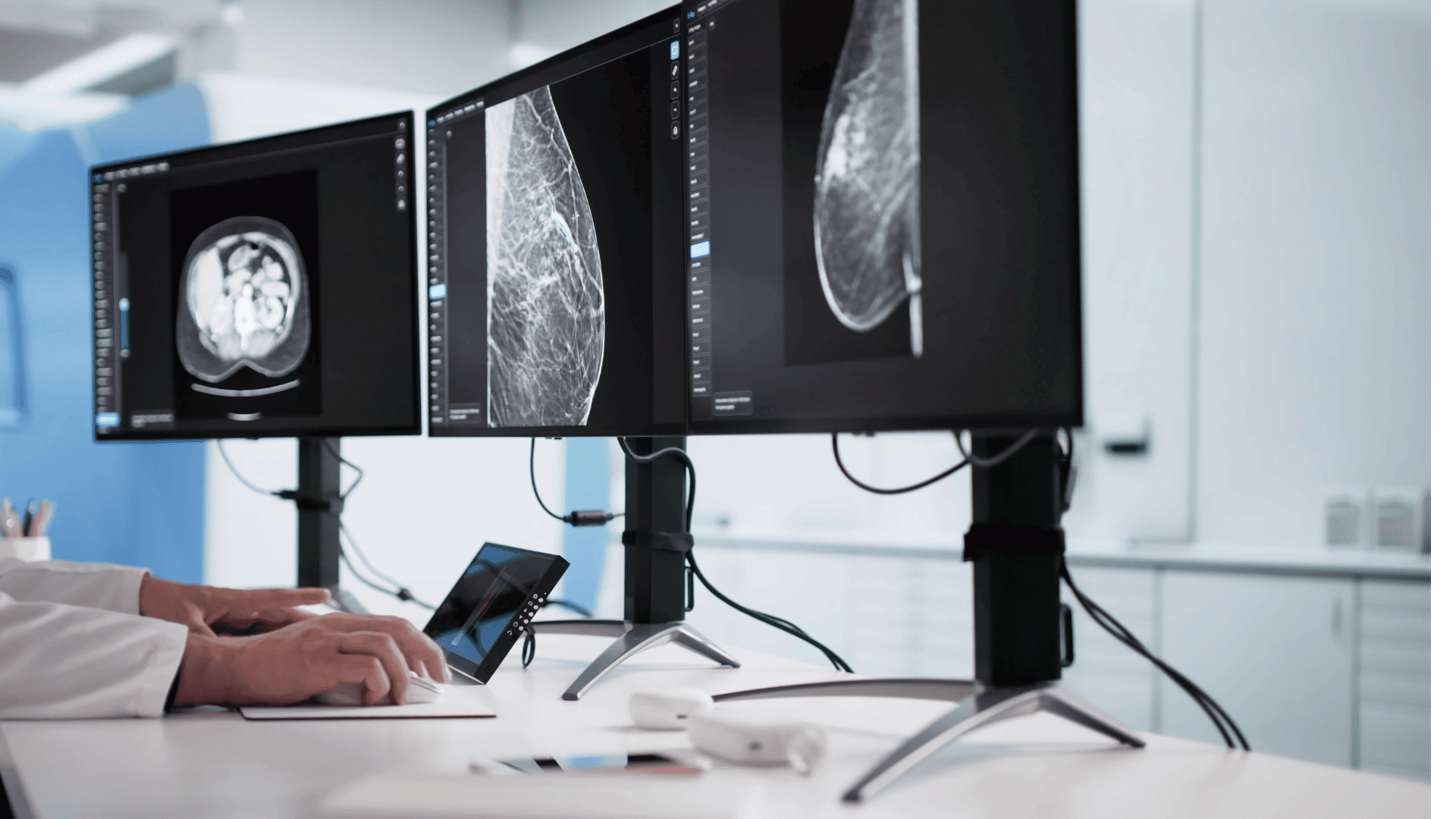
Breast cancer treatments have improved in recent years, but the cancer returning continues to be a problem. Doctors need better ways to predict if a tumor will come back. Today, they use genomic tests to evaluate the risk and see if a patient might benefit from chemotherapy. However, these methods are costly, take weeks to get results, and destroy the extracted tissue samples, meaning they can’t be used for future testing.
A team of researchers created an AI test to predict recurrence faster and for less money. Published in Nature Communications, the AI looks at normal microscopic tissue samples on glass slides. It combines those images with routine clinical data like a patient’s age, tumor stage, and hormone-receptor status.
“Breast cancer is not a single disease, and decisions about how aggressively to treat it are often difficult,” explained Krzysztof J. Geras, a visiting scholar at NYU’s Center for Data Science and an adjunct assistant professor at NYU Grossman School of Medicine, who led the work. “This research shows that an AI test can read the same tumor slides pathologists already examine and, combined with basic clinical details, accurately estimate how likely a patient’s cancer is to return.”
AI Learns When Breast Cancer will Come Back
Advertisement
The team built this tool drawing from 15 patient populations across seven countries, evaluating its accuracy on more than 3,500 patients. According to the researchers, the AI reliably separated higher-risk from lower-risk patients. It also worked well in evaluating recurrence probability in two types of breast cancer—triple-negative and HER2-positive—that currently lack reliable genomic tests.
“The model’s accuracy doesn’t come from hand-labeled data alone,” Yann LeCun, Jacob T. Schwartz Chaired Professor of Computer Science and Data Science at New York University and one of the paper’s authors, added. “It comes from self-supervised pretraining that lets it learn rich representations first, which then translate into strong downstream performance—a recipe that should generalize far beyond breast cancer and, more broadly, is the kind of new AI science these hard problems demand.”
Only the Beginning
“In testing on thousands of patients, our AI test matched or outperformed a widely used genomic test,” said Geras, who is also co-founder. “Because it relies on existing slides, it could deliver answers in hours instead of weeks, at lower cost, while sparing tissue for future testing.”
The researchers state they still need completed randomized clinical trials to build confidence in using this test to guide actual treatments.
 Read Exclusive Stories
 Bookmark & Save Articles For Later