In Cape Cod, a crew aboard a ship called Timothy Michael recently spotted a lobster with unusual and extremely rare coloring. One half of its body from head to tail was orange-red, and the other half was dark brown, with a straight line dividing the hues. This is a rare 1-in-50-million example of a “split-color” lobster.
“Split-Color” Lobster
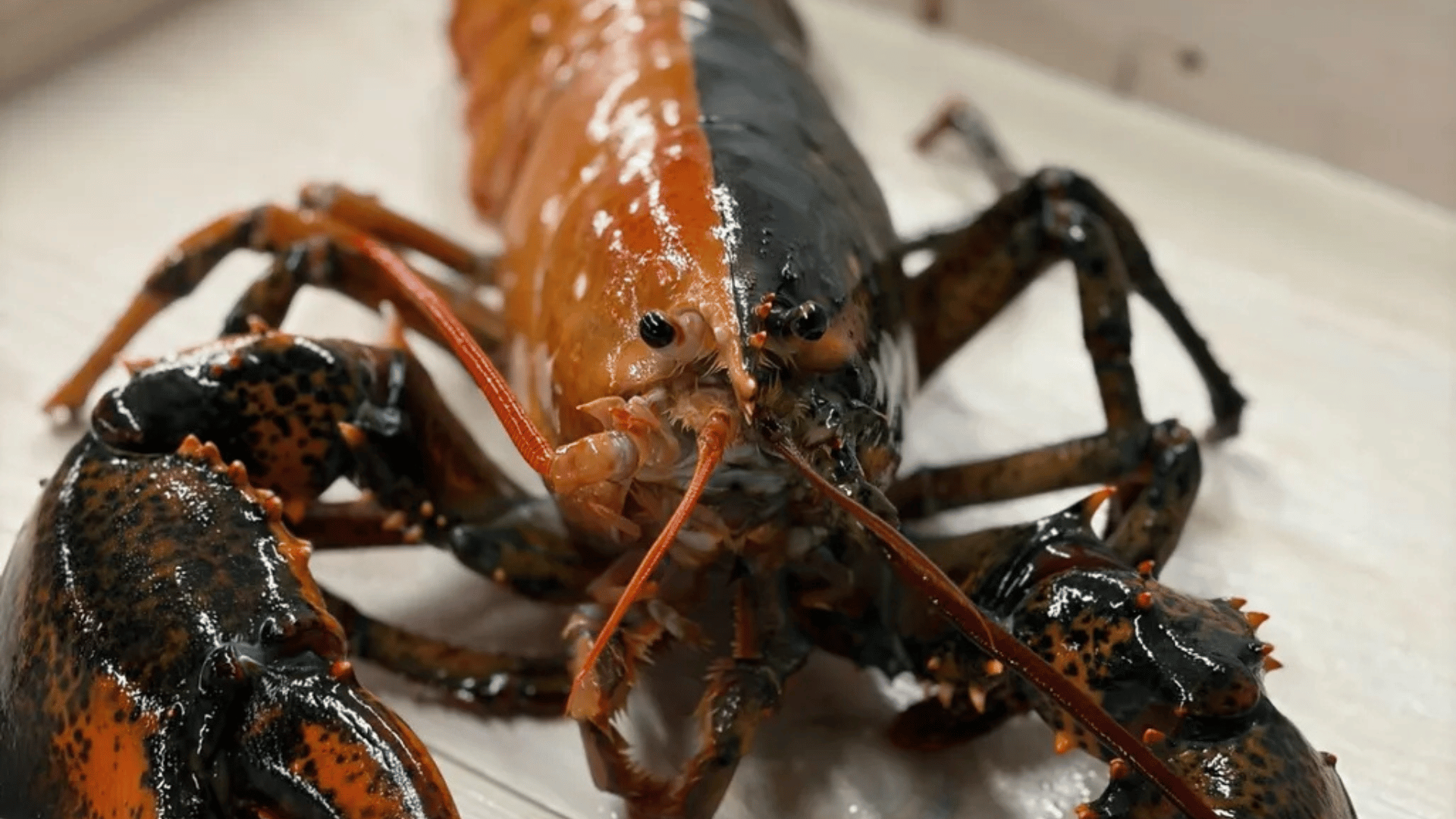
The lobster was pulled by Wellfleet Shellfish Company. Rather than selling it, they decided to donate it to the Woods Hole Science Aquarium, a Cape Cod institution operated by the National Oceanic and Atmospheric Administration Fisheries.
“Instead of heading to market, she’s heading somewhere even more special,” the company wrote on social media.
Established in 1875 as the nation’s oldest public marine aquarium, the facility is currently closed for repairs but will reopen in early 2027. Once it reopens, the split-color lobster will be “one of the first animals going back into the aquarium,” Julia Studley, an aquarium biotechnician, tells the Cape Cod Times’ Heather McCarron.
Advertisement
Split-colored lobsters look like “two individual lobsters cut lengthwise and spliced together,” according to the nonprofit Seacoast Science Center in Rye, New Hampshire. It’s a type of chimera, meaning it contains multiple genetically distinct cells, as if they’re from multiple individuals.
“Split-colorization occurs when two fertilized, unlaid eggs contact each other, causing one to absorb the other,” Studley tells Popular Science’s Laura Baisas. “This creates a lobster with two sets of genetic information, and the ability to store color pigments differently on either side of its shell.”
American lobsters are typically brown with hints of green or blue to help them blend into ocean floor surroundings, so researchers are surprised this bright specimen has survived for so long.
“Lobsters with unusual coloring often don’t have the camouflage to thrive for long, so the fact that this one reached over three pounds means it’s been through a lot,” Dan Brandt, chief operating officer of Wellfleet Shellfish Company, stated.
This isn’t the first time researchers have uncovered a lobster with unique coloring, as they’ve previously seen a speckled lobster, blue lobster, “callico” lobster, “cotton candy” lobster, and albino lobster.
 Read Exclusive Stories
 Bookmark & Save Articles For Later