Soft robots are intended to replace stiff, bulky robots for fitting into tight spaces or handling unique shapes. Traditional robots are great for assembly lines because of their strength and durability. Still, for some industries, including the medical field or search and rescue, soft robots are the ideal choice.
Researchers at Colorado State University built a bendable, tube-shaped robot that moves like an elephant trunk or an octopus tentacle. Rather than hard joints, it uses an engineering method called tensegrity. Stiff rods sit inside a web of tight cables, allowing the arm to bend, stretch, and flatten out without snapping. Claws sit at both ends, allowing it to grab tools or link up with partner units.
“Often the physical structure of robots is fixed, but our approach allows these flexible systems to adapt their shape to their environment and to the potentially changing needs of their mission by collapsing, stretching or grasping,” Associate Professor Jianguo Zhao, who led the project in CSU’s Department of Mechanical Engineering. “They are also modular, meaning each robot works like a building block: It can operate on its own or connect with others to form bigger, more capable shapes.”
Teaming Up to Create a More Flexible Robot
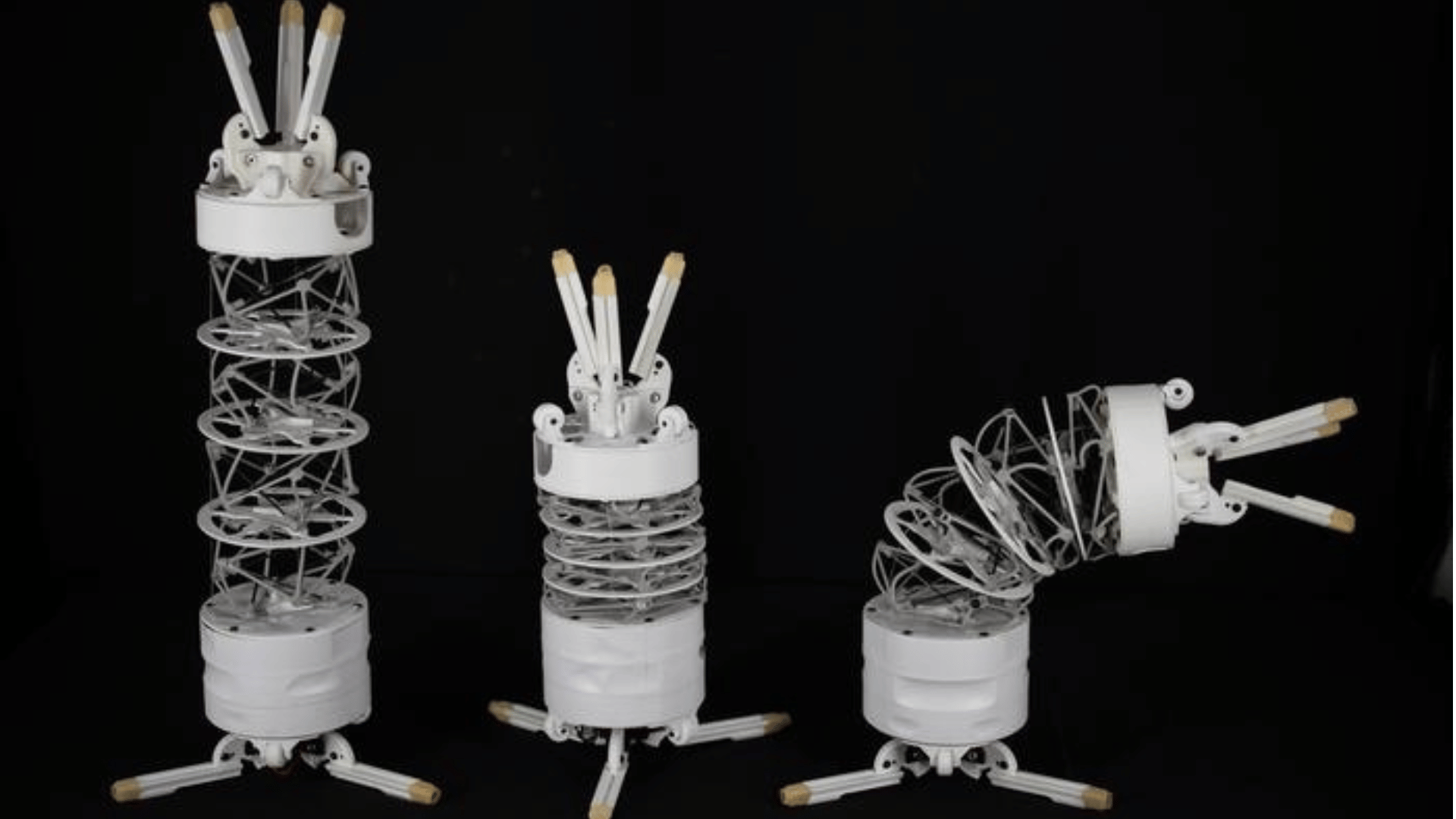
The team chose physical claws rather than magnets to join the units, since magnets can slip. That simple choice makes the system much tougher.
“They can bend around to lift and carry different sized objects with their body or to navigate difficult terrain like a snake would,” Zhao said. “The claw-attachment also reduces the chance of misalignments during connections – making it easier for them to team up and form loops, chains and branches of different sizes to accomplish their tasks. They are very adaptable to the situation and goals.”
Mahmud Hasan Saikot, a doctoral student and co-first author on the study, tested the arms across outdoor landscapes to see how they handled rough terrain. Getting the hardware right was not easy; finding motors that were tiny, strong, and reliable took several attempts.
“Right now, these systems need to be piloted by a human. However, we have already demonstrated that two robots can find each other and connect on their own. In the future, we can envision mostly autonomous teams of tens or even hundreds of them – attached through the claws – traveling to a location and then deploying for a specific purpose,” he said. “With that in mind, we want to continue improving their ability to work together with minimal human supervision.”
Advertisement
 Read Exclusive Stories
 Bookmark & Save Articles For Later