Astronomers have observed a wandering supermassive black hole tear apart a passing star, creating a flash of light so bright it briefly outshone its entire host galaxy.
The Wandering Black Hole
Even more surprisingly, the black hole wasn’t where astronomers expected to find it. Instead of sitting at the center of its galaxy, it was located about 30,000 light-years away, earning it the nickname “orphan” black hole.
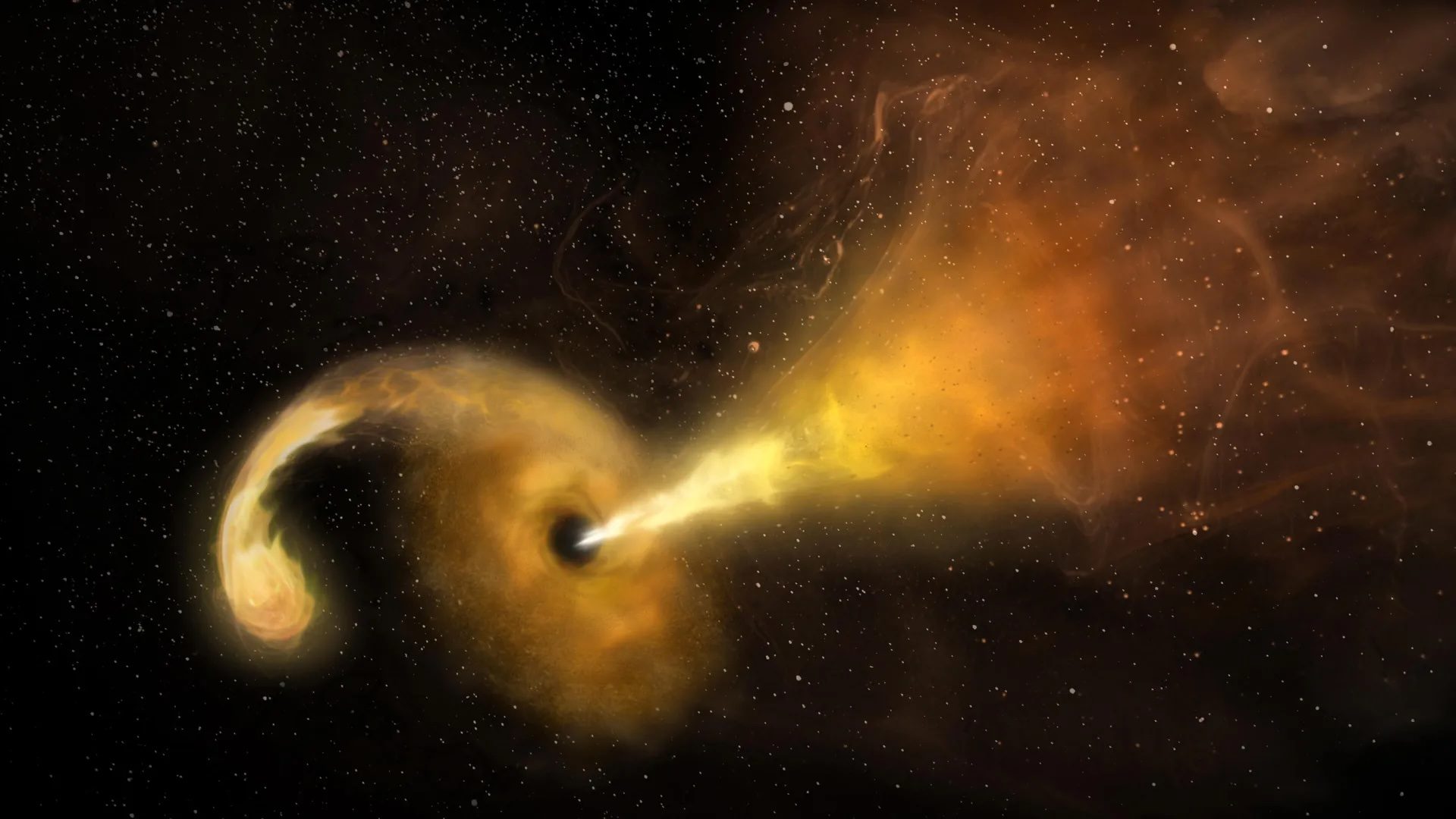
If a star gets too close to this black hole, the black hole’s gravity pulls the star apart. The pieces fall into the black hole and give off a very bright flash of ultraviolet light that we can see from Earth. This black hole is huge, about a million times heavier than our sun.
How It Was Found
Advertisement
The ultraviolet flash was first spotted by an automated telescope in November 2025. NASA’s Neil Gehrels Swift Observatory zoomed in on the object. An artificial intelligence algorithm spotted the flash of light and alerted the observatory. It picked up signals consistent with a tidal disruption event, even though the black hole was in an unusual location.
Why Was It Out There?
Scientists have proposed a few theories as to why a supermassive black hole exists outside the center of its host galaxy.
One theory suggests that the black hole resulted from two galaxies colliding. As the galaxies merged into one, the gravitational pull between the two supermassive black holes created a battle for dominance. The smaller black hole was ejected from the new galaxy.
Another suggestion is that a small dwarf galaxy is colliding with a larger galaxy. Therefore, the black hole belongs to the smaller galaxy that is being incorporated into the larger one.
Astronomers hope to find more instances of these wandering black holes to determine how often they exist in the universe.
 Read Exclusive Stories
 Bookmark & Save Articles For Later