Batteries usually rely on liquids sealed inside rigid cases to prevent leaks, which limits the design of a device. A team at The University of Texas at El Paso (UTEP) figured out how to 3D-print an essential battery part in almost any shape.
This means energy storage could be built directly into medical monitors or aerospace parts, rather than forcing the device to fit around the battery.
Printed Battery Components in Nearly Any Shape
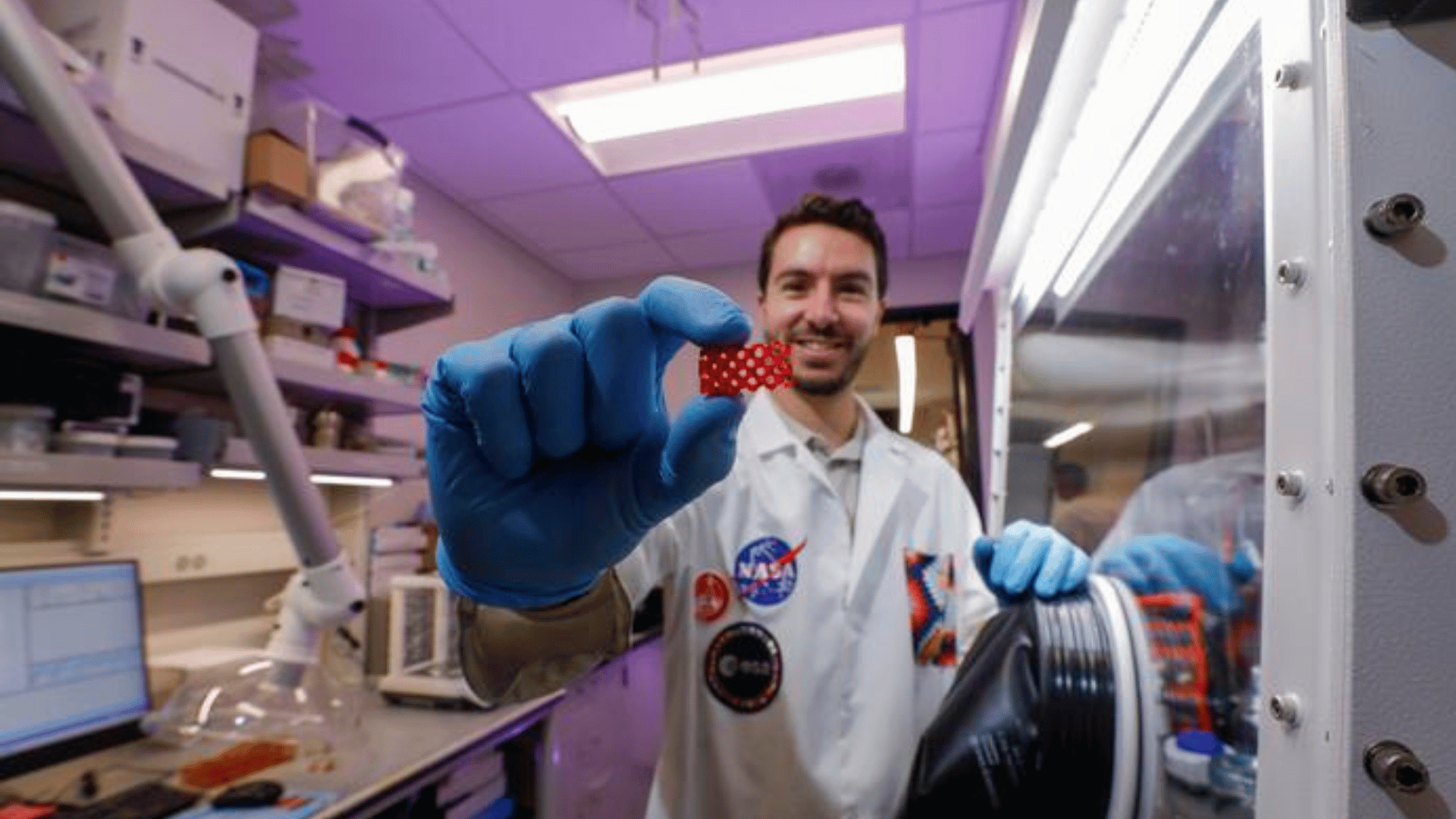
Working with Sandia National Laboratories, the UTEP team focused on gel polymer electrolytes. The electrolyte is the material inside a battery that moves charged particles between terminals to create electricity. Instead of a standard liquid, they mixed a light-curable resin with a lithium-based liquid electrolyte and then hardened this mixture layer by layer using 3D printing.
Interestingly, researchers printed the parts in regular room air instead of a sealed, oxygen-free chamber, and the material kept its performance. A ratio of one part resin to four parts electrolyte gave them a clean print. The printed gel reached ionic conductivities up to $3.4 \times 10^{-3}$ siemens per centimeter. That is very close to the liquid versions they want to replace.
Advertisement
To prove the design freedom, they printed solid discs, an open honeycomb lattice, and a one-centimeter cube. The study also helped clarify how the choice of solvent affects printability and battery behavior.
Any Shape, Anywhere
“For years, the shape of a battery has dictated the shape of the device it powers,” said Alexis Maurel, Ph.D., the study’s lead researcher and a faculty member in UTEP’s Department of Metallurgical, Materials and Biomedical Engineering. “We are showing that you can print a high-performing electrolyte battery component with any shape and place it almost anywhere you want. That changes what designers are able to imagine.”
The team plans to refine their mix and eventually build complete battery cells.
“This research demonstrates how advanced manufacturing and energy technologies are merging to create entirely new possibilities for battery design,” said Kenith Meissner, Ph.D., dean of the Miguel A. Loya College of Engineering. “By developing a scalable method to 3D-print battery electrolytes in virtually any shape, Dr. Maurel and his collaborators are helping position UTEP at the forefront of next-generation energy storage research while providing our students with hands-on experience in technologies that are critical to the future of aerospace, transportation, and advanced manufacturing.”
 Read Exclusive Stories
 Bookmark & Save Articles For Later