Researchers at Cincinnati Children’s have found a way to grow larger versions of human gut tissue twice as fast as before. As a bonus, these mini-organs grow their own nerve cells.
The study, published May 22, 2026, in Nature Biomedical Engineering, shows how a team of 19 scientists from Cincinnati and France scaled up production. They used 3D-printed trays made from a flexible, rubber-like silicone to guide the tissue growth.
Speeding Up Gut Tissue Growth
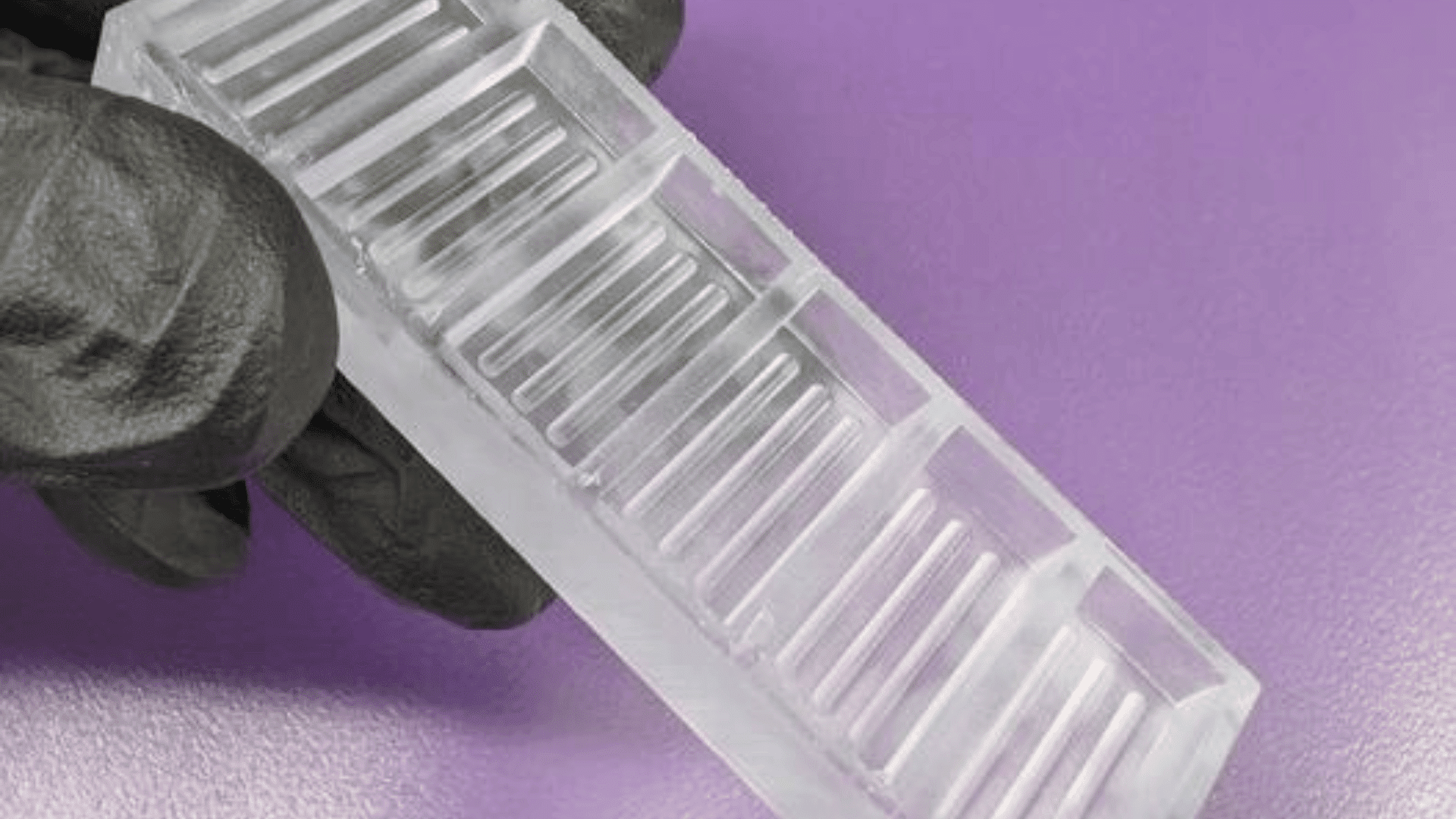
The new system is called a “confined culture system.” Basically, the team prints trays with specific grooves in them and then place tiny, sphere-shaped cells into them. Researchers explain that this forces them to line up, fuse together, and grow into a tube shape.
By day 14, they say, the tissue has everything it needs. This process used to take 28 days. The team then transplanted these tissues into rodents to let them mature. They grew up to 8 centimeters of functioning small intestine tissue, while older methods usually only yielded about 1 centimeter.
“By reaching transplantation maturity twice as fast and developing their own functional nerves, these organoids demonstrate how engineering principles can drive biological innovation,” said Holly Poling, PhD, a lead staff investigator on the project. “Our confined culture system is more than a production method; it’s a scalable, flexible platform for building complex human tissues.”
The Nervous System Connection
Advertisement
One of the biggest accomplishments is that the tissue grows its own working nerves without scientists having to manually add them.
“This platform’s simplicity, reproducibility, and versatility make it accessible for widespread adoption,” Jim Wells, PhD, a study co-author, said. “In addition, the emergence of a self-organized nervous system within these organoids is particularly important for further studies of neurodevelopmental disorders.”
Maxime Mahe, PhD, the senior author, adds that the cells do a lot of the heavy lifting themselves when given the right space.
“We are now able not only to generate complex gastrointestinal organoids at scale, but also to guide their differentiation into functional tissues with integrated enteric neuronal networks,” Mahe added. “By leveraging a defined growth environment, the intrinsic self-organization capacity of the cells drives the formation of tissue structures that closely resemble the human gastrointestinal tract.”
Treating Children
We are still far away from growing whole, adult-sized organs in a lab. However, this tissue could eventually be used to patch up damaged parts of a patient’s stomach, colon, or small intestine. Researchers believe this method could eventually advance how we treat sick kids.
“It is still not possible to grow complete, full-sized human organs in some sort of tank, but research like this has produced significant amounts of tissue that can be matched directly to individual patients,” Michael Helmrath, MD, a surgeon-scientist at Cincinnati Children’s who co-directs CuSTOM, said. “We believe such tissues, once transplanted, would further grow and multiply as part of the patient’s own organ to restore functions.”
Before this enters human trials, it must go through more testing. But if it works, some children might get the help they need without ever waiting for a full organ transplant.
 Read Exclusive Stories
 Bookmark & Save Articles For Later