Everyone knows the saying “cats always land on their feet”, but how do they do it? Scientists have recently investigated the mechanical properties of a cat’s spine to determine how the animals twist right side up while falling.
How Do Cats Always Land on Their Feet?
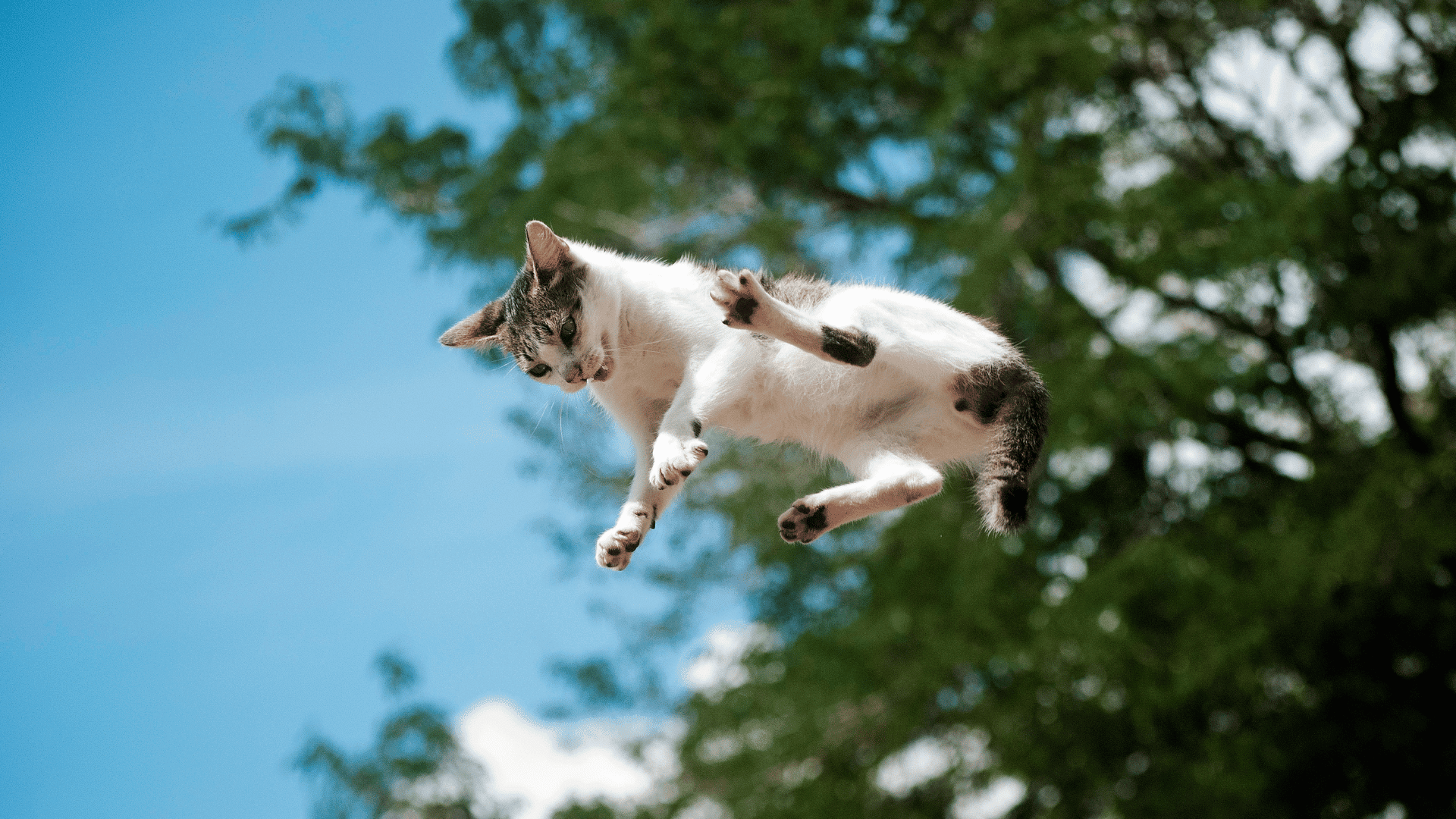
Yasuo Higurashi, a researcher in Yamaguchi University’s Laboratory of Veterinary Physiology and Biochemistry, and colleagues examined the cat spine’s range of motion and stiffness by collecting spines from dead cats and physically twisting them. They also dropped two live cats from low heights to study them in action.
“To prevent injury, we placed a thick, soft cushion at the landing site,” Higurashi tells the New York Times. “One of our undergraduate students did the dropping.”
Advertisement
Researchers noticed that, when testing the live cats, their upper trunk finished twisting before their lower trunk. They also analyzed the properties of the thoracic (upper) and lumbar (lower) regions independently, finding that the two spinal areas were distinct when twisting. According to Higurashi, the cat’s thoracic spine can twist like a human neck.
“These results suggest that trunk rotation during air-righting in cats occurs sequentially, with the anterior trunk rotating first followed by the posterior trunk, and that their flexible thoracic spine and rigid lumbar spine in axial torsion are suited for this behavior,” the researchers write in the study.
Gregory Gbur, author of Falling Felines and Fundamental Physics, who didn’t participate in the new research, responded to the new paper in a blog post. Gbur noted that the two falling cats in Higurashi’s research turned right 14 out of 16 times.
“Apparently there is some natural tendency for cats to twist right, even though they clearly can go both ways,” Gbur writes. “My best guess at this point is that some asymmetric placement of internal organs may make it just a little easier to go one way than another.”
The study was published last month in the journal The Anatomical Record.
 Read Exclusive Stories
 Bookmark & Save Articles For Later