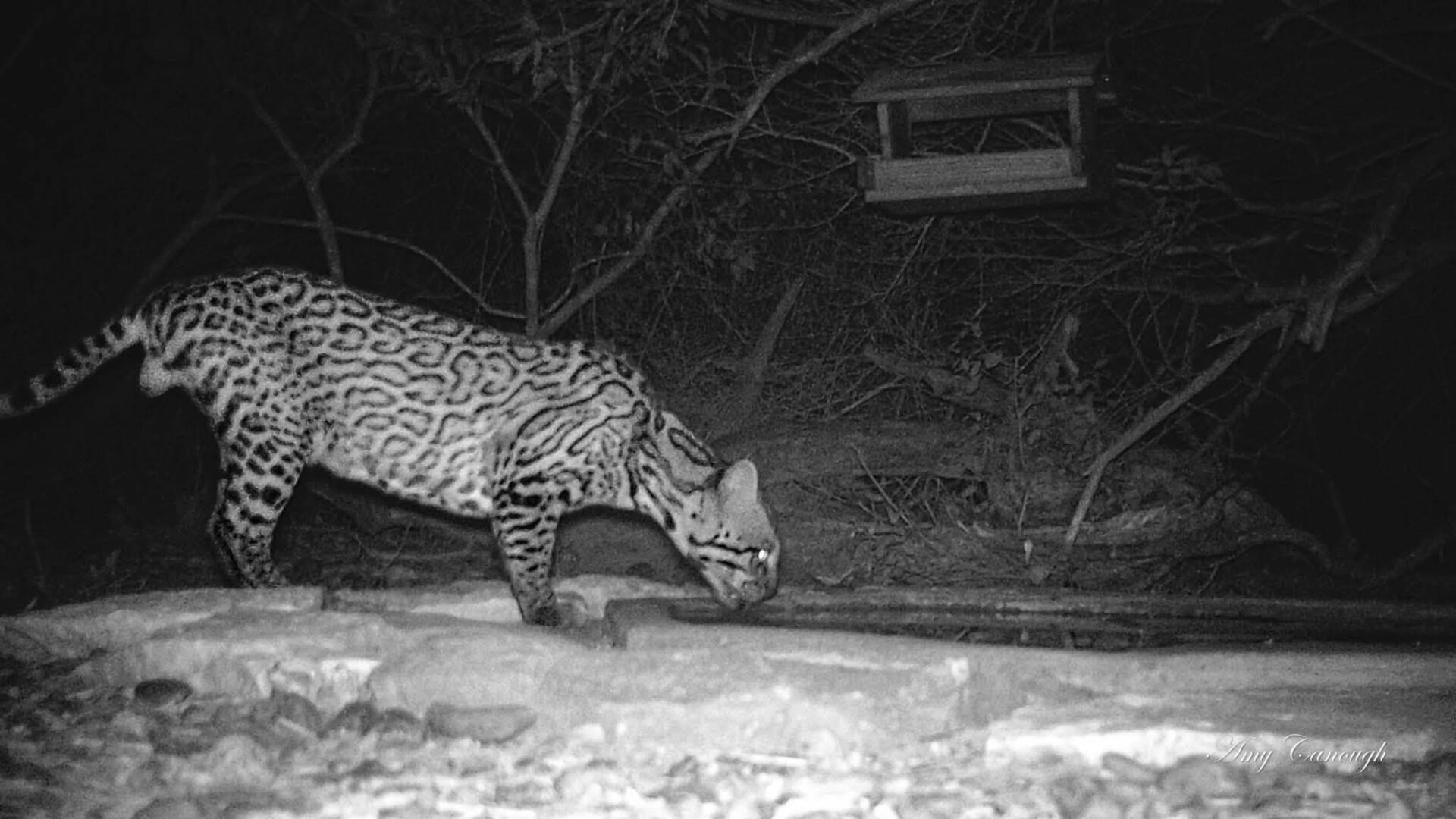
A male ocelot was recently spotted drinking water at Laguna Atascosa National Wildlife Refuge in South Texas. The elusive, endangered wildcat was seen in Texas amid efforts to monitor the species.
Wild Ocelot Sighting
“Every ocelot sighting in Texas is rare,” stated Aislinn Maestas, assistant regional director of the U.S. Fish and Wildlife Service. “With less than 100 known individuals, and with ocelots being elusive, nocturnal animals, we share in the excitement when one is captured on a trail camera.”
Amanda De Leon shared on social media that a park host at Laguna Atascosa National Wildlife Refuge had captured footage of a male ocelot drinking water near one of the Visitor Center’s bird feeding stations.
“Seeing one of these rare, secretive ocelots on camera is truly special and such a beautiful reminder of the INCREDIBLE and WILD WONDERS right here in our backyard,” she wrote on Facebook alongside a black-and-white photo of the rare creature sipping water from a cement water basin.
Advertisement
The fewer than 100 known ocelots in Texas primarily survive in two isolated breeding populations. The larger population, known as the Ranch Population, is located in Willacy, Kenedy, and Kleberg counties. The smaller Refuge Population lives in and around Laguna Atascosa National Wildlife Refuge in Cameron County.
Ocelots are considered endangered under the Endangered Species Act, according to the U.S. Fish and Wildlife Service.
“For ocelots to achieve recovery, there needs to be at least 200 ocelots in the wild in Texas for at a minimum of 10 years,” Maestas noted. “This sighting is therefore important as it documents a healthy individual in the wild.”
A record number of ocelots have been recorded at the refuge in recent years, after researchers announced the documentation of 22 rare cats back in April. They distinguished between the cats by tagging them with collars, monitoring their movements, and spotting patterns in their fur.
“For a lot of years, the numbers thrown about were about 15 to 18, but usually 14 or 16, and like I said, in less than two years, we have identified at least 22 on camera,” Elizabeth Grunwald, a research associate with the Caesar Kleberg Wildlife Research Institute, told local outlet Valley Central at the time. “We know there have to be some more out there.”
 Read Exclusive Stories
 Bookmark & Save Articles For Later