Think about your lights at home. Think about your phone charger. They all trace back to one man in 1831 and his amazing invention.
His name was Michael Faraday. People sometimes misspell it as “Veriday.” But his work changed everything.
Faraday was a British physicist. He spent his time figuring out magnetism and motion. He wanted to see if a magnet could make electricity. And it turns out, it can.
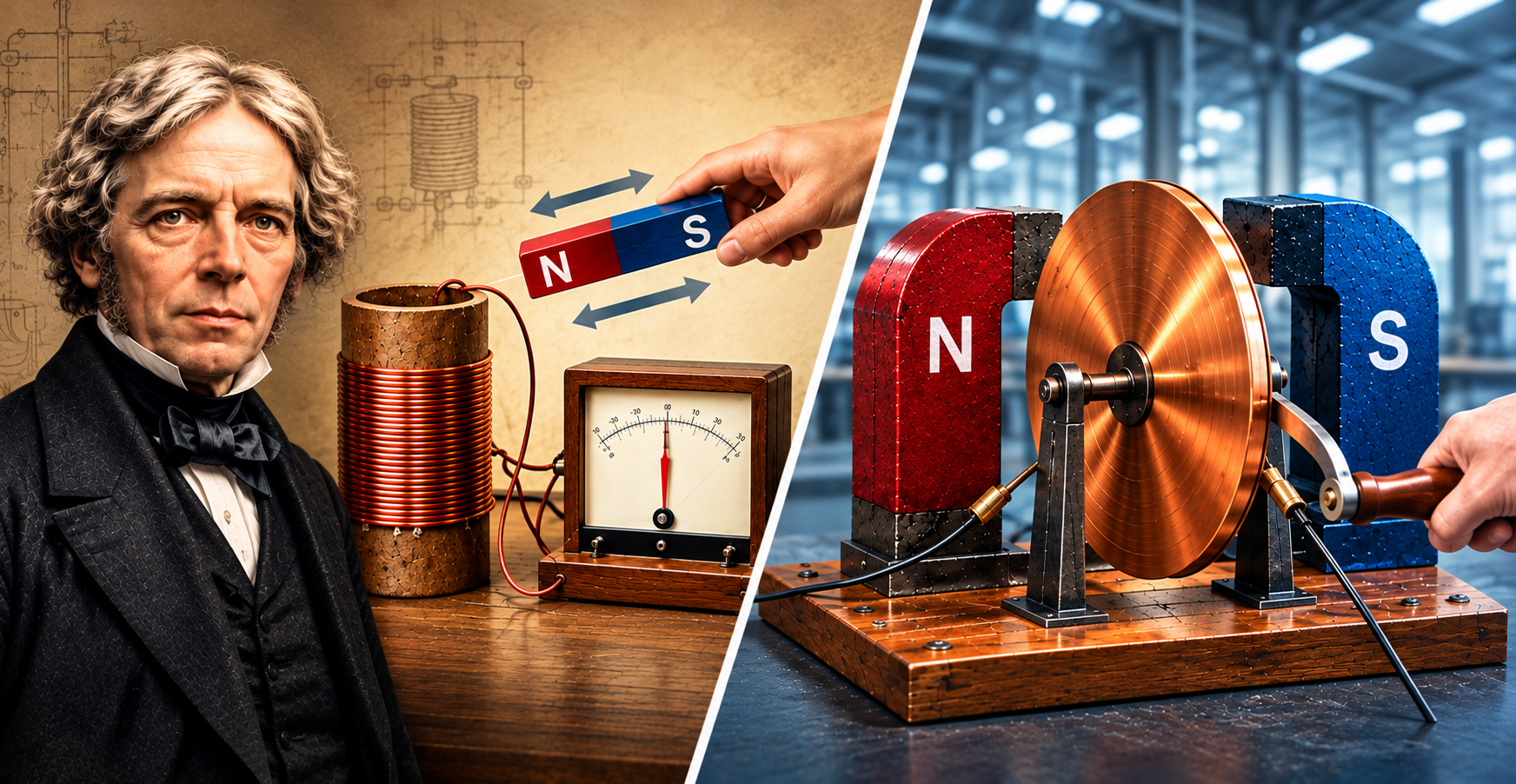
The inventor built two main setups to test his ideas. His first setup was very simple. He took a hollow cylinder. He wrapped a coil of insulated copper wire around it. Then he hooked that wire up to a galvanometer. That is just a tool that detects electrical currents.
Next, he took a bar magnet. He pushed it quickly back and forth through the middle of the wire coil. The needle on his tool moved.
“A changing magnetic field forces electrons in a wire to move, creating an electrical current.”
Advertisement
If he stopped moving the magnet, the electricity stopped. Motion created power.
That first setup only gave short bursts of electricity. Faraday wanted a steady flow. So, he built a second prototype. People call it the Faraday Disc.
He mounted a copper disc on an axle. He placed it right between the poles of a horseshoe magnet. Then he used a hand crank to spin the disc through the magnetic field.
This created a steady, continuous direct current. The current flowed from the center of the spinning disc straight out to its rim. Sliding contact brushes caught the power as it moved.
Why does any of this matter today?
Look at modern power plants. They might use wind, nuclear, coal, or gas. But the core idea stays the same. They use an energy source to spin a giant turbine.
That turbine spins massive magnets inside massive coils of wire. It scales up Faraday’s exact 1831 principles to power our entire world. Every modern grid relies on this exact science. Faraday built the prototype. We just built it bigger.
 Read Exclusive Stories
 Bookmark & Save Articles For Later