Heart disease is the leading cause of death in the United States, with about 800,000 people undergoing heart surgery every year. Usually, when surgeons or medical students need to practice these intense procedures, they have to use animal models or cadavers. However, these hearts aren’t always perfect replicas of a specific patient, and you can’t reuse them.
A Printed Heart For Surgical Training
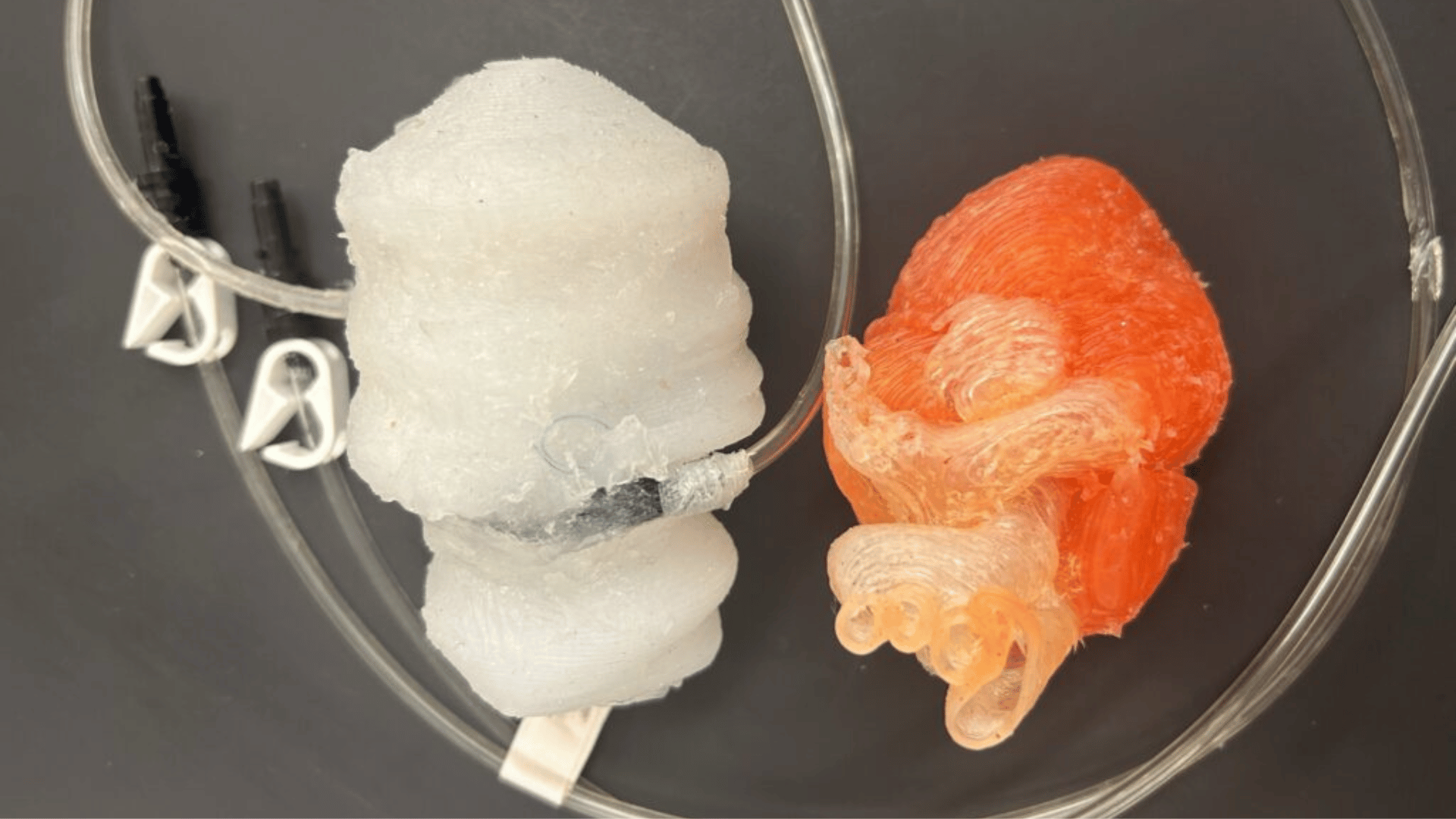
Researchers at Washington State University (WSU) developed a 3D-printed model of the left side of the human heart that contracts and beats. This groundbreaking development gives doctors a way to rehearse complex surgeries on a synthetic model that acts like the real thing.
“It’s very useful for doctors and surgeons to practice when the heart is still beating, especially for minimally invasive surgery,” said Kaiyan Qiu, a professor at WSU’s School of Mechanical and Materials Engineering. “In our case, this model is the first fully synthetic model that, without any assistance of animal models, mimics the complete left side of the heart.”
“We were able to incorporate both the anatomic features and the dynamic functions,” Qiu added.
Advertisement
How It Works
The team focused on the left side of the heart because it handles the highest pressures and pumps oxygenated blood to the rest of the body. They used scans of a real heart to print a replica that includes the atrium, ventricle, and the mitral valve. To make it move, they used tiny pneumatic actuators and string-like materials that mimic how a real heart manages valve movement.
Previous synthetic models were often made using molds, which made it hard to get the shapes right.
“There have been other, synthetic models that are mostly mold-casted, and one of the main limitations there is that they cannot do some of the more complex curvatures that you see in the heart,” said Alejandro Guillen Obando, a PhD candidate at WSU. “Our layer-by-layer approach in 3D printing allows us to add more curvature and make the chambers simulate a real heart.”
To test it out, the researchers printed a defective valve and then repaired it using a special device. Sensors on the model showed the blood pressure rising correctly, and ultrasound images proved the “blood” was flowing the right way. The team is now working on a model with all four chambers and hopes to eventually let doctors use these for patient-specific rehearsals.