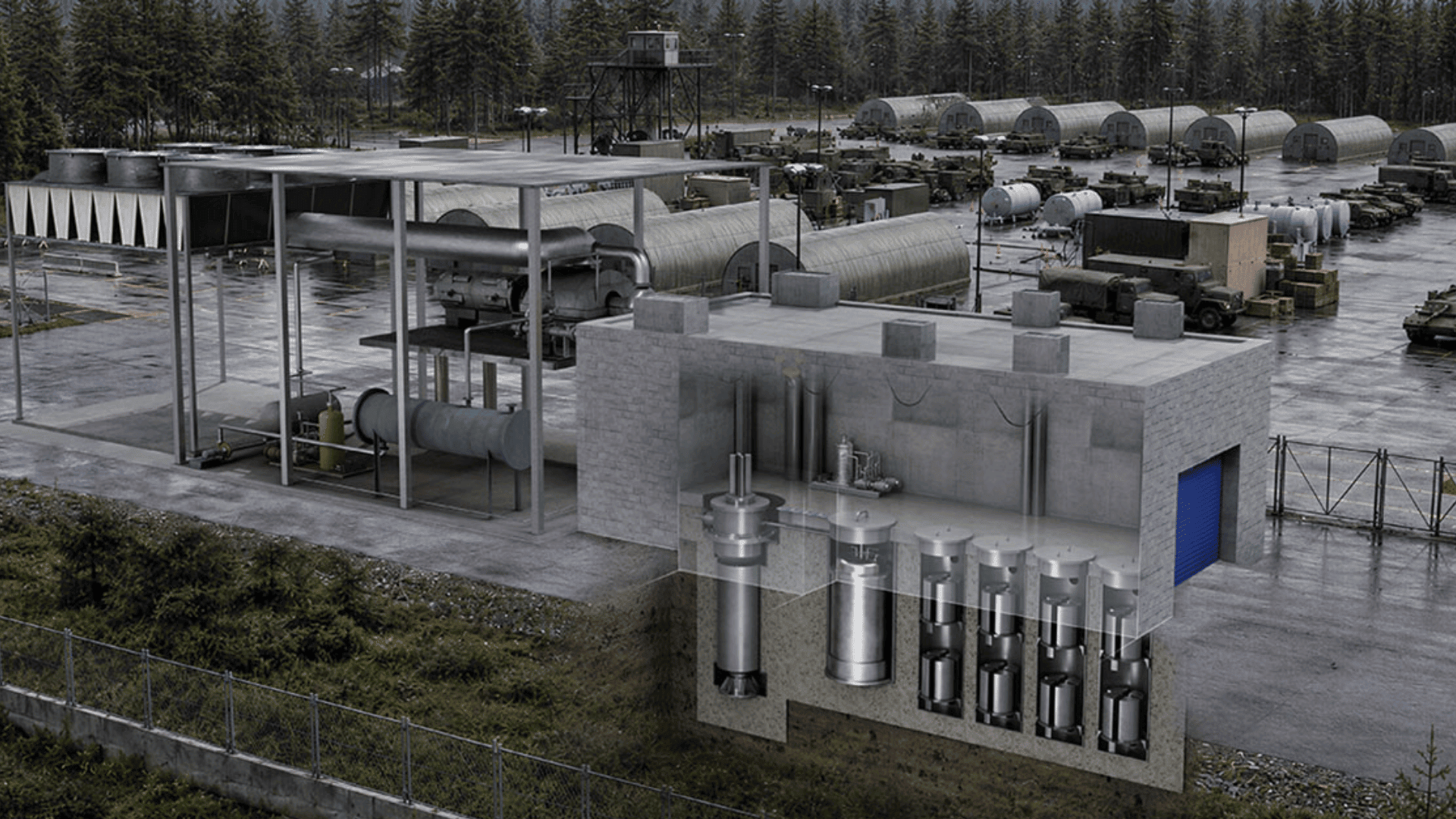
The U.S. Army wants to make sure its remote bases always have power, even if the main grid goes down. So, it partnered with General Atomics Electromagnetic Systems (GA-EMS) to build a solution. It is called the General Atomics Tactical Energy System, or GA-TES for short.
Basically, it is a microreactor designed to be shipped by truck or rail to any given location. The system has a 40-year design life and produces about 5 megawatts of electric power, but it can scale up to 20 megawatts.
A Microreactor Built for Remote Areas
This project is part of the Army’s Janus Program, run alongside the Department of Defense Innovation Unit. They want to turn commercial nuclear tech into working hardware for the military.
“The Janus Program is about transitioning from designs and experiments to reliable commercial hardware which secures our energy independence,” Jeff Waksman, PhD., principal deputy assistant secretary of the Army for Installations, Energy and Environment, explained. “The Janus Program vendors were selected through a deeply rigorous evaluation on technical, financial and organizational capabilities conducted by an all-star panel of dozens of experts from across the nation. We look forward to working alongside each team as they proceed toward successfully completing the rigorous technical milestones we’ve agreed upon.”
The Army is planning to test, develop, and plan the site for this system at Fort Hood in Texas.
Safe and Simple
Advertisement
The GA-TES microreactor uses a liquid-metal-cooled system and special uranium-zirconium hydride (UZrH) fuel. However, doesn’t rely on big water cooling systems or mechanical pumps. It uses natural circulation instead.
“General Atomics draws on more than 70 years of nuclear innovation and reactor expertise to deliver microreactor technologies that provide safe, dependable and independent power for military installations,” Scott Forney, president of GA-EMS, highlighted. “Our experience designing and deploying 68 reactors worldwide and supporting reactor technologies throughout their lifecycles positions us to deliver assured energy solutions that enhance operational resilience and strengthen mission readiness.”
This means fewer moving parts and less need for operators to jump in.
Christina Back, Ph.D., vice president of GA-EMS Nuclear Technologies and Materials, pointed out why fewer moving parts and less need for operators means so much.
“Passive safety and operational simplicity are fundamental to our Tactical Energy System design. Self-protecting UZrH fuel and pump-free natural-circulation cooling reduce reliance on active systems and operator intervention, while provide flexibility to meet evolving defense energy requirements,” she concluded.
 Read Exclusive Stories
 Bookmark & Save Articles For Later